

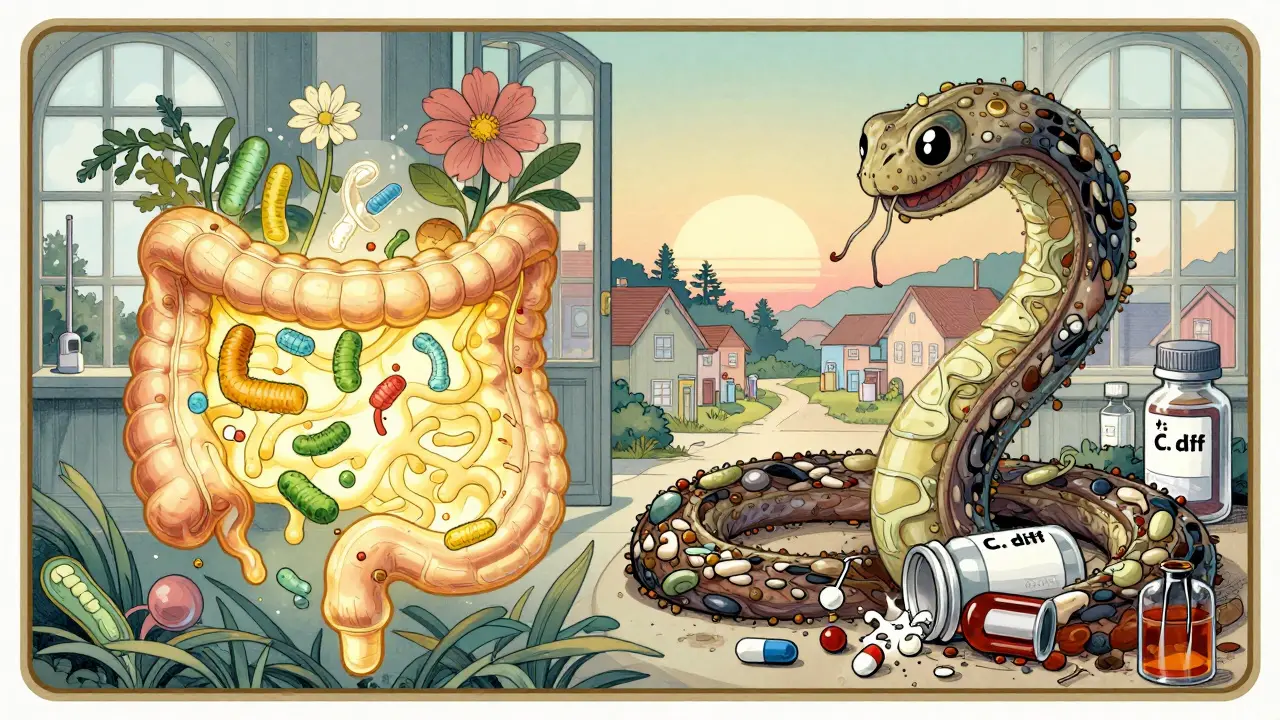
When you take an antibiotic, it doesn’t just kill the bad bacteria-it wipes out the good ones too. That’s why so many people end up with diarrhea after a course of antibiotics. For most, it’s mild and goes away on its own. But for some, it turns into something far more dangerous: C. difficile infection, or CDI. This isn’t just a stomach upset. It’s a serious, sometimes life-threatening condition that’s becoming more common, more resistant, and harder to treat.
What Exactly Is C. difficile?
Clostridioides difficile is a spore-forming bacterium that lives harmlessly in some people’s guts. But when antibiotics disrupt the natural balance of bacteria in your intestines, C. diff takes over. It produces two powerful toxins that attack the lining of your colon, causing inflammation, severe diarrhea, and in worst cases, toxic megacolon or sepsis.
It’s not new. First identified in 1978, C. diff was once a rare hospital-only problem. Now, it’s everywhere. About 500,000 cases happen each year in the U.S. alone, and nearly 30,000 people die within 30 days of diagnosis. The real danger? It’s not just in hospitals anymore. More than a quarter of cases now start in the community, in people who’ve never been hospitalized.
Which Antibiotics Are Most Likely to Cause It?
Not all antibiotics carry the same risk. Some are far more likely to trigger C. diff than others. The biggest culprits are:
- Fluoroquinolones (like ciprofloxacin and levofloxacin)
- Third- and fourth-generation cephalosporins (such as ceftriaxone and cefepime)
- Clindamycin
- Carbapenems (like meropenem)
These drugs are broad-spectrum-they kill a wide range of bacteria. That’s great for fighting tough infections, but terrible for your gut microbiome. Even a short course can be enough. One study found that people who took clindamycin were over 10 times more likely to develop C. diff than those who didn’t.
On the flip side, antibiotics like penicillin, amoxicillin, and azithromycin carry much lower risk. If you’re prescribed an antibiotic and you’ve had C. diff before, ask your doctor: Is there a narrower-spectrum option?
How Do You Know If It’s C. diff-and Not Just a Bad Stomach?
Diarrhea after antibiotics is common. But C. diff has warning signs:
- Watery diarrhea three or more times a day for two or more days
- Abdominal pain or cramping
- Fever
- Nausea
- Loss of appetite
- White blood cell count over 15,000 cells/μL (a lab marker)
Here’s the catch: Not every case of antibiotic-associated diarrhea is C. diff. In fact, 66% of cases aren’t. That’s why testing matters. Doctors usually start with a stool test that checks for glutamate dehydrogenase (GDH), then follow up with toxin detection or a nucleic acid test (NAAT). But you can’t just send in any stool sample. It must be unformed, and you can’t have taken laxatives in the last 48 hours. Many patients get misdiagnosed as having viral gastroenteritis or IBS-especially if they’re older or have other health issues.

How Is It Treated? Vancomycin, Fidaxomicin, or Something Else?
Treatment has changed dramatically in the last decade. In the past, metronidazole was the go-to. Now? It’s mostly outdated.
Why? Because it’s failing. Studies show metronidazole fails in 30-40% of cases now-up from just 5-15% years ago. The CDC officially updated its guidelines in 2023 to reflect this. It’s no longer first-line.
Today’s standard treatments:
- Vancomycin (125mg, four times daily for 10 days): Still widely used. Costs around $1,650 per course. Works well for most people.
- Fidaxomicin (200mg, twice daily for 10 days): More expensive ($3,350), but cuts recurrence by nearly half. Only 13% of patients relapse with fidaxomicin vs 22% with vancomycin.
For severe cases-where you have a high white blood cell count or elevated creatinine-doctors may start with higher doses of vancomycin. In life-threatening cases, like ileus or megacolon, they add intravenous metronidazole and sometimes even give vancomycin rectally.
And don’t take anti-diarrheal meds like loperamide (Imodium). They might seem helpful, but they trap the toxins in your colon. The Cleveland Clinic says they “won’t help and might make it worse.”
What Happens When It Comes Back?
Recurrence is the real nightmare. About 20-30% of people who get C. diff once will get it again. Some get it three, four, even seven times.
For the first recurrence, doctors often repeat the same treatment. But for the second or third? That’s where things get more complex.
One proven strategy is a vancomycin taper: Start with 125mg four times a day for 10 days, then reduce to twice daily for a week, then once daily for another week, then every 2-3 days for up to eight weeks. This slow weaning helps your gut bacteria recover.
Another option is rifaximin, a non-absorbed antibiotic that stays in the gut. Used after fidaxomicin, it’s shown promise in preventing further recurrences.
But the most effective option for multiple recurrences? Fecal microbiota transplantation (FMT)-a procedure where healthy donor stool is transplanted into the patient’s colon.
It sounds extreme, but it works. In 85-90% of cases, FMT cures recurrent C. diff. The FDA approved the first microbiome-based product, Rebyota, in late 2022. In early 2023, they approved Vowst, a pill form of spore-based microbiome therapy. Patients who’ve tried it say things like, “After seven recurrences, one FMT fixed me for good.”
Can Probiotics Help Prevent It?
You’ve probably seen ads for probiotics to prevent antibiotic side effects. But the science is mixed.
A 2017 Cochrane review found that certain strains-Saccharomyces boulardii and Lactobacillus rhamnosus GG-could reduce the risk of C. diff by up to 60% in high-risk patients. But the Infectious Diseases Society of America doesn’t recommend them routinely. Why? Because the evidence isn’t consistent enough across all populations.
One thing is clear: Not all probiotics are equal. If you’re going to try one, choose one with these specific strains. Don’t just grab any yogurt or supplement labeled “probiotic.”
How Do You Prevent It in the First Place?
Prevention is where the biggest wins happen-and it’s not about fancy treatments.
- Use antibiotics only when necessary. The CDC says 30-50% of antibiotic use in hospitals is unnecessary. Ask: Do I really need this? Is there a narrower-spectrum option?
- Wash your hands with soap and water. Alcohol-based hand sanitizers don’t kill C. diff spores. Only soap and water will.
- Disinfect surfaces with EPA List K products. Regular cleaners won’t cut it. You need sporicidal agents that kill C. diff spores.
- Shorten antibiotic courses. The longer you’re on antibiotics, the more your gut microbiome gets wrecked. Don’t take them “just in case.”
Hospitals that run full antibiotic stewardship programs-where doctors review every antibiotic prescription-have seen CDI rates drop by 26%. That’s not magic. That’s smart prescribing.
What About the Future?
The fight against C. diff is evolving fast.
Drugs like ridinilazole (in Phase III trials) are showing better results than vancomycin, with fewer recurrences. Monoclonal antibodies like bezlotoxumab (Zinplava) can be given alongside antibiotics to cut recurrence risk by 10%. It’s expensive, but for high-risk patients, it’s worth it.
And the focus is shifting from just killing C. diff to protecting the gut. Researchers are developing antibiotics that target C. diff without wiping out everything else. Imagine an antibiotic that only attacks the bad bug-and leaves the good ones alone. That’s the next frontier.
The CDC now classifies C. diff as an “urgent threat.” But we’re not powerless. Every time a doctor prescribes an antibiotic wisely, every time a patient washes their hands properly, every time a hospital uses the right disinfectant-we reduce the spread.
What Should You Do If You’re on Antibiotics?
Here’s what to do now:
- Ask your doctor: “Is this antibiotic really necessary?”
- If you’re on one of the high-risk antibiotics, watch for diarrhea. Don’t ignore it.
- If diarrhea starts, stop taking anti-diarrheals. Call your doctor.
- Wash your hands with soap and water after using the bathroom.
- Don’t share towels, bedding, or bathrooms if you’re sick.
- Keep track of your symptoms. How many bowel movements a day? Any fever? Pain?
Recovery isn’t instant. Many people report brain fog and fatigue for weeks after the diarrhea stops. That’s normal. Your gut is healing. Eat simple foods. Avoid sugar, dairy, and fatty meals until you’re sure things are stable.
Can you get C. diff without taking antibiotics?
Yes. While antibiotics are the biggest risk factor, about 25% of cases happen in people who haven’t taken antibiotics recently. These are called community-associated cases. They often occur in people with weakened immune systems, recent hospital visits, or close contact with someone who has C. diff. It’s also possible to pick up spores from contaminated surfaces, even if you’ve never taken an antibiotic.
Is C. diff contagious?
Absolutely. C. diff spreads through the fecal-oral route. Spores can live on doorknobs, bed rails, toilets, and phones for months. If someone with C. diff doesn’t wash their hands properly, they can spread it to others. That’s why handwashing with soap and water is critical-not just for patients, but for caregivers and visitors too.
Why can’t alcohol-based hand sanitizers kill C. diff?
C. diff forms spores that are extremely tough. Alcohol-based sanitizers are great for killing viruses and most bacteria, but they don’t penetrate or destroy these spores. Only soap and water, combined with mechanical scrubbing, can physically remove them from your skin. That’s why the CDC insists on handwashing-not sanitizing-for C. diff prevention.
How long does it take to recover from C. diff?
Most people start feeling better within 3 to 5 days of starting the right antibiotic. But full recovery can take weeks. Many report fatigue, brain fog, and digestive sensitivity for up to a month. Recurrence is common in the first few months, so it’s important to avoid unnecessary antibiotics during that time. Some people need ongoing dietary adjustments-low sugar, low fat, high fiber-to help their gut heal.
Can C. diff be fatal?
Yes. In severe cases, C. diff can lead to toxic megacolon, sepsis, or perforation of the colon. These are medical emergencies. About 30,000 people in the U.S. die from C. diff each year, mostly older adults with other health conditions. Early diagnosis and proper treatment make a huge difference. Don’t delay care if symptoms are worsening.