

Dental Procedure Safety Calculator
This calculator helps determine if your dental procedure is safe while taking blood thinners based on current medical guidelines.
Results will appear here
Select your medication type and procedure to see your safety assessment
Why You Don’t Need to Stop Your Blood Thinners for Most Dental Work
Many people on blood thinners panic when their dentist mentions a cleaning, filling, or extraction. They’ve heard stories about people bleeding too much after dental work and assume they need to stop their medication. That’s not true - and stopping your blood thinner can be more dangerous than the procedure itself.
Today, most dental procedures can be done safely while you’re still taking your anticoagulant. The American Dental Association (ADA) updated its guidelines in 2022 to make this clear: do not stop your blood thinner for routine cleanings, fillings, root canals, or even single tooth extractions. The risk of a clot forming - like a stroke or pulmonary embolism - is far greater than the risk of extra bleeding during or after the procedure.
How Dental Procedures Are Classified by Bleeding Risk
Not all dental work is the same. Dentists and specialists use a simple system to group procedures by how likely they are to cause bleeding. This helps decide if any special steps are needed.
- Low-risk procedures: Regular checkups, X-rays, teeth cleaning above the gum line, taking dental impressions. No changes to your medication needed.
- Low-moderate risk: Fillings, root canals, deep cleaning (scaling and root planing). Again, no need to stop your blood thinner.
- Moderate risk: Removing one to three teeth, gum surgery, removing impacted teeth. Most patients can still proceed without stopping medication - but the dentist will use extra care to control bleeding.
Anything beyond three extractions or major oral surgery (like jaw reconstruction) is considered high-risk. That’s when your doctor and dentist might talk about temporarily adjusting your meds - but even then, it’s not automatic.
INR Levels and Warfarin: What’s Safe?
If you’re on warfarin (a vitamin K antagonist), your doctor likely checks your INR (International Normalized Ratio) regularly. This number tells how long your blood takes to clot.
For most dental work, these INR ranges are considered safe:
- Low-risk procedures: INR under 3.5
- Low-moderate risk: INR under 3.0
- Moderate risk: INR under 3.5 (with extra hemostatic steps)
If your INR is higher than these numbers, your dentist won’t proceed without checking with your doctor. But if it’s within range - even if it’s at the top end - you’re usually fine. You don’t need to lower your INR just for a filling or a cleaning.
Direct Oral Anticoagulants (DOACs): What’s Different?
DOACs - like apixaban (Eliquis), rivaroxaban (Xarelto), and dabigatran (Pradaxa) - are now the most common blood thinners prescribed. About 60% of new anticoagulant prescriptions in 2023 were for DOACs.
Unlike warfarin, DOACs don’t need regular blood tests. Their effects wear off faster, which makes managing dental work easier.
For most procedures, you just take your usual dose. But for moderate-risk procedures like extractions, your dentist might suggest skipping your morning dose on the day of the procedure. This reduces the peak drug level in your blood. The key is timing: if you skip your dose, schedule the procedure at least 4 hours after your last pill. That gives your body time to clear some of the medication.
Never stop DOACs without talking to your doctor. Stopping even for a day can raise your risk of stroke or clotting.
What About Aspirin and Other Antiplatelets?
Some people take aspirin or clopidogrel (Plavix) to prevent heart attacks or strokes. These aren’t technically blood thinners - they’re antiplatelets. They work differently than warfarin or DOACs.
Current guidelines say: keep taking aspirin. It’s safe for dental work. But if you’re on dual antiplatelet therapy (like aspirin + clopidogrel), your dentist may ask you to hold the clopidogrel for a day or two before a major extraction. Aspirin stays on. Why? Because stopping aspirin increases heart attack risk more than holding clopidogrel increases bleeding risk.
Never stop your antiplatelets on your own. Always check with your cardiologist first.
How Dentists Control Bleeding - Without Stopping Your Meds
Dentists aren’t just guessing how to stop bleeding. They use proven methods that work even when you’re on blood thinners.
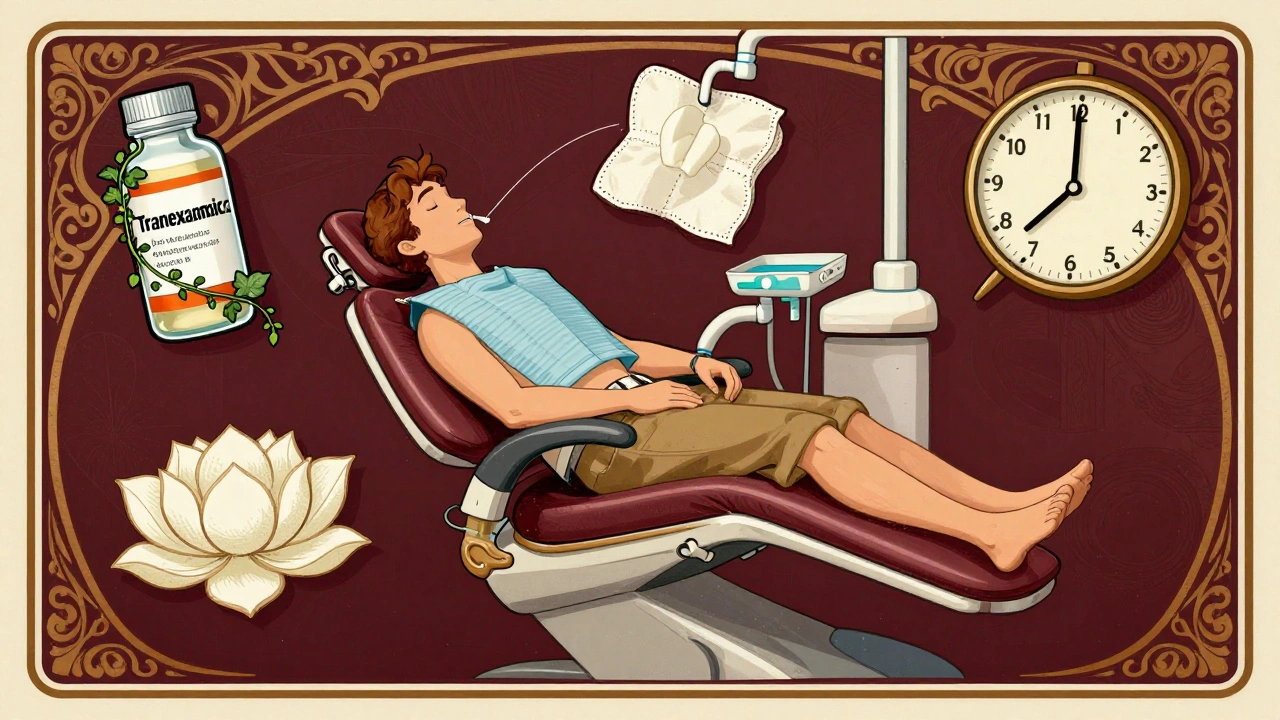
- Tranexamic acid mouthwash: A special rinse made with 5% tranexamic acid. You swish 10ml for 1-2 minutes, then spit. Repeat every 2 hours for the first 24 hours after extraction. This helps clots form and stick. It’s effective for up to 5 days if stored in the fridge.
- Pressure and packing: Gauze packs, collagen sponges, or fibrillar mesh are placed in the socket after extraction. You bite down firmly for 30-45 minutes.
- Stitches: Often used after multiple extractions or gum surgery. They hold tissue together while healing begins.
- Avoiding multiple extractions: Dentists won’t pull two or three teeth next to each other in one visit. They’ll space them out over two or three appointments to reduce bleeding pressure.
These techniques are so effective that the American Academy of Oral Medicine says: “Most bleeding from dental procedures is not difficult to control and stop, even in patients who are taking blood thinners.”
Drugs That Make Bleeding Worse - And What to Avoid
Some medications you take for other things can make bleeding more likely. These include:
- NSAIDs: Ibuprofen, naproxen, diclofenac - even over-the-counter ones. Use acetaminophen (Tylenol) instead for pain.
- Aspirin: If you’re not already on it, don’t start it before dental work.
- Some antibiotics: Clarithromycin and fluconazole can interfere with DOACs and raise bleeding risk.
- Herbal supplements: Garlic, ginkgo, ginseng, fish oil - stop these 7-10 days before surgery if possible.
Always tell your dentist about every pill, supplement, or cream you use. Even “natural” products can interact.

What to Do After Your Dental Procedure
After your appointment, follow these simple steps:
- Keep gauze in place for at least 30-45 minutes. Don’t spit or rinse during this time.
- After 24 hours, gently rinse with salt water (1/2 tsp salt in warm water) - no mouthwash with alcohol.
- Don’t smoke or use a straw for 72 hours. Suction can pull out the clot.
- Eat soft foods. Avoid hot, spicy, or crunchy stuff.
- Use ice packs on your cheek if swelling occurs.
Call your dentist immediately if you notice:
- Bleeding that doesn’t stop after 2-3 hours of pressure
- Swelling that gets worse after 2 days
- Fever, chills, or a bad taste in your mouth
Who Needs Special Care?
Some patients need extra attention:
- Younger patients: A 25-year-old with a blood clot from a long flight, or a 32-year-old athlete with atrial fibrillation - they’re becoming more common.
- Pregnant patients: Warfarin is risky in pregnancy. DOACs aren’t approved. Dentists work closely with OB-GYNs to manage care.
- People with kidney or liver disease: These conditions affect how your body processes blood thinners. Your INR or drug levels may be unpredictable.
- Those on multiple blood thinners: If you’re on warfarin + aspirin, or DOAC + clopidogrel, your risk is higher. Coordination between your cardiologist and dentist is essential.
Why the Old Advice Was Wrong
For decades, dentists told patients to stop warfarin before any procedure. That was based on fear - not science.
Studies now show that stopping anticoagulants even for a few days increases the chance of a deadly clot by 2-4 times. Meanwhile, the amount of bleeding during a simple extraction doesn’t change much.
One study found that 5% of patients on warfarin had minor bleeding after dental work - but only 0.2% had serious bleeding. The risk of a stroke or heart attack from stopping the drug? Up to 10 times higher.
Today’s guidelines reflect this shift. In 2022, 78% of U.S. dental practices followed the ADA’s updated recommendations. That number is rising.
Bottom Line: Stay on Your Meds, Talk to Your Team
You don’t need to stop your blood thinner for most dental work. The risks of stopping far outweigh the risks of bleeding.
Here’s what you should do:
- Never stop your medication without talking to your doctor.
- Bring a list of all your meds to your dental appointment.
- Ask your dentist if they’ve treated patients on blood thinners before.
- Follow post-op instructions carefully.
Dentists are trained to handle this. You’re not alone. Millions of people get fillings, cleanings, and extractions every year while on blood thinners - and they’re safe.
Should I stop my blood thinner before a dental cleaning?
No. Routine dental cleanings are low-risk procedures. Stopping your blood thinner increases your risk of stroke or blood clots without reducing bleeding. Keep taking your medication as prescribed.
Can I get a tooth pulled if I’m on warfarin?
Yes, if your INR is under 3.5. Single extractions are considered moderate-risk, but they can be done safely with proper hemostatic techniques like tranexamic acid rinse and pressure packing. Multiple extractions may require spacing out over appointments.
What’s the safest painkiller after a dental procedure on blood thinners?
Acetaminophen (Tylenol) is the safest option. Avoid NSAIDs like ibuprofen or naproxen, as they increase bleeding risk. Aspirin should also be avoided unless you’re already taking it for heart protection.
Do I need to check my INR before a dental appointment?
If you’re on warfarin and your last INR was more than 2 weeks ago, it’s a good idea to get it checked before a moderate-risk procedure like an extraction. For routine cleanings or fillings, it’s not required unless your INR has been unstable.
Can I use mouthwash after a tooth extraction if I’m on blood thinners?
Avoid commercial mouthwashes for the first 24 hours - they often contain alcohol, which can irritate the socket. After that, use salt water rinses. If your dentist prescribes tranexamic acid rinse, use it as directed - it helps stop bleeding.
Are DOACs safer than warfarin for dental work?
Yes, generally. DOACs have a shorter half-life, so their effect wears off faster. For most procedures, you can just skip your morning dose. There’s no need for regular blood tests, which makes planning easier. But you still shouldn’t stop them without consulting your doctor.





Angela R. Cartes
December 8, 2025 AT 22:27Andrea Beilstein
December 9, 2025 AT 03:45Ryan Brady
December 10, 2025 AT 17:16Raja Herbal
December 12, 2025 AT 10:38Lauren Dare
December 14, 2025 AT 05:50Gilbert Lacasandile
December 14, 2025 AT 18:43Lola Bchoudi
December 16, 2025 AT 12:50Morgan Tait
December 17, 2025 AT 11:56Darcie Streeter-Oxland
December 18, 2025 AT 09:40