

Traveling across time zones isn’t just about jet lag-it’s a serious risk to your health if you’re taking daily medication. Around 52% of U.S. adults take prescription meds regularly, and nearly half of them miss doses when they travel. A missed pill, a delayed injection, or an out-of-sync insulin dose can lead to hospital visits, seizures, blood clots, or even life-threatening complications. The good news? With the right plan, you can stay on track no matter how many time zones you cross.
Know Your Medication’s Tolerance for Timing
Not all meds are created equal when it comes to timing. Some can be taken a few hours early or late with no problem. Others? Even a 30-minute shift can throw off your whole system.For most common medications-like blood pressure pills, cholesterol drugs, or thyroid hormones-you have a four-hour window. That means if you usually take your pill at 8 a.m., you can take it anytime between 6 a.m. and 12 p.m. without losing effectiveness. This rule comes from research at the University of California San Francisco and holds true for about 70% of daily prescriptions.
But for high-risk meds, that window shrinks to just two hours-or less.
- Insulin: Basal insulin (like Lantus or Levemir) needs to be timed within 30-60 minutes of your usual schedule. Missing it by more than two hours can spike your blood sugar.
- Anti-seizure drugs: Johns Hopkins found that going more than two hours late increases seizure risk by 3.7 times.
- Hormonal contraceptives: If you’re more than 12 hours late on the pill, you lose protection. Backup contraception is required.
- HIV antiretrovirals: These need to stay in your system 24/7. Even a single missed dose can lead to drug resistance.
- Warfarin: Your INR levels can swing wildly with schedule changes or diet shifts. Get tested within 72 hours of returning home.
If you’re on one of these, don’t guess. Talk to your doctor at least two weeks before you leave. Some people need a custom schedule-like taking half a dose mid-flight and the rest upon arrival.
Plan Ahead: The 4-Week Rule
Waiting until the night before your flight to think about your meds is a recipe for disaster. The American Pharmacists Association recommends starting your plan 4-6 weeks before departure. Here’s what to do:- Check your supply. Do you have enough for your trip plus a 7-day buffer? For international travel, aim for a 14-day surplus. Delays happen. Baggage gets lost. You need extra.
- Get a doctor’s letter. If you’re carrying controlled substances-like opioids, stimulants, or certain anxiety meds-you need a signed note from your doctor. Countries like Japan, South Korea, and the UAE ban common U.S. prescriptions without one.
- Call your pharmacy. Ask if they can refill early or mail you a supply. Many chains like CVS and Walgreens now offer pre-travel consultations.
- Research destination rules. The WHO says 27% of medication disruptions come from breaking local drug laws. For example, codeine is illegal in Singapore. Melatonin is a controlled substance in the UK. Know before you go.
Pack Smart: Don’t Risk Losing Your Meds
The biggest cause of medication emergencies on trips? Lost luggage. A 2024 survey by Chemique Pharm found that 63% of medication-related emergencies happened because people packed pills in checked bags. One in five travelers lost their entire supply.Here’s how to avoid that:
- All meds in carry-on. The TSA allows any quantity of medication in your carry-on, even if it’s over 3.4 ounces. Just tell the agent at the start of screening.
- Keep a printed list. Write down every medication: brand name, generic name, dosage, frequency, and why you take it. Include allergies. Store this in your wallet or purse-not with your pills.
- Use a digital backup. Save a photo of your list on your phone and email it to a trusted contact.
- Refrigerated meds? Use an insulated pouch with ice packs. Insulin exposed to heat above 86°F for more than 24 hours can lose 27% of its potency.
- Don’t transfer pills. Keep them in original bottles. Customs agents and ER doctors need to see the label.
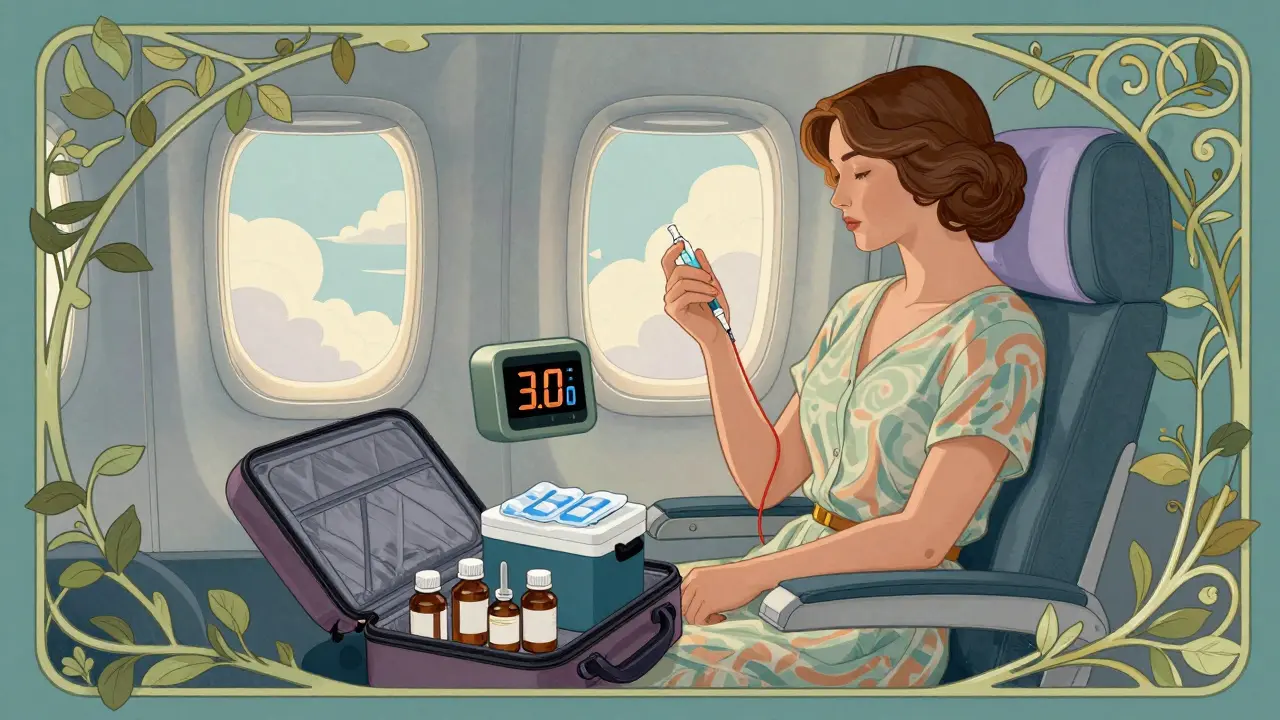
Adjust Your Schedule: When and How
The big question: Do you stick to home time or switch to local time?For time zone changes under three hours? Keep your home schedule. No need to overcomplicate it.
For bigger jumps-say, flying from New York to Tokyo (13 hours ahead)-you need a strategy.
Most doctors recommend this approach:
- Take your first dose at your home time. If you usually take your pill at 8 a.m. EST, take it at 8 a.m. EST-even if it’s 9 p.m. in Tokyo.
- Then switch to local time. After that first dose, start taking your meds at the same local time each day. So if your next dose is due at 8 a.m. home time, that’s 9 p.m. local time. Wait until the next morning (local time) to take your next pill.
- For multi-day trips, gradually shift your schedule over 2-3 days before departure. If you’re flying east, start taking your meds 1-2 hours earlier each day. Flying west? Go later.
Pro tip: Use a countdown timer, not a time-zone alarm. NimbleRx’s 2024 study found travelers who used countdown timers (set to hours, not clock time) improved adherence by 32%. Why? Your phone’s clock changes automatically. Your brain doesn’t. A 12-hour countdown is clearer than “Take pill at 3 a.m.”
Use Tech to Stay on Track
Your phone can be your best ally-if you use it right.- Medication reminder apps with auto-time-zone adjustment (like Medisafe, MyTherapy, or Mango Health) cut missed doses by 47% compared to regular alarms.
- Set multiple alerts. One for the actual time, one for “Did you take it?” 15 minutes later.
- Sync with your calendar. Block time for your meds like you would a meeting.
- Use smart pill dispensers. Devices like Hero or MedMinder dispense pills automatically and send alerts if you skip a dose.
Don’t rely on memory. Even the most disciplined people forget when they’re tired, jet-lagged, or in a new environment.
What If You Miss a Dose?
Don’t panic. Don’t double up.Here’s what to do based on the type of medication:
- Most meds: If you miss a dose and it’s within 2 hours of your next scheduled time, skip it. If it’s more than 2 hours before the next dose, take it now.
- Antibiotics: Never double up. Inconsistent dosing increases antibiotic resistance by 18%, per CDC data. Just resume your schedule.
- HIV meds: Take the missed dose immediately-even if it’s close to the next one. Consistency is critical.
- Insulin: If you miss a basal dose, contact your doctor. Don’t guess the correction. High blood sugar is dangerous.
- Warfarin: Skip the missed dose. Don’t try to catch up. Your INR could spike dangerously.
Mayo Clinic found that doubling doses to make up for a missed one increases the risk of adverse events by 4.2 times. That’s not worth the risk.

When to Call Your Doctor
You don’t need to handle this alone. Reach out if:- You’re crossing more than five time zones
- You’re on insulin, seizure meds, or anticoagulants
- You’re unsure about local laws where you’re going
- You’ve missed a dose and don’t know what to do
- You’re traveling to a country with limited pharmacy access
Many clinics now offer virtual pre-travel consults. Don’t wait until you’re at the airport.
Final Checklist Before You Leave
- [ ] Medication supply: 7-14 days extra - [ ] Doctor’s letter for controlled substances - [ ] Printed and digital medication list - [ ] All meds in carry-on, in original bottles - [ ] Refrigerated meds in insulated cooler with ice packs - [ ] Medication app set up with countdown timers - [ ] Destination drug laws checked - [ ] Emergency contact info saved on phone - [ ] Travel insurance covers medication-related emergenciesTraveling shouldn’t mean risking your health. With a little planning, you can enjoy your trip without worrying about missed pills or dangerous gaps in your treatment. The key isn’t perfection-it’s preparation.
Can I bring my medications in my carry-on even if they’re over 3.4 ounces?
Yes. The TSA allows any amount of medication in your carry-on, regardless of size, as long as it’s for personal use. You must declare it to the TSA agent at the start of screening. Keep medications in their original bottles with labels intact. You don’t need to put them in a clear plastic bag like liquids.
What if I lose my meds while traveling?
If you lose your medication, go to a local pharmacy with your printed medication list and doctor’s contact info. Many pharmacies can fill prescriptions from U.S. providers, especially for common drugs. For controlled substances, you may need to contact your doctor for an emergency refill or a new prescription. Always carry a digital copy of your list and your doctor’s number.
Should I take my pills at home time or local time when I travel?
For time zone changes under three hours, stick with home time. For larger changes, take your first dose at home time, then switch to local time for all future doses. This avoids confusion and keeps your body on a stable rhythm. Use a countdown timer app to help you track when to take your next pill.
Can I split my insulin dose during a long flight?
Yes, but only if your doctor advises it. For long flights crossing five or more time zones, some endocrinologists recommend splitting your basal insulin dose-taking half before takeoff and half after landing. Never adjust insulin without professional guidance. Blood sugar swings can be dangerous.
Is it safe to take my pills with food while traveling?
It depends on the medication. Some pills need to be taken on an empty stomach; others require food to reduce side effects. Check your prescription label or ask your pharmacist. If you’re unsure, take your pill with a light snack like crackers or a banana. Avoid alcohol, grapefruit, and large meals unless approved by your doctor.
What should I do if I’m on multiple medications with different schedules?
Use a pill organizer labeled by time of day and set multiple reminders on your phone. Group meds by function-e.g., morning meds, evening meds. Apps like Medisafe let you upload all your prescriptions and automatically adjust for time zones. If your regimen is complex, ask your pharmacist to create a simplified schedule before you leave.
Are there any countries where common U.S. medications are illegal?
Yes. Countries like Japan, South Korea, the UAE, and Singapore ban common U.S. drugs like Adderall, Vicodin, and even some cold medicines containing pseudoephedrine. Always check the destination country’s drug regulations before you travel. The U.S. State Department website has a list of restricted substances by country.
Do I need to tell my airline about my medications?
No, you don’t need to notify your airline unless you’re carrying oxygen or require special assistance. But you must declare medications to TSA at security. Airlines are required to allow medically necessary liquids over 3.4 ounces in carry-on, so you’re protected by federal rules.
What to Do After You Return
Your trip’s over, but your medication plan isn’t done. When you get home:- Resume your normal schedule immediately.
- Monitor for side effects-your body may still be adjusting.
- If you’re on warfarin, get your INR checked within 72 hours.
- Refill your prescriptions as soon as possible. Don’t wait until you’re out.
- Review what worked and what didn’t. Update your travel plan for next time.
Medication adherence isn’t just about taking pills-it’s about staying alive, healthy, and in control. Whether you’re flying across the country or around the world, a few simple steps can make all the difference.





roger dalomba
December 25, 2025 AT 16:34Erwin Asilom
December 27, 2025 AT 00:10Also, never trust airport security to understand insulin. Always say ‘medical device’-they’ll leave it alone.
Sophia Daniels
December 27, 2025 AT 07:27Also, the fact that we need a PhD in pharmacology just to go to Bali? That’s not a travel tip-that’s a national failure.
Peter sullen
December 29, 2025 AT 03:48Moreover, the retention of original pharmaceutical labeling is not merely a regulatory formality-it is a critical component of pharmacovigilance during international transit.
Natasha Sandra
December 29, 2025 AT 23:27Sandeep Jain
December 31, 2025 AT 15:21Brittany Fuhs
January 1, 2026 AT 22:05Also, why is melatonin controlled in the UK? It’s just a sleep supplement. This is why I don’t travel outside the U.S.
Nikki Brown
January 3, 2026 AT 21:46And yes, I’ve had to explain to a TSA agent why I have 17 bottles in my bag. They don’t care. They just want to know if it’s a bomb. Your pills aren’t special. Your life isn’t more important than anyone else’s. Just take your meds. Stop making it a performance.
Steven Destiny
January 5, 2026 AT 16:19Fabio Raphael
January 7, 2026 AT 08:21Amy Lesleighter (Wales)
January 8, 2026 AT 02:44Becky Baker
January 10, 2026 AT 01:34Rajni Jain
January 11, 2026 AT 19:26Sumler Luu
January 12, 2026 AT 11:38sakshi nagpal
January 12, 2026 AT 14:16