
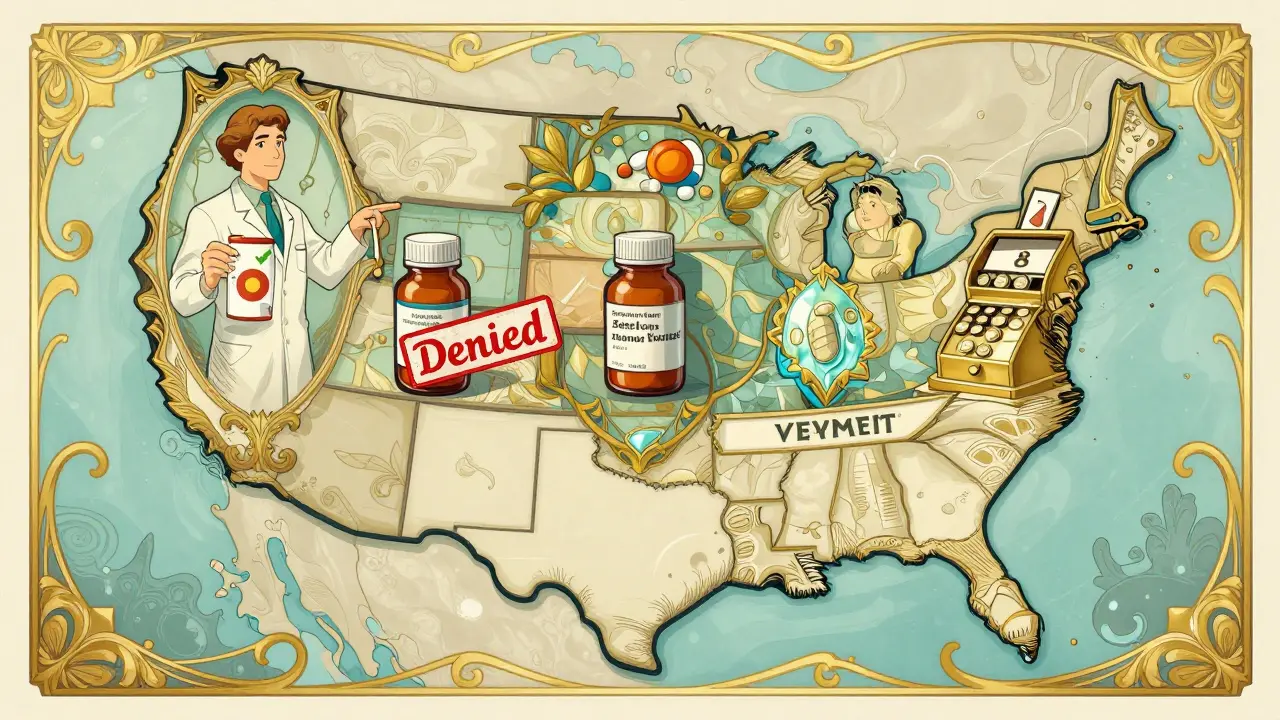
When it comes to getting generic drugs through Medicaid, there’s no single rule that applies across the U.S. What’s covered in Colorado might be denied in Texas, and what’s free in Vermont could cost you $8 in Florida. Even though every state offers prescription drug coverage under Medicaid, the Medicaid generic coverage rules vary wildly - and knowing those differences can mean the difference between staying on your medication or going without.
Why Generic Drugs Matter in Medicaid
Generic drugs make up over 84% of all Medicaid prescription claims, yet they account for less than a third of total drug spending. That’s because generics cost far less than brand-name versions. In 2024, Medicaid spent $38.7 billion on generics - a huge savings compared to what it would’ve cost to use brand drugs for the same conditions. States rely on generics to stretch limited budgets and keep millions of low-income patients on essential meds for diabetes, high blood pressure, asthma, and depression. But here’s the catch: just because a drug is generic doesn’t mean it’s automatically covered. States control how these drugs are managed through formularies, copays, prior authorizations, and substitution rules. And those rules change from state to state.Automatic Generic Substitution: Not a Guarantee
Forty-one states require pharmacists to substitute a generic version when it’s available and approved as therapeutically equivalent by the FDA. That sounds straightforward - until you dig deeper. In Colorado, the law says a pharmacist must switch to the generic unless the doctor writes “dispense as written” or the brand is actually cheaper. But in other states, like California, substitution is allowed but not required. The pharmacist can still give you the brand if you ask, even if the generic is cheaper. Some states go even further. In 17 states, pharmacists can swap out a brand for a different generic - even if it’s not the one the doctor picked - as long as it’s considered therapeutically equivalent and the cost difference is over $10. This is called therapeutic interchange. But only 28 states require the pharmacist to document why they made the switch. In 12 states, no notice to the doctor is needed at all. That inconsistency creates confusion. A patient might get one generic in one pharmacy and a different one at another - with no warning. And if those generics don’t work the same way for them, it can lead to side effects or treatment failure.Formularies and Tiers: What’s Covered and What’s Not
Every state uses a drug formulary - a list of covered medications - usually broken into tiers. Tier 1 is almost always generic drugs. Tier 2 is brand names. Higher tiers mean higher costs. But here’s where it gets messy. Some states list hundreds of generics in Tier 1. Others only cover a handful. In states like New York and Massachusetts, most common generics are on the preferred list with low or no copay. But in Mississippi, over 150 generic drugs require prior authorization before you can get them - even if they’re on the FDA’s approved list. States also use “preferred drug lists” (PDLs) to push prescribers toward cheaper, clinically proven options. For example, Colorado’s PDL requires patients to try three different preferred proton pump inhibitors before approving a more expensive one for acid reflux. If you’re on a brand-name drug and your state moves it to non-preferred status, you might suddenly need a doctor’s note just to keep taking it.Prior Authorization: The Hidden Hurdle
Prior authorization is when your doctor has to get approval from the state’s Medicaid program before you can get a drug. It’s common for brand-name drugs - but increasingly, it’s being used for generics too. In Colorado, most generics on the preferred list don’t need prior auth. But if you need a non-preferred generic - say, a specific version of metformin - you’re stuck waiting. The state says decisions come back within 24 hours. In other states, like Georgia or Alabama, it can take up to 72 hours. That’s three days without your medication. Some states require prior auth for entire classes of generics. For example, if you’re on opioids, many states limit you to 7-day supplies and 8 pills per day - even if the prescription is for a generic. Others require you to fail on two or three cheaper generics before approving a more expensive one. A 2024 University of Pennsylvania study found that when Medicaid patients got denied a generic due to prior auth, their hospital admission rate jumped by 12.7%. That’s not just inconvenient - it’s dangerous.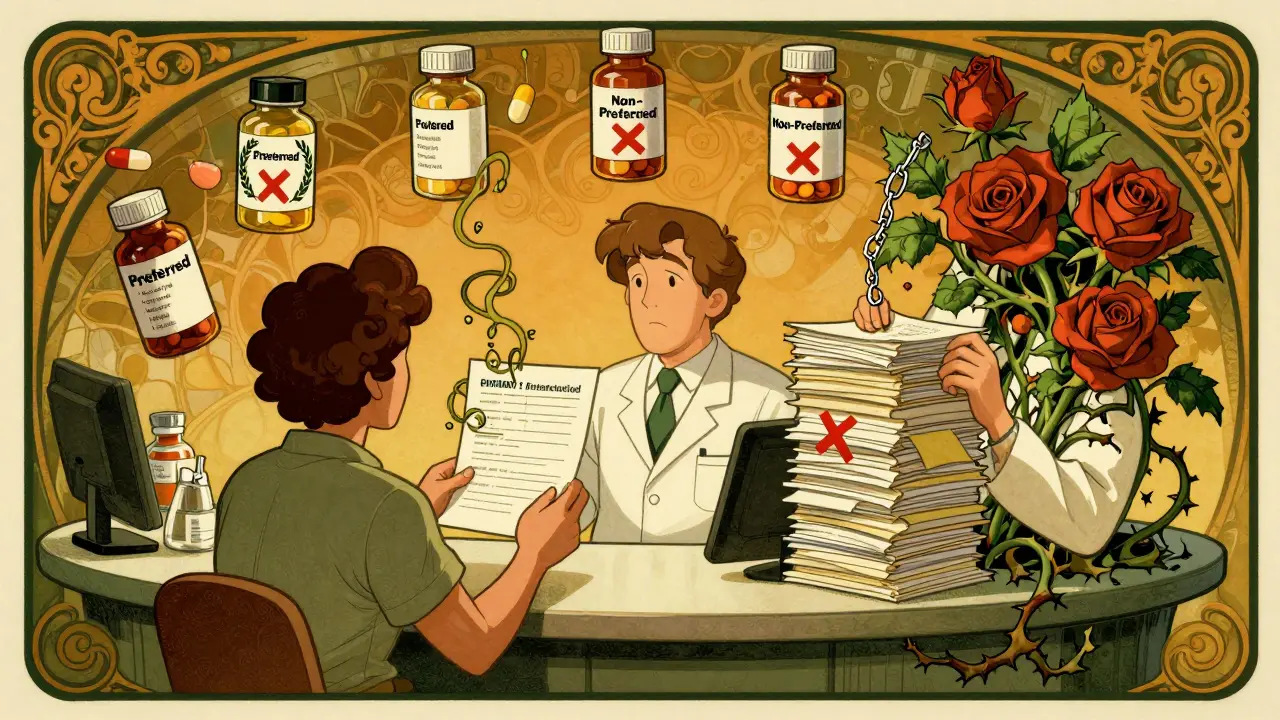
Copays: Paying for Your Pills
Federal rules let states charge up to $8 per prescription for non-preferred generics if your income is below 150% of the poverty line. But many states charge less - or nothing at all. In California, most Medicaid beneficiaries pay $0 for generics. In Florida, it’s $1 for preferred generics and $3 for non-preferred. In New Hampshire, you pay $5 no matter what. But in states like North Carolina and Louisiana, you could pay the full $8 - even for a basic drug like lisinopril. And here’s something few people realize: copays can change based on where you fill your prescription. A pharmacy in a rural area might charge more because Medicaid reimburses them less. In Texas, only 67% of community pharmacies participate in Medicaid - meaning you might have to drive farther just to get your meds at the lowest price.Pharmacist Discretion and Provider Burden
The burden isn’t just on patients. Doctors spend an average of 15.3 minutes per patient just dealing with prior authorization requests for generic drugs. That’s over 8,200 hours a year per physician - time that could’ve been spent seeing patients. Pharmacists are caught in the middle too. They have to know state-specific rules, check formularies, call doctors, and sometimes argue with Medicaid systems that don’t talk to each other. In Massachusetts, providers rate the formulary system 4.6 out of 5 for clarity. In Mississippi? 2.8. That gap isn’t just bureaucratic - it’s a barrier to care.What’s Changing in 2025 and Beyond
New rules are coming. In late 2024, CMS proposed requiring all states to cover anti-obesity medications under Medicaid - a first-of-its-kind expansion. That could affect nearly 5 million people, but it’s not yet final. Another big change looming: a proposed federal law that would remove inflation-based rebates for most generic drugs from the Medicaid Drug Rebate Program. Right now, drugmakers pay back a percentage of price hikes to states. If that changes, states could lose over $1.2 billion a year in rebates. That means higher costs for patients, tighter formularies, or both. Meanwhile, more states are testing value-based purchasing for generics - like Michigan’s program for diabetes drugs that cut costs by 11.2% without hurting adherence. Only 9 states have tried this so far, but interest is growing.
What You Need to Do Right Now
If you’re on Medicaid and take generics:- Find your state’s current Preferred Drug List (PDL). Most are online under your Medicaid agency’s website.
- Check if your drug is preferred or non-preferred. If it’s non-preferred, ask your doctor if there’s a cheaper, approved alternative.
- Ask your pharmacist if they can substitute a generic - and whether they’re required to.
- If you’re denied a drug, file an appeal immediately. Most states have a 10-day window.
- Keep a list of all your meds and which ones require prior auth. Bring it to every appointment.
FAQ
Are all generic drugs covered by Medicaid?
No. While every state covers outpatient prescription drugs, each state decides which specific generics are included on its formulary. Some states exclude certain generics due to cost, lack of clinical evidence, or because they’re not on the preferred drug list. Always check your state’s current Preferred Drug List.
Can I be forced to switch from a brand-name drug to a generic?
Yes, in 41 states, pharmacists are required to substitute a generic if it’s therapeutically equivalent - unless the doctor specifically says "dispense as written." Some states allow substitutions even if the brand is cheaper, while others require the generic to be less expensive. Always check your state’s substitution laws.
Why do I need prior authorization for a generic drug?
Even though generics are cheaper, states use prior authorization to control spending on non-preferred generics or those with safety concerns. For example, some states require you to try other generics first (step therapy) or limit quantities for drugs like opioids. Prior auth ensures the drug is medically necessary and aligns with state guidelines.
How much can I be charged for a generic drug?
Federal rules allow states to charge up to $8 for non-preferred generics if your income is below 150% of the federal poverty level. Many states charge less - some $0. Check your state’s Medicaid copay schedule. You may pay more if you use a non-participating pharmacy or if your drug is not on the preferred list.
What if my state denies coverage for a generic I need?
You have the right to appeal. Most states have a 10-day window to file an appeal after denial. Your doctor can write a letter explaining why the drug is medically necessary. If you’re on a chronic condition like hypertension or diabetes, delays can lead to serious health consequences - so act quickly.
Can I use a different pharmacy to get my generic drug?
Yes, but not all pharmacies participate in Medicaid. Participation rates vary - from 98% in Vermont to under 70% in Texas. If your pharmacy doesn’t accept Medicaid or charges more, you may need to switch to a participating pharmacy to get the lowest price. Ask your state Medicaid office for a list of approved pharmacies.
Chiraghuddin Qureshi
January 21, 2026 AT 21:17Lauren Wall
January 23, 2026 AT 20:47Tatiana Bandurina
January 25, 2026 AT 16:50Philip House
January 25, 2026 AT 20:17Ryan Riesterer
January 26, 2026 AT 23:44Akriti Jain
January 27, 2026 AT 05:46Mike P
January 27, 2026 AT 12:40Jasmine Bryant
January 28, 2026 AT 14:43Liberty C
January 30, 2026 AT 04:26shivani acharya
January 31, 2026 AT 05:53Sarvesh CK
February 1, 2026 AT 21:26