
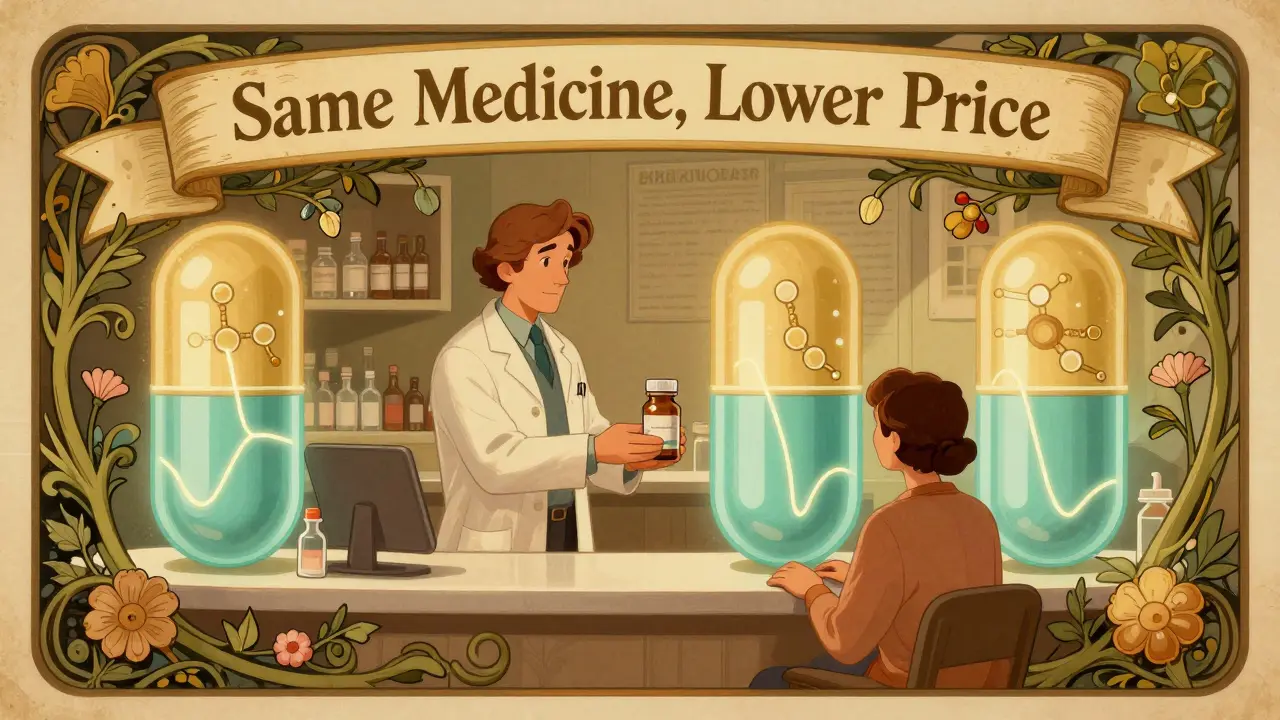
More than 90% of prescriptions filled in the U.S. are for generic drugs. Yet, nearly half of patients still worry they’re not as safe or effective as brand-name medicines. Why? Because most people don’t understand what "generic" actually means. That’s where infographics about generics come in - simple, visual tools that turn confusing science into clear, trustworthy facts.
What Generic Drugs Really Are
A generic drug isn’t a copy. It’s the same medicine, made to meet the exact same standards as the brand-name version. The FDA requires generics to have the same active ingredient, strength, dosage form, and route of administration. That means if you take a generic version of metformin, it works the same way in your body as the brand-name version. The only differences? The shape, color, or inactive ingredients like fillers or dyes. These don’t affect how the drug works - they just make the pill look different.
One of the most powerful infographics about generics from the FDA, titled "What Makes a Generic the Same as a Brand-Name Drug?", uses side-by-side graphs to show how the active ingredient releases at the same rate in the body. In testing, 89% of patients understood this bioequivalence concept from the visual alone - compared to only 67% who got the same info from text. That’s the power of a good visual.
How the FDA Ensures Generics Are Safe
There’s a myth that generics skip testing. They don’t. Every generic drug goes through the same rigorous review as the original. The FDA checks the manufacturing site, tests batches for purity, and confirms the drug dissolves in the body just like the brand-name version. This process isn’t shortcuts - it’s science.
Infographics from the FDA break this down visually. One shows a timeline: brand drug patent expires → generic company applies → FDA reviews for 10 months → approval granted. Another uses icons to show how the same quality controls apply to both brand and generic factories. These aren’t marketing materials - they’re regulatory evidence made easy to see.
Why Patients Still Hesitate
Even with all the data, fear sticks. Some patients think a different-looking pill means it’s weaker. Others worry about the manufacturer - "Is this made in a country I don’t trust?" Some believe the lower price means lower quality.
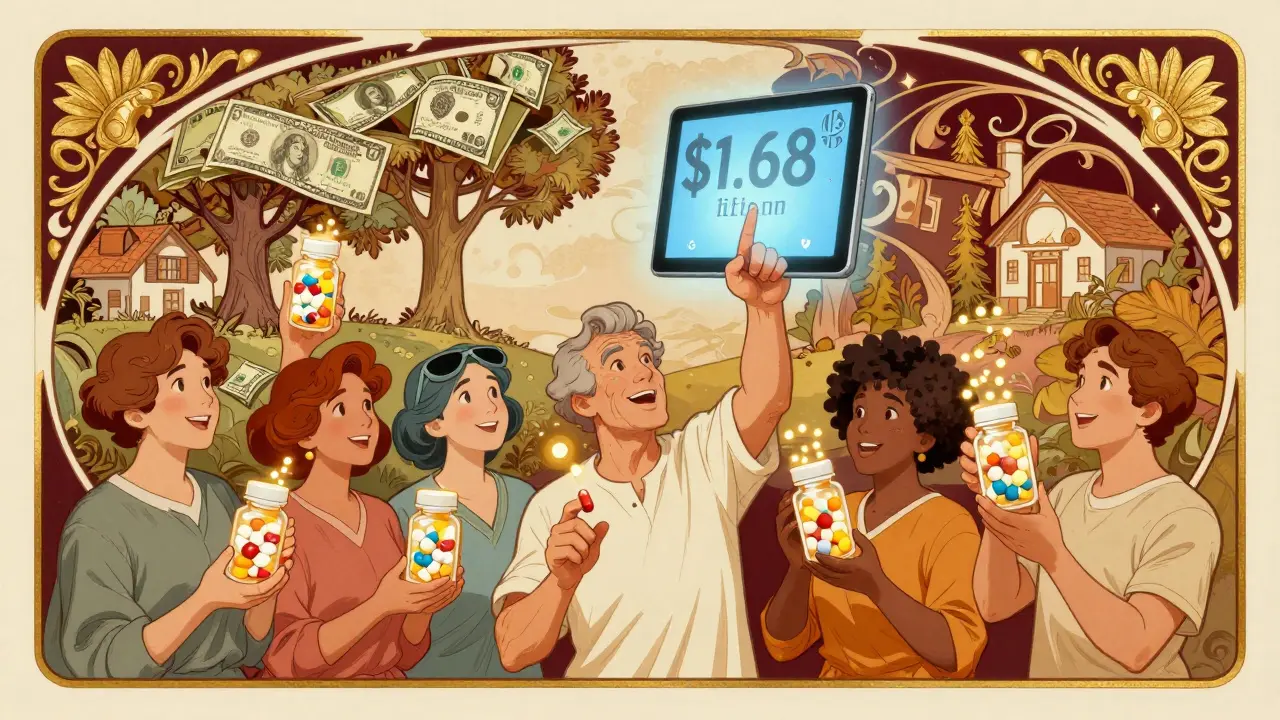
Research shows these fears are stronger in certain groups. African American and Hispanic patients report higher concerns about generic quality than White patients. That’s why the FDA released a special infographic on health equity - the only one that directly addresses how generics reduce cost barriers for low-income and minority communities. It shows data: generics saved $1.68 trillion between 2010 and 2019. That’s money kept in patients’ pockets, not spent on pills.
How Healthcare Providers Use These Tools
Pharmacists are the frontline for generic education. At Kaiser Permanente, 78% of pharmacists keep printed copies of FDA infographics behind the counter. One pharmacist said: "I’ve printed this and keep it behind the counter - cuts counseling time in half for generic questions."
Doctors use them too. The American Medical Association rated FDA generics infographics as "highly effective" - 4.7 out of 5 - for helping explain substitution to patients. The "Exclusivity and Generic Drugs" infographic, which shows patent timelines with clear arrows and dates, helps doctors answer: "Why can’t I get this generic yet?"
But not every tool works the same. The GTMRx Institute’s infographics focus on medication management systems - great for clinics, but less useful for a patient holding a pill bottle. BeMedWise has patient-friendly designs, but only covers generics in 3 out of 15 of their core materials. The FDA’s suite is the most complete.
Technical Details That Matter
These aren’t just pretty pictures. They’re built to work in real-world settings. Most are PDFs sized for 8.5 x 11 inches - easy to print and hand to patients. File sizes range from 200KB to under 1MB, so they load fast on phones. They use high-contrast colors and alt text for screen readers, meeting accessibility standards. Language is written at an 8th-grade reading level, tested with real patients.
The FDA tests each infographic with at least 30 diverse people before release. Average comprehension? 87%. That’s not accidental. It’s design. One infographic explains inactive ingredients - what they are, why they’re harmless - and received 63 positive patient comments in just two years. Another tackles the myth that "brand-name is stronger" by showing identical dissolution curves. No jargon. No fluff.
Where These Tools Are Falling Short
Even the best tools have gaps. Experts warn that infographics oversimplify drugs with narrow therapeutic indexes - like warfarin or levothyroxine - where tiny differences in absorption can matter. None of the current visuals flag these exceptions clearly. The Institute for Safe Medication Practices says this is a risk: patients might assume all generics are interchangeable, even when they’re not.
Also, only one FDA infographic mentions manufacturer differences - and even that’s brief. Patients ask: "Is this made by the same company as the brand?" The answer is often no, but it’s not explained visually. And while the FDA offers all materials in Spanish, other groups like GTMRx only translate 30% of theirs.
How to Use These Infographics
You don’t need a degree to use them. Here’s how they’re used in real clinics:
- Print and place in waiting rooms - patients read them while waiting.
- Share via patient portals - clinics link to the FDA’s free downloads.
- Hand them out during counseling - pharmacists point to the graphs while talking.
- Embed in EHR systems - Epic added FDA infographics in late 2022; over 450,000 patients viewed them in six months.
The FDA even offers a free 15-minute training module for staff. Over 12,000 healthcare workers completed it in 2022. That’s how you scale trust - not with posters, but with consistent, accurate visuals.
What’s Next for Generic Education
These tools are evolving. In early 2023, the FDA updated its "Generic Drug Facts" infographic to show $313 billion in annual savings - up from $297 billion. GTMRx launched interactive versions where patients input their meds and get personalized explanations.
The next big step? Augmented reality. At the 2023 Digital Health Summit, the FDA showed a prototype: point your phone at a pill bottle, and a 3D model appears showing how the generic and brand versions dissolve at the same rate. It’s still a prototype, but it’s coming.
With bipartisan support and new laws funding patient education, these tools aren’t going away. They’re getting better. And as generic use climbs toward 95% by 2028, clear visuals will be the key to making sure patients don’t just accept them - they understand them.
Are generic drugs really as good as brand-name drugs?
Yes. The FDA requires generic drugs to have the same active ingredient, strength, dosage, and performance as the brand-name version. They must dissolve in the body at the same rate and be manufactured under the same strict quality standards. The only differences are in color, shape, or inactive ingredients - none of which affect how the drug works.
Why do generic drugs look different from brand-name ones?
By law, generics can’t look identical to brand-name drugs. That’s to avoid confusion and trademark issues. The difference is only in the inactive ingredients - like dyes or fillers - which don’t affect how the medicine works. The active ingredient, the part that treats your condition, is exactly the same.
Do generic drugs cost less because they’re lower quality?
No. Generics cost less because their manufacturers don’t have to repeat expensive clinical trials. The original company already proved the drug works. Generic makers only need to prove their version is bioequivalent - which is much cheaper. The FDA still tests every batch for quality. Lower price doesn’t mean lower safety.
Can I trust generics made outside the U.S.?
Yes. The FDA inspects all manufacturing sites - whether in the U.S., India, China, or elsewhere - using the same standards. Over 50% of generic drugs sold in the U.S. are made overseas, but every facility must meet FDA quality rules. The location doesn’t determine safety - the inspection does.
Are there any drugs where generics might not work as well?
For most drugs, generics work just as well. But for a small group called "narrow therapeutic index" drugs - like warfarin, levothyroxine, or some seizure medications - tiny differences in absorption can matter. Even though generics are approved as bioequivalent, some patients and doctors prefer to stick with one brand for consistency. Always talk to your pharmacist or doctor if you’re unsure.
Where can I find these infographics?
The FDA offers all their generic drug infographics for free on their website at fda.gov/generics. They’re available as downloadable PDFs, in English and Spanish, and optimized for printing or digital viewing. Many pharmacies and clinics also link to them on their patient education pages.


Raushan Richardson
December 28, 2025 AT 02:51These infographics are a game-changer. I work in a clinic and we’ve been using the FDA ones for months now. Patients actually stop asking if generics are ‘fake medicine’ after seeing the side-by-side dissolution graphs. No more confusion, just clarity. Love when science gets made simple.
Robyn Hays
December 28, 2025 AT 18:14It’s wild how much power a well-designed visual has. I used to roll my eyes at ‘infographics,’ but this? This is art meets public health. The one showing $1.68 trillion saved? That’s not just data-it’s dignity. People aren’t just saving money, they’re keeping their homes, their food, their dignity. That’s the real win.
Satyakki Bhattacharjee
December 30, 2025 AT 16:16Why do we even need this? If you take medicine, you should trust the doctor. If you don’t trust, don’t take it. This is overcomplicating simple things. People are too scared of science now. Just swallow the pill.
Kishor Raibole
December 30, 2025 AT 21:18It is, indeed, a matter of considerable public interest that the dissemination of graphical representations regarding pharmaceutical equivalence has achieved such a marked degree of efficacy in the reduction of patient apprehension. One must, however, critically evaluate whether such visual aids, while aesthetically pleasing, may inadvertently obfuscate the nuanced pharmacokinetic variances inherent in certain therapeutic classes. The FDA, while commendable in its outreach, may be engaging in a form of benevolent paternalism.
John Barron
December 31, 2025 AT 22:41Okay but let’s be real-this is just corporate propaganda. The FDA is a revolving door for pharma execs. You think they really care if you understand generics? They care if you stop suing them. And those ‘infographics’? Made by the same contractors who designed the opioid crisis brochures. 🤡
Liz MENDOZA
January 1, 2026 AT 19:12I’ve had patients cry because they thought generics were ‘cheap junk.’ Seeing that infographic about the same active ingredient? They hugged me. Not because they were grateful for the info-but because they finally felt heard. This isn’t just education. It’s healing.
Jane Lucas
January 3, 2026 AT 11:55Miriam Piro
January 3, 2026 AT 19:37Let’s not pretend this is about patient education. The real goal? To get people to take cheaper pills so Big Pharma can keep raising brand-name prices. The FDA doesn’t care about your trust-they care about your compliance. And those ‘high-contrast’ infographics? Designed to make you feel guilty for doubting. They’re not helping you understand-they’re gaslighting you into silence. 🤖💊
Kylie Robson
January 5, 2026 AT 02:00While the visual metaphors presented are cognitively accessible, one must interrogate the methodological rigor of bioequivalence thresholds-particularly the 80–125% AUC and Cmax confidence interval window. The assumption that this range guarantees therapeutic interchangeability is statistically robust but clinically reductive, especially in polypharmacy cohorts with altered CYP450 metabolism. The infographics, while aesthetically effective, fail to contextualize pharmacogenomic variability. This is harm reduction through oversimplification.
Caitlin Foster
January 5, 2026 AT 18:29So let me get this straight-you spent 10 pages explaining that a pill is a pill… and you think that’s news? 😂 I’ve been taking generics since 2010. My blood pressure hasn’t changed. My bank account? Thank you. 🙏✨
Todd Scott
January 7, 2026 AT 12:58As someone who grew up in rural India where generics were the only option, I can tell you: this isn’t just an American issue. In villages where people choose between medicine and food, these visuals are life-saving. The FDA’s work here is global. The fact that they’re available in Spanish? That’s inclusion. But they need more languages-Hindi, Bengali, Arabic. This should be a worldwide toolkit, not a U.S. pamphlet.
Paula Alencar
January 8, 2026 AT 13:03The profound societal implications of this initiative cannot be overstated. The integration of accessible, visually-driven pharmacological education into the primary care ecosystem represents a paradigmatic shift in health literacy. By mitigating the psychological burden of pharmaceutical mistrust, these infographics function not merely as informational artifacts, but as instruments of socioeconomic justice. The fact that they are optimized for screen readers and 8th-grade comprehension is not an afterthought-it is a moral imperative. We must scale this model across all chronic disease domains.
Alex Lopez
January 10, 2026 AT 12:59Agreed with the infographic approach-but let’s not ignore the elephant in the room: the FDA doesn’t test every batch of every generic. They sample. And if a plant fails? They shut it down. But between inspections? It’s a gamble. The visuals don’t say that. They make it look like every pill is checked. It’s not. 🤷♂️