

Imagine waking up one morning to find your favorite ring no longer fits. You shrug it off as weight gain or a swollen finger. But what if that swelling is actually your bone structure changing? For people living with acromegaly, this is a daily reality. It is a rare chronic endocrine disorder where the body produces too much growth hormone (GH) and insulin-like growth factor-1 (IGF-1) after the growth plates in long bones have closed. Unlike gigantism, which affects children before their bones stop growing, acromegaly causes disproportionate enlargement of the hands, feet, and facial features in adults.
This condition is not just about looking different; it is a systemic issue that can significantly impact life expectancy if left untreated. However, modern medicine has turned the tide. With early diagnosis and targeted treatment, patients can normalize their hormone levels and return to a near-normal lifespan. Here is what you need to know about the signs, the cause, and the best ways to manage this complex condition.
Key Takeaways
- Acromegaly is primarily caused by a benign tumor on the pituitary gland, affecting approximately 60 people per million annually.
- Common symptoms include enlarged hands and feet, thickened skin, joint pain, and sleep apnea, often leading to diagnostic delays of 7-10 years.
- Diagnosis relies on blood tests for IGF-1 levels and an oral glucose tolerance test, confirmed by a pituitary MRI.
- Treatment typically starts with transsphenoidal surgery, followed by medications like somatostatin analogs or radiation if necessary.
- Successful management normalizes mortality risks, but requires lifelong monitoring for potential hormone deficiencies.
What Is Acromegaly and Who Does It Affect?
Acromegaly is a hormonal disorder characterized by excessive secretion of growth hormone from the pituitary gland in adults. First described by Pierre Marie in 1886, this condition remains relatively rare. According to data from the Mayo Clinic, the prevalence is about 60 cases per million people, with 3 to 4 new cases emerging every year per million population. It predominantly affects adults between the ages of 30 and 50, though it can occur at any age after puberty.
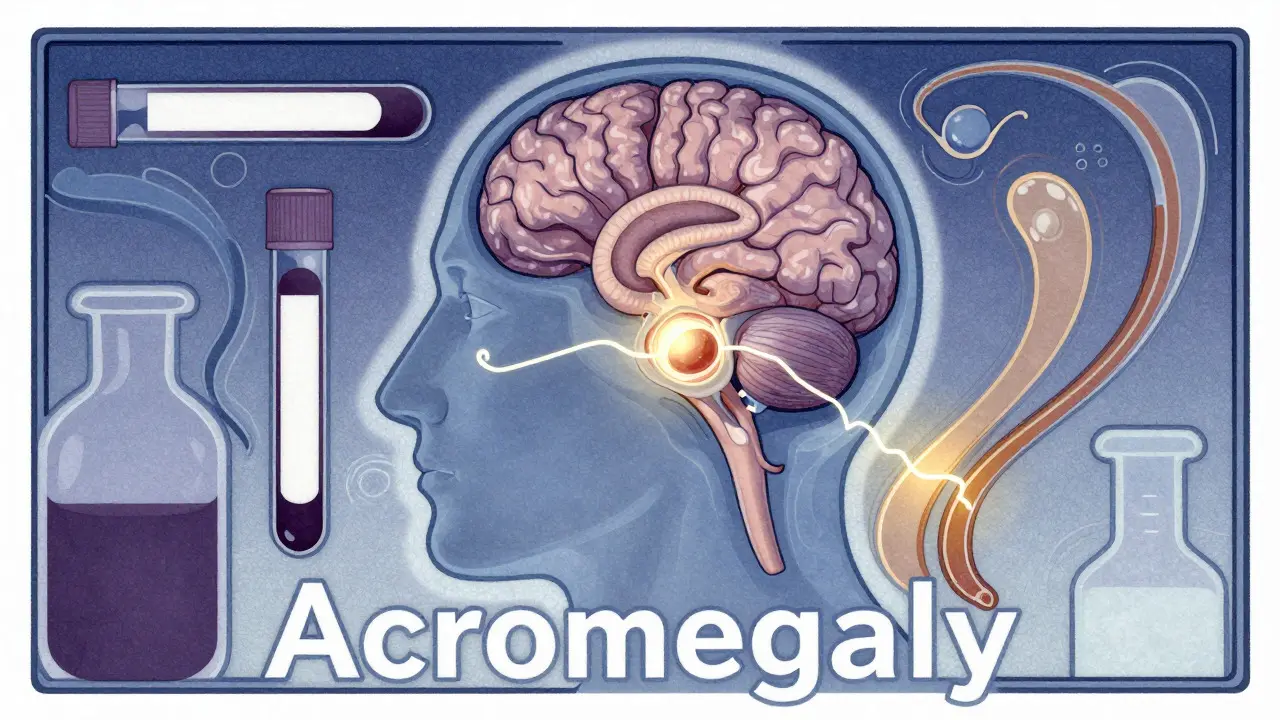
The root cause is almost always a pituitary adenoma. In 95% of cases, this is a noncancerous tumor that develops on the pituitary gland, located at the base of the brain. This gland acts as the body's master control center for hormones. When a tumor forms, it pumps out extra GH, which in turn signals the liver to produce more IGF-1. This combination drives the overgrowth of tissues throughout the body. Because the long bones have already fused in adulthood, the growth is not proportional height increase but rather a thickening of existing structures.
Recognizing the Signs: Beyond Physical Changes
Because acromegaly develops slowly, many people mistake the symptoms for natural aging or other common conditions. The physical changes are distinctive, however. About 90% of patients report progressive enlargement of their hands and feet. You might notice that your shoe size increases or that your rings feel tight. Facial changes are also prominent, with 85% of patients experiencing a protruding brow bone and jaw. The skin often becomes thicker and oilier, and the voice may deepen due to vocal cord thickening.
Beyond the mirror, the internal effects are significant. Joint pain affects nearly 80% of patients, often mistaken for arthritis. Sleep apnea is present in about 60% of cases, leading to chronic fatigue. Metabolic issues are common too, with diabetes mellitus occurring in 16-36% of patients and hypertension affecting 30-50%. If these symptoms cluster together, especially in middle-aged adults, it is worth discussing with a healthcare provider. The average diagnostic delay is notoriously long, often spanning 7 to 10 years, so awareness is critical.
How Doctors Diagnose Acromegaly
Diagnosing acromegaly involves a specific sequence of tests to confirm both the hormone excess and the source of the problem. The first step is usually a simple blood test measuring IGF-1 levels. Since IGF-1 levels correlate with GH production, elevated values suggest the disorder. However, because IGF-1 fluctuates, doctors follow up with an oral glucose tolerance test (OGTT). In healthy individuals, consuming sugar suppresses GH levels below 1 μg/L. In acromegaly, GH levels remain high despite the sugar load.
Once biochemical evidence is found, the next step is imaging. An MRI of the pituitary gland is essential to locate the tumor. Most tumors are small microadenomas (less than 10mm), accounting for 25% of cases, while larger macroadenomas (10mm or more) make up the remaining 75%. Larger tumors are more likely to press on nearby nerves, causing headaches or visual field defects, which occurs in about 44% of patients. Distinguishing acromegaly from similar conditions like Cushing's disease (caused by cortisol excess) is important, as the treatments differ significantly.
Treatment Options: Surgery, Medication, and Radiation
The goal of treatment is to normalize GH and IGF-1 levels to reduce the risk of cardiovascular disease and cancer. The approach depends on the size and location of the tumor.
- Transsphenoidal Surgery: This is the first-line treatment for most patients. A neurosurgeon removes the tumor through the nose and under the upper lip, avoiding a craniotomy. For smaller microadenomas, success rates are high, achieving biochemical remission in 80-90% of cases. For larger macroadenomas, success rates drop to 40-60%, often requiring additional therapy. Recovery typically takes 2-4 weeks.
- Medical Therapy: If surgery is not an option or does not fully resolve the issue, medications are used. Somatostatin receptor ligands, such as octreotide LAR, are the most common. These injections, given monthly, block the tumor from releasing GH. Other options include dopamine agonists like cabergoline or GH receptor antagonists like pegvisomant. These drugs help lower hormone levels and shrink tumors in some cases.
- Radiation Therapy: This is usually reserved for difficult-to-control cases as a third-line treatment. While it can achieve biochemical control in about 50% of patients over 10 years, it carries a risk of hypopituitarism (underactive pituitary gland), which may require lifelong hormone replacement therapy.
| Modality | Success Rate (Biochemical Remission) | Primary Use Case | Key Considerations |
|---|---|---|---|
| Transsphenoidal Surgery | 80-90% (Microadenomas) 40-60% (Macroadenomas) |
First-line for most patients | Minimally invasive; potential for cure |
| Somatostatin Analogs | Variable; controls levels in ~70% | Post-surgery or pre-surgery shrinkage | Monthly injections; GI side effects possible |
| Radiation Therapy | ~50% at 10 years | Refractory cases | Slow onset; risk of hypopituitarism |
Living with Acromegaly: Long-Term Management
Managing acromegaly is a marathon, not a sprint. Even after successful treatment, patients need regular monitoring. Blood tests for IGF-1 and GH should be performed every 3 to 6 months initially to ensure levels remain stable. Many patients experience improvements in quality of life, such as reduced joint pain and better sleep, even if hormone levels are only partially controlled.
A major concern is the development of hypopituitarism, where the pituitary gland stops producing other essential hormones like thyroid-stimulating hormone or cortisol. This occurs in about 28% of patients following treatment. Recognizing symptoms like extreme fatigue, low blood pressure, or cold intolerance is vital for early intervention. Multidisciplinary care involving endocrinologists, neurosurgeons, and primary care providers ensures that all aspects of health are monitored. New technologies, such as AI-assisted facial recognition software, are also emerging to help detect subtle changes earlier, potentially reducing diagnostic delays in the future.
Frequently Asked Questions
Is acromegaly hereditary?
Most cases of acromegaly are sporadic, meaning they happen by chance. However, rare genetic syndromes like Multiple Endocrine Neoplasia type 1 (MEN1) can predispose individuals to pituitary tumors. If there is a strong family history of endocrine disorders, genetic counseling may be recommended.
Can you reverse the physical changes of acromegaly?
Partial reversal is possible. Once hormone levels are normalized, soft tissue swelling reduces, and symptoms like joint pain and sleep apnea improve. However, bony changes, such as enlarged hands or facial bone structure, are permanent. That said, some patients report a reduction in ring size or shoe width over time as soft tissue volume decreases.
How long does it take to diagnose acromegaly?
The average diagnostic delay is unfortunately long, ranging from 7 to 10 years. This is because symptoms develop slowly and are often attributed to other conditions like arthritis or menopause. Early suspicion by primary care physicians and access to specialized endocrine centers can shorten this timeline significantly.
What is the life expectancy of someone with acromegaly?
If untreated, acromegaly can reduce life expectancy by 10-15 years due to cardiovascular and metabolic complications. However, with successful treatment that normalizes IGF-1 levels, life expectancy approaches that of the general population. Regular monitoring is key to maintaining this improved prognosis.
Are there new treatments coming for acromegaly?
Yes, research is ongoing. Recent developments include long-acting formulations of somatostatin analogs that require less frequent dosing. Additionally, clinical trials are evaluating combination therapies, such as pairing pegvisomant with octreotide, to treat difficult-to-control cases. Diagnostic tools using AI are also being refined to detect the condition earlier.