

Autoimmune hepatitis isn't something you catch from someone else. It’s not caused by alcohol, viruses, or poor diet. It happens when your immune system - the very thing meant to protect you - turns against your own liver. Instead of fighting off germs, it attacks liver cells, causing inflammation that can slowly scar the organ over time. Left untreated, it can lead to cirrhosis, liver failure, or even the need for a transplant. The good news? With the right diagnosis and treatment, most people can stop the damage and live normal, healthy lives.
How Is Autoimmune Hepatitis Diagnosed?
There’s no single test that says, "Yes, this is autoimmune hepatitis." Doctors have to piece together clues from blood tests, symptoms, and a liver biopsy. It’s like solving a puzzle where most pieces are blurry.
Blood work usually shows high levels of liver enzymes - ALT and AST - often five to ten times above normal. You’ll also see elevated immunoglobulin G (IgG), a type of antibody that’s usually high when your immune system is overactive. Autoantibodies like ANA (antinuclear antibodies) or SMA (smooth muscle antibodies) are found in about 80% of cases. These aren’t signs of infection; they’re red flags that your immune system is misfiring.
But here’s the catch: these antibodies can show up in other conditions too. That’s why a liver biopsy is required. A small sample of liver tissue, taken with a thin needle under ultrasound guidance, reveals the signature pattern: interface hepatitis. That’s when immune cells cluster right at the edge between the liver’s portal areas and the main tissue, chewing away at healthy cells. Without seeing this pattern, doctors won’t confirm the diagnosis.
The Revised International Autoimmune Hepatitis Group (IAIHG) scoring system helps put it all together. Points are given for antibody levels, IgG elevation, liver histology, and ruling out other causes like hepatitis B or C. A score above 15 means probable autoimmune hepatitis. Above 20? That’s a definite diagnosis.
Why Steroids Are the First Line of Treatment
Once diagnosed, the goal is simple: shut down the immune attack before it destroys too much liver tissue. The go-to starting point? Corticosteroids - usually prednisone or prednisolone.
These drugs are powerful anti-inflammatories. They don’t cure autoimmune hepatitis, but they stop the immune system from tearing up the liver. Most patients see their liver enzyme levels drop within two weeks. That quick response isn’t just a sign the treatment is working - it’s also a clue that the diagnosis is likely correct.
The typical starting dose is 0.5 to 1 mg per kilogram of body weight per day - that’s usually 30 to 60 mg daily. The dose is then slowly lowered over 6 to 8 weeks. By the end of that time, most people are on 10 to 15 mg a day. The goal isn’t to eliminate the drug entirely - it’s to find the lowest dose that keeps the disease quiet.
But steroids come with a price. About 70% of people on steroid-only treatment develop side effects. Moon face, weight gain, mood swings, insomnia, high blood sugar, thinning bones, and cataracts are common. One patient described it as "feeling unrecognizable" after three weeks. That’s why doctors don’t leave patients on high-dose steroids for long.
The Role of Azathioprine - The Steroid-Sparing Partner
Azathioprine (sold as Imuran or generic versions) is the other half of the equation. It’s an immunosuppressant that works differently than steroids. Instead of calming inflammation immediately, it quietly reduces immune activity over weeks and months.
When combined with prednisone, azathioprine lets doctors cut the steroid dose by 70 to 80% within six months. That dramatically reduces side effects. In fact, only about 30% of people on the combo therapy develop serious steroid-related problems - compared to 70% on steroids alone.
Azathioprine is usually started at 50 mg a day and increased to 1 to 2 mg per kg daily (up to 150 mg). It’s taken long-term - often for years. But it’s not risk-free. About 12% of patients experience bone marrow suppression, which can lower white blood cells and increase infection risk. Gastrointestinal issues like nausea and pancreatitis happen in up to 35% of users.
That’s why testing for TPMT enzyme levels is now standard before starting azathioprine. About 0.3% of people have a genetic variant that makes them unable to process the drug. Without testing, they could develop life-threatening blood cell drops. In Europe, 78% of centers test for this. In the U.S., it’s still only about 45%. If you’re prescribed azathioprine, ask if your doctor has checked your TPMT.

What Does Successful Treatment Look Like?
Success isn’t just about feeling better. It’s about what the numbers and the biopsy show.
A complete biochemical response means ALT and AST levels return to normal, and IgG drops back to baseline. That happens in 60 to 80% of patients within 18 to 24 months. But biochemical improvement doesn’t always mean the liver has healed. That’s why a second biopsy after two to three years is recommended. If the interface hepatitis is gone, that’s histological remission - and it’s a huge win.
Studies show that in 50 to 70% of patients, the liver fibrosis (scarring) actually reverses. One patient on Reddit shared that after two years on low-dose steroids and azathioprine, her biopsy went from F3 (advanced scarring) to F0 (no scarring). That’s not rare - it’s the goal.
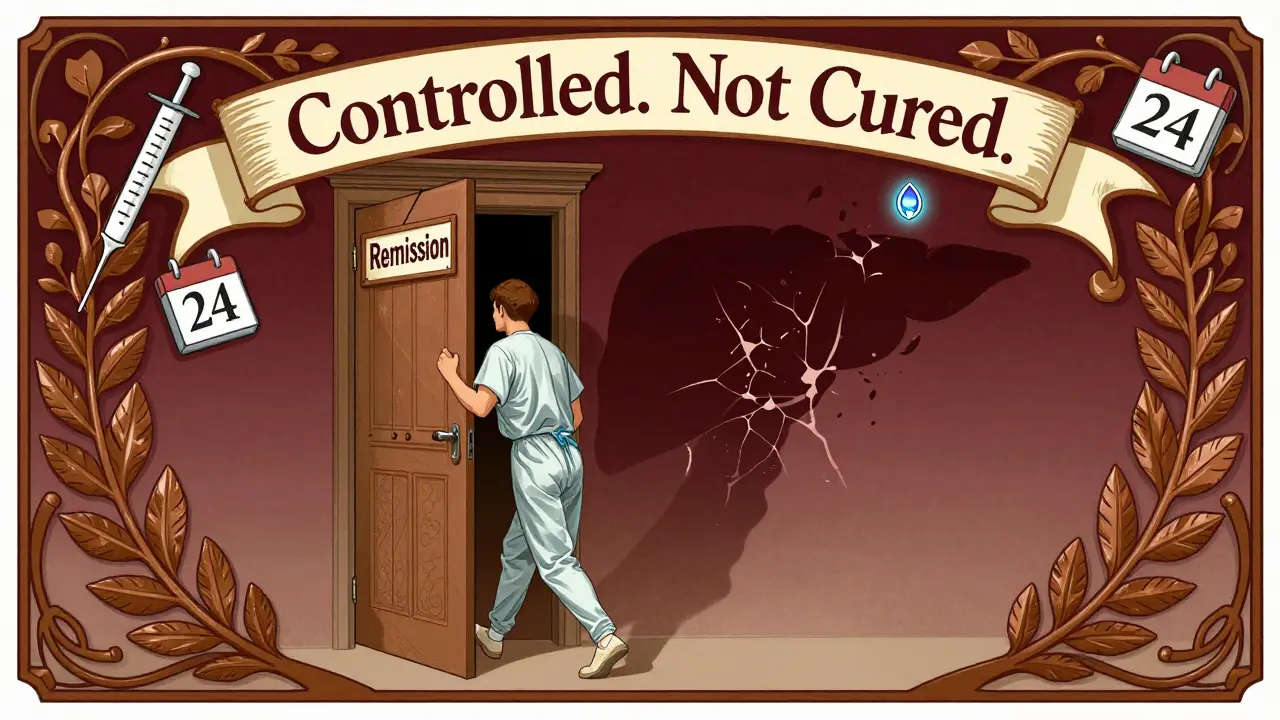
But remission doesn’t mean cure. Most people - 60 to 80% - need to stay on some form of treatment indefinitely. If you stop too soon, the chance of relapse is 50 to 90%. Even if you’ve been stable for two or three years, stopping treatment is risky and should only be attempted under close supervision, with gradual tapering over six to twelve months.
What If the First Treatment Doesn’t Work?
Not everyone responds. About 10 to 15% of patients don’t improve after 12 to 18 months. That’s called treatment failure. Others can’t tolerate the side effects - even at low doses.
That’s when second-line drugs come in. Mycophenolate mofetil (CellCept) is the most common alternative. It’s often used when azathioprine causes pancreatitis or low blood counts. It works similarly but with a different side effect profile - more diarrhea and less bone marrow suppression.
For those who don’t respond to either, calcineurin inhibitors like tacrolimus or cyclosporine are options. They’re stronger immunosuppressants, used cautiously because of kidney toxicity risks.
There’s new hope on the horizon. Drugs like tofacitinib (a JAK inhibitor) and clazakizumab (an IL-6 blocker) are in clinical trials. Early results show response rates of 50% or higher in patients who failed standard therapy. The FDA even granted breakthrough status to obeticholic acid for AIH in 2024, with phase 3 trials showing better outcomes than standard treatment.
What You Need to Do Before and During Treatment
Before starting immunosuppressants, you need to be tested for hepatitis B. About 15 to 20% of people carry the virus without knowing it. If you’re treated with steroids or azathioprine, that hidden virus can flare up dangerously. If you test positive, you’ll need antiviral medication like tenofovir before starting AIH treatment.
Vaccinations matter too. Get hepatitis A and B shots before you start immunosuppression. Once you’re on these drugs, your body won’t respond as well to vaccines - only 40 to 60% effectiveness versus 90% in healthy people.
Monitoring is non-negotiable. Blood tests for liver enzymes and blood counts are done every 2 to 4 weeks at first. Once stable, every 3 months. IgG levels are checked quarterly. If you’re on azathioprine, your doctor should check your blood counts monthly for the first six months.
Long-term, bone density scans are recommended, especially for women over 50 or anyone on steroids for more than six months. Calcium, vitamin D, and sometimes bisphosphonates are prescribed to protect against osteoporosis.
Living With Autoimmune Hepatitis
It’s not easy. Many patients say the side effects of treatment are worse than the disease. Weight gain, mood swings, hair thinning, and constant fatigue are real. One patient on a liver forum wrote: "I felt like I was losing myself to the meds."
But the alternative - uncontrolled inflammation - is worse. The goal isn’t perfection. It’s control. Most people on stable treatment can work, travel, have families, and live full lives. The key is consistency: taking your meds, showing up for blood tests, and talking to your doctor when things change.
Support groups, like those run by the Autoimmune Hepatitis Association, are full of people who’ve been there. Their advice? Don’t quit. Don’t skip doses. Don’t ignore symptoms. And if you feel like the treatment is worse than the disease - tell your doctor. There’s always another option.
Can autoimmune hepatitis be cured?
Autoimmune hepatitis cannot be cured, but it can be controlled. With treatment, most people achieve remission - meaning the immune attack stops and liver damage halts. In many cases, existing scarring even improves. However, 60 to 80% of patients need lifelong low-dose therapy to prevent relapse. Stopping treatment too soon leads to relapse in 50 to 90% of cases.
How long do you take steroids and azathioprine for autoimmune hepatitis?
Steroids are usually started at a higher dose and tapered over 6 to 8 weeks to a maintenance level of 10 to 15 mg daily. Azathioprine is started at 50 mg and increased to 1-2 mg/kg daily. Most people stay on low-dose steroids and azathioprine for years - often indefinitely. Some may try to stop after 2-3 years of complete remission, but only about 45% stay in remission two years after stopping. Treatment duration is personalized based on response and side effects.
What are the most common side effects of azathioprine?
The most common side effects of azathioprine are nausea, vomiting, and loss of appetite. More serious risks include bone marrow suppression (low white blood cells, red blood cells, or platelets), which occurs in about 12% of patients. Pancreatitis affects up to 35%, and fatigue is reported by nearly 30%. That’s why regular blood tests and TPMT enzyme testing are required before starting treatment.
Is a liver biopsy always necessary to diagnose autoimmune hepatitis?
Yes. Blood tests and autoantibodies can suggest autoimmune hepatitis, but they’re not enough. The only way to confirm it is by seeing the hallmark pattern of interface hepatitis in a liver biopsy. This is required by all major guidelines, including the 2025 EASL Clinical Practice Guidelines. The biopsy also helps rule out other liver diseases like primary biliary cholangitis or non-alcoholic steatohepatitis.
Can you drink alcohol if you have autoimmune hepatitis?
No. Alcohol puts extra stress on the liver, even when the disease is under control. For someone with autoimmune hepatitis, any alcohol use increases the risk of faster scarring and liver failure. Complete abstinence is recommended. This isn’t just advice - it’s a medical necessity.
Are there new treatments for autoimmune hepatitis on the horizon?
Yes. Several new drugs are in clinical trials. JAK inhibitors like tofacitinib have shown 55% response rates in patients who didn’t respond to steroids or azathioprine. Monoclonal antibodies targeting IL-6 (clazakizumab) and bile acid modulators like obeticholic acid (Ocaliva) are also showing promise. The FDA granted breakthrough therapy status to obeticholic acid in 2024. These treatments may become options for those who can’t tolerate current therapies or don’t respond to them.
What Comes Next?
If you’ve just been diagnosed, it’s normal to feel overwhelmed. The medications seem harsh. The side effects are scary. But remember - this disease is treatable. Thousands of people are living with controlled autoimmune hepatitis right now. They’re working, raising families, traveling.
Your next steps? Get your TPMT tested before starting azathioprine. Ask about hepatitis B screening. Schedule your first follow-up blood test in two weeks. Find a hepatologist who specializes in autoimmune liver disease - not just any gastroenterologist. And join a patient community. You’re not alone.
The 2025 EASL guidelines have made treatment more precise, less reliant on antibody labels, and more focused on real outcomes - not just blood numbers. That’s progress. And with ongoing research into biomarkers and targeted therapies, the future for people with autoimmune hepatitis is brighter than ever.





Ben Harris
December 26, 2025 AT 07:44Jason Jasper
December 27, 2025 AT 01:03Zabihullah Saleh
December 28, 2025 AT 07:10Winni Victor
December 30, 2025 AT 00:08Lindsay Hensel
December 31, 2025 AT 06:36sagar patel
January 1, 2026 AT 00:47Christopher King
January 1, 2026 AT 12:46Sophie Stallkind
January 1, 2026 AT 17:40Katherine Blumhardt
January 2, 2026 AT 05:08