
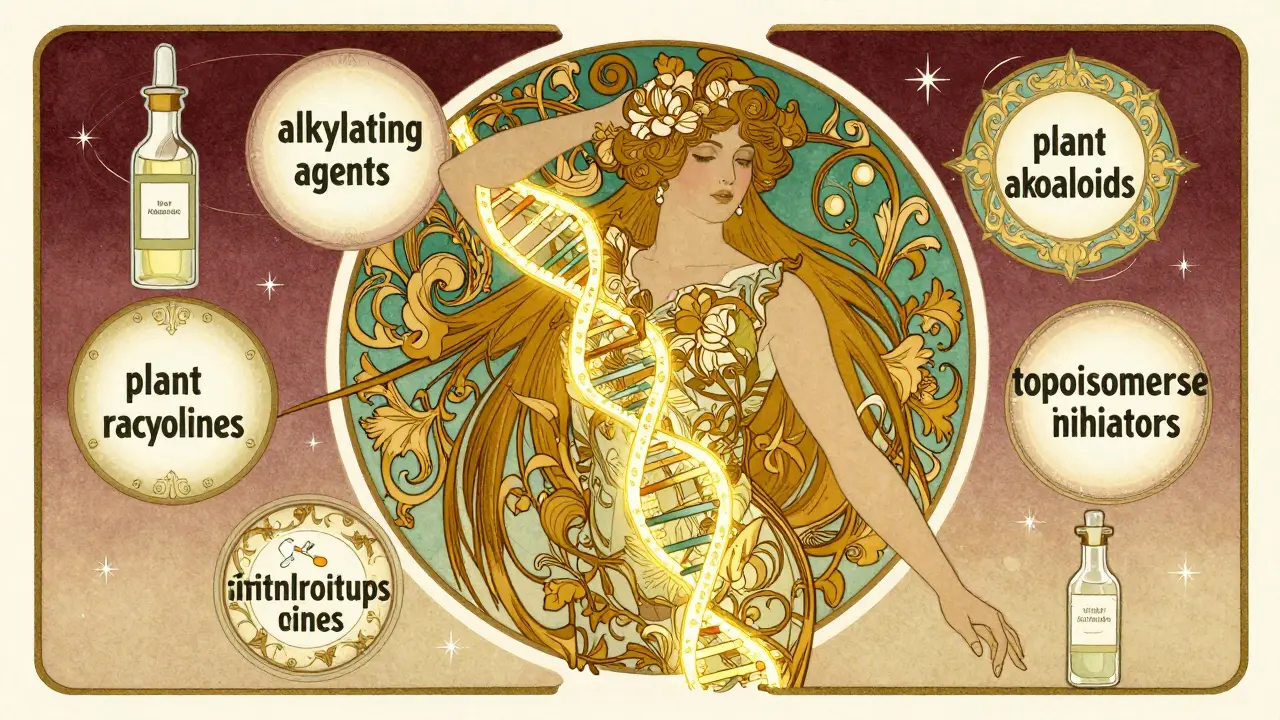
Chemotherapy isn’t just one drug-it’s a whole system of powerful medicines designed to kill cancer cells by attacking anything that divides fast. It’s been saving lives since the 1940s, when doctors first noticed that soldiers exposed to mustard gas had fewer white blood cells. That observation led to the first chemotherapy drug, nitrogen mustard, used on a patient with lymphoma in 1942. Today, over 100 different chemotherapy drugs are in use, each working in its own way to stop cancer from spreading.
How Chemotherapy Targets Cancer Cells
Cancer cells grow and divide much faster than most normal cells. Chemotherapy takes advantage of that by hitting cells during their division cycle. It doesn’t care if the cell is cancerous or not-it just targets anything that’s actively multiplying. That’s why it works so well against fast-growing tumors, but also why it causes side effects in healthy tissues like hair follicles, the gut lining, and bone marrow.
There are six main classes of chemotherapy drugs, each with a different trick:
- Alkylating agents like cyclophosphamide and cisplatin damage DNA directly by sticking chemical groups onto it, making it impossible for the cell to copy its genes.
- Antimetabolites such as 5-fluorouracil and capecitabine fake the building blocks of DNA and RNA. When the cell tries to use them, it gets stuck and dies.
- Anthracyclines like doxorubicin slip between DNA strands and block enzymes needed to untangle the genetic code, causing breaks in the DNA.
- Plant alkaloids like vincristine and paclitaxel freeze the cell’s internal skeleton (microtubules), which stops the cell from splitting in two.
- Topoisomerase inhibitors such as etoposide trap enzymes that normally unwind DNA during replication, leaving the cell with irreparable damage.
- Miscellaneous agents include drugs like temozolomide that work in unique ways, often used for brain tumors.
Most chemotherapy is given through an IV-about 65% of treatments-but some, like capecitabine, come as pills you swallow. Others go directly into the spinal fluid, the abdomen, or even an artery feeding the tumor. Dosing is precise: paclitaxel for breast cancer is usually 175 mg per square meter of body surface every three weeks. A full cycle might last two to six weeks, with breaks in between so your body can recover.
Why Chemotherapy Still Matters Today
Even with all the new targeted therapies and immunotherapies, chemotherapy remains the backbone of cancer care. The American Society of Clinical Oncology says it’s still the first choice for 78% of blood cancers like leukemia and lymphoma. In ovarian cancer, nearly all patients get chemo. For colorectal cancer, it’s used in 85% of cases. Even in breast cancer, where newer drugs exist, chemo is still given to about 70% of patients, especially before surgery to shrink tumors.
It’s also the only treatment that can reach cancer cells anywhere in the body. Targeted drugs only work if the tumor has a specific mutation-like HER2 or BRCA. Immunotherapies need the immune system to recognize the cancer. Chemotherapy? It just attacks fast-dividing cells, no matter where they are. That’s why it’s still critical for metastatic disease.
And it’s not outdated. In 2023, the FDA approved trilaciclib, the first drug designed to protect bone marrow during chemo, reducing the risk of low blood counts. Scalp cooling systems, now recommended in new guidelines, cut hair loss in half for patients on taxanes. These aren’t just minor tweaks-they’re major improvements in how we use chemo today.
Common Side Effects and What You Can Do About Them
Side effects happen because chemotherapy can’t tell the difference between a cancer cell and a healthy one that divides quickly. But today’s side effect management is far better than it was 20 years ago.
Fatigue is the most common complaint. Eighty-two percent of patients report it. It’s not just being tired-it’s a deep, bone-weary exhaustion that doesn’t go away with sleep. Studies show 30 minutes of moderate exercise daily-like walking or light cycling-can reduce fatigue by 25-30%. Don’t wait until you feel strong to move. Move to get strong.
Nausea and vomiting used to be unavoidable. Now, with drugs like ondansetron and aprepitant, severe nausea drops from 80% to under 20% in high-risk treatments. But delayed nausea-hitting 24+ hours after chemo-is still tough. Only 32% of patients find anti-nausea meds helpful for this. Eating small, bland meals (toast, rice, bananas) helps. Avoid strong smells. Stay hydrated. Drink 1-2 liters of water a day.
Hair loss affects 78% of patients. It’s not just the scalp-eyebrows, eyelashes, body hair all go. Scalp cooling caps, worn during infusion, reduce hair loss to about 25% in breast cancer patients on taxanes. They’re not perfect, but they’re a game-changer for many.
Chemo brain is real. Three out of four patients report trouble concentrating, remembering names, or finding words during treatment. For 35%, it lasts six months or longer after chemo ends. Meditation apps like Calm or Headspace, used for just 20 minutes a day, have been shown to cut cognitive complaints by 40%. Writing things down, using calendars, and avoiding multitasking help too.
Peripheral neuropathy is tingling, numbness, or pain in hands and feet. It’s common with drugs like paclitaxel and cisplatin. About 30-40% of patients get it. Five to ten percent end up with permanent nerve damage. Report tingling early. Wear gloves in cold weather. Avoid sharp objects. Don’t wait until it’s painful to tell your doctor.
Low blood counts can be dangerous. If your white blood cell count drops too low, you’re at risk for infection. A fever of 100.4°F or higher during chemo is an emergency-you need to call your oncology team right away. Platelet counts can drop, leading to easy bruising or bleeding. Hemoglobin levels fall, causing dizziness and shortness of breath. Blood tests every cycle catch these before they become life-threatening.
What Doesn’t Work (And What Might Help)
Some myths about chemo side effects won’t die. Vitamin D supplements? Cancer Council NSW says check your levels before starting taxanes-low vitamin D is linked to worse nerve damage. But the American Society of Clinical Oncology says there’s not enough proof to recommend it routinely. Don’t take high doses without talking to your doctor.
Medical cannabis? Early studies show CBD and THC blends can reduce neuropathic pain by 55%. In places where it’s legal, some patients use it under medical supervision. It’s not a cure, but it’s a tool worth discussing.
Red urine after doxorubicin? Normal. It’s the drug coloring your urine. Black stools? Not normal. That could mean internal bleeding. Call your team immediately.
Most patients learn what works for them by their third or fourth cycle. One person swears by ginger tea for nausea. Another finds cold compresses help with mouth sores. Keep a journal. Note what triggers your symptoms and what helps. Your oncology team wants to hear it.
Chemotherapy in the Modern Era
Chemotherapy isn’t the future of cancer treatment-but it’s still the present. While targeted drugs and immunotherapies are taking over for some cancers, like lung cancer with EGFR mutations, chemo remains essential for many others. It’s cheaper, more widely available, and works on tumors without clear targets.
Doctors now combine chemo with newer therapies. For example, in triple-negative breast cancer, chemo is paired with immunotherapy. In ovarian cancer, it’s given with PARP inhibitors. These combinations are extending survival and sometimes curing disease that was once untreatable.
The global chemotherapy market is worth nearly $19 billion and growing. Why? Because demand is rising-not just in wealthy countries, but in places like India, Brazil, and Nigeria, where cancer rates are climbing and access to newer drugs is limited. Chemo is still the most practical option for millions.
As one oncologist put it: "Chemotherapy isn’t elegant. It’s blunt. But it’s effective. And we’re getting better at making it less brutal."
How long does chemotherapy stay in your body?
Most chemotherapy drugs are cleared from your bloodstream within hours or days. But their effects on cells can last weeks. Side effects like fatigue or nerve damage may linger because the damage to healthy cells takes time to heal. The drugs themselves don’t stay in your system, but their impact can.
Can you work during chemotherapy?
Many people do, especially if their job isn’t physically demanding. Fatigue and "chemo brain" are the biggest barriers. Some adjust their hours, work remotely, or take days off around treatment. Employers are legally required to make reasonable accommodations in most countries. Talk to your oncology team and HR early about what’s possible.
Does chemotherapy hurt?
The infusion itself usually doesn’t hurt-like getting an IV for a blood test. But some drugs can cause burning or discomfort if they leak outside the vein. That’s why nurses check your line carefully. Some side effects like nerve pain or mouth sores can be painful, but those are managed with medication. Pain during treatment isn’t normal and should be reported.
Is chemotherapy worth it if it has so many side effects?
That’s a deeply personal question. For many, the answer is yes. Chemo has improved survival rates for cancers like Hodgkin lymphoma, testicular cancer, and childhood leukemia from near-zero to over 80%. Even when it doesn’t cure, it can extend life by months or years with good quality. The goal isn’t just to live longer-it’s to live well. Supportive care today makes that possible.
What happens if chemotherapy doesn’t work?
If the cancer doesn’t respond or comes back, your team will reassess. They might switch to a different chemo regimen, try a targeted therapy if a new mutation is found, or consider immunotherapy. Clinical trials are always an option. Palliative care can also be introduced to manage symptoms and improve quality of life, even if treatment is no longer aimed at curing.
Chemotherapy is harsh, but it’s also one of the most powerful tools we have against cancer. The drugs are evolving. The support around them is better than ever. And for millions, it’s the difference between life and death.

Josh McEvoy
January 24, 2026 AT 07:55Chloe Hadland
January 25, 2026 AT 03:44Amelia Williams
January 26, 2026 AT 00:25Sharon Biggins
January 26, 2026 AT 23:21lorraine england
January 27, 2026 AT 00:43Karen Conlin
January 27, 2026 AT 04:51John McGuirk
January 28, 2026 AT 13:54Michael Camilleri
January 28, 2026 AT 16:52Darren Links
January 29, 2026 AT 05:40