
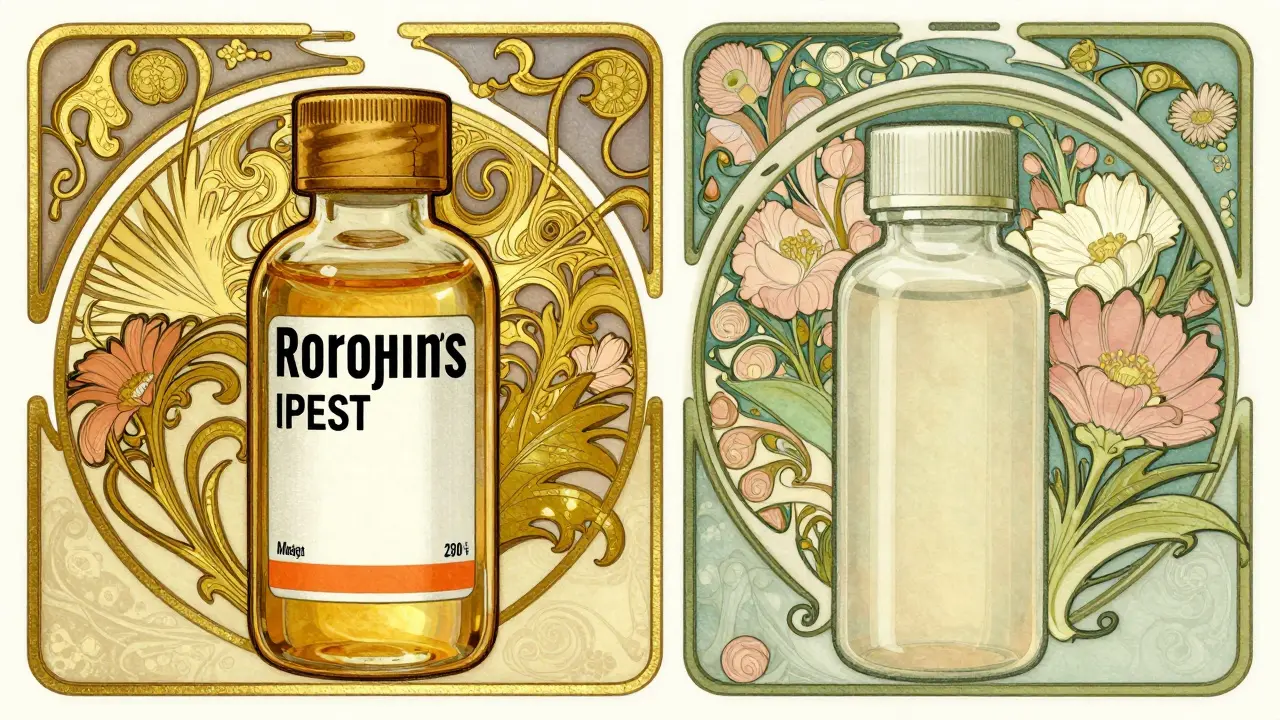
Imagine paying $350 a month for a life-saving medication, only to find out a nearly identical version exists for $25. For millions of people, this isn't a hypothetical scenario-it's the difference between staying healthy and rationing doses. In the U.S. healthcare system, healthcare drug spending is a massive financial burden, but the introduction of generic alternatives acts as the primary pressure valve, preventing costs from spiraling completely out of control.
To understand how this works, we first need to define what we're talking about. Generic Drugs is a category of medications created to be chemically identical to brand-name drugs after the original patent expires. They aren't "knock-offs"; they are regulated pharmaceutical products that must prove they work exactly the same way in the human body as the original. When a brand-name company develops a new drug, they get a patent to recoup their massive R&D costs-often billions of dollars. Once that patent expires, generic manufacturers can enter the market, sparking competition that crashes the price.
The impact of this competition is staggering. In 2024, generics made up 90% of all prescriptions filled in the U.S. (about 3.9 billion scripts), yet they only accounted for 12% of total spending. Compare that to brand-name drugs: they represent just 10% of prescriptions but eat up 88% of the budget. Without generics, the healthcare system would likely collapse under the weight of its own pharmacy bills.
The Legal Engine: The Hatch-Waxman Act
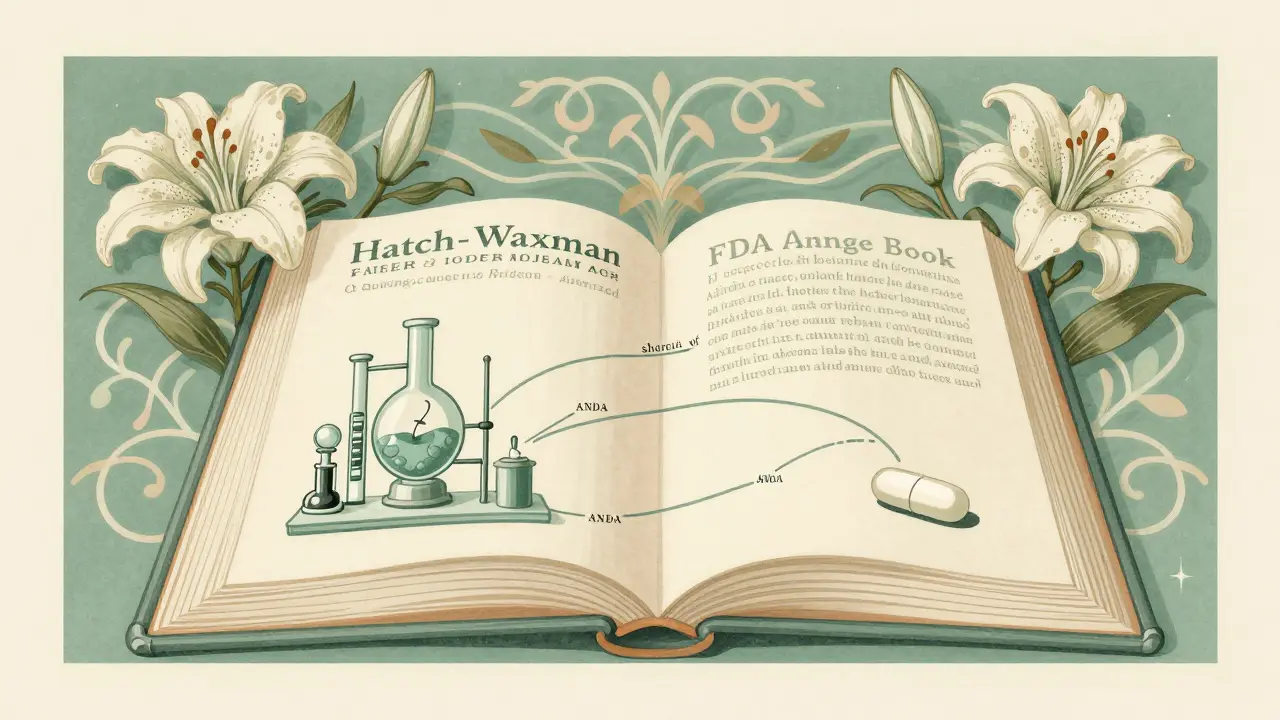
We didn't always have a streamlined way to get generics into the market. That changed with the Hatch-Waxman Act, which is the 1984 legislation that created a shortcut for generic drug approval called the Abbreviated New Drug Application (ANDA). Before this, generic makers had to run full-scale clinical trials, which was too expensive to justify. The Act allowed them to simply prove bioequivalence-meaning the drug gets into the bloodstream at the same rate and extent as the brand name.
This created a predictable cycle: Innovation (Brand) → Patent Expiry → Generic Competition → Price Drop. To keep this honest, the FDA maintains the Orange Book, which is the official FDA publication listing approved drug products and their therapeutic equivalence. When a pharmacist looks at the Orange Book and sees an "A" code, they know the generic is interchangeable with the brand without needing to call the doctor.
How Generics Actually Save Money
Why is the price difference so extreme? A brand-name drug can cost $2.6 billion to develop over 15 years. A generic, however, only needs to prove it matches the original. The cost of an ANDA application is roughly $1 million, and the approval process takes about a year. Because the R&D risk is gone, generic companies compete on price.
Generic drugs typically enter the market at 80-85% lower prices than the brand. If you have three or four different companies selling the same generic, the price drops even further. According to experts like Dr. Aaron Kesselheim from Harvard, every new generic entrant can shave another 11-15% off the price. This is far more effective than government negotiation. While the Inflation Reduction Act's Medicare negotiations are helpful, they only target a small number of drugs. Generic competition, on the other hand, works across the entire pharmaceutical landscape.
| Strategy | Typical Savings | Implementation Speed | Scope |
|---|---|---|---|
| Generic Substitution | 80-85% | Immediate (post-patent) | Broad (Small Molecules) |
| Step Therapy | 12-15% | Moderate | Insurance-led |
| Value-Based Pricing | 1-3% | Slow (Pilot based) | Limited |
| Medicare Negotiation | 38-79% | Long-term (Scheduled) | Selected high-cost drugs |
The Next Frontier: Biosimilars
Not every drug is a simple chemical. Some are "biologics"-massive, complex molecules grown in living cells. You can't just copy these; you have to make a "similar" version. This is where Biosimilars come in. A biosimilar is a biologic medication that is highly similar to an already approved reference biologic, with no clinically meaningful differences in safety or efficacy.
Biologics are the most expensive drugs on the market. Specialty drugs now account for 51% of all drug spending despite being only 5% of prescriptions. Biosimilars offer a 15-35% discount. While that's not as deep as the 85% cut we see with generics, the absolute dollar savings are huge because the starting price is so high. The problem? We're facing a "biosimilar void." About 90% of biologics losing patents in the next decade don't even have a biosimilar in development. This is a massive missed opportunity for cost control.
The "Cat and Mouse" Game: Why Some Drugs Stay Expensive
If generics are so great, why aren't all drugs cheap? Brand-name companies have developed some clever (and controversial) ways to keep generics out. One common tactic is the "patent thicket," where a company files over 100 patents on a single drug-covering everything from the pill's coating to the way it's manufactured-to extend their monopoly. Then there's "product hopping," where they tweak a formula slightly and move patients to a "new" version just before the old patent expires.
There are also "pay-for-delay" deals. This is when a brand company pays a generic manufacturer to stay out of the market for a few years. The Federal Trade Commission found that these deals cost consumers billions every year. This artificial delay keeps prices high for patients who could otherwise be switching to a cheaper alternative.
Real-World Trade-offs: Are Generics Always Better?
For 99% of people, generics are a no-brainer. But there are a few exceptions. Some medications have a "narrow therapeutic index," meaning a tiny change in the dose or how the body absorbs it can be dangerous. Drugs like warfarin or levothyroxine (for thyroid) sometimes cause issues when patients switch brands because different fillers (inactive ingredients) can change how the drug is absorbed.
Speaking of fillers, while the active ingredient is identical, the inactive ones aren't. Some people have allergic reactions to the dyes or binders used in a generic version. While this is rare-the FDA reports only a small fraction of adverse events are linked to substitutions-it's something doctors keep an eye on for sensitive patients.
Supply Chain Risks and the Future
Our reliance on generics has created a new problem: supply chain fragility. About 80% of active pharmaceutical ingredients (APIs) are made in India and China. When the pandemic hit, we saw hundreds of drug shortages. Because generics have such thin profit margins, companies don't keep huge stockpiles. If one factory in India shuts down, pharmacies across the U.S. run out of a critical medication.
Looking ahead, the goal is to move toward a system that rewards true innovation while ensuring rapid generic entry. We need to close the biosimilar void and stop patent-gaming. When competition works, everyone wins: patients afford their meds, and the government spends less on healthcare subsidies.
Are generic drugs as effective as brand-name drugs?
Yes. The FDA requires generics to be bioequivalent, meaning they have the same active ingredient, strength, and dosage form, and they deliver the same amount of drug to the bloodstream in the same amount of time. Clinical efficacy ratings for generics and brands are virtually identical.
Why are some generics more expensive than others?
Price depends on how many companies are competing. If only one company makes a generic, they can keep the price higher. If five companies compete, the price usually plummets. Additionally, "complex generics" (like inhalers) cost more to develop and therefore stay more expensive.
What is a biosimilar and how is it different from a generic?
A generic is a chemical copy of a small-molecule drug. A biosimilar is a "highly similar" version of a biologic (a complex protein). Because biologics are made in living cells, they can't be perfectly copied, so biosimilars are designed to be nearly identical in effect, though not identical in structure.
Can I ask my pharmacist to switch me to a generic?
In 48 U.S. states, pharmacists can substitute a generic if it's listed as therapeutically equivalent in the FDA Orange Book. However, for some narrow therapeutic index drugs, your doctor may need to provide explicit authorization first.
What are the risks of switching to a generic?
The risks are very low, but some patients may react to the inactive ingredients (fillers or dyes) used by a specific generic manufacturer. In rare cases, people with very sensitive hormone levels (like those on thyroid meds) may notice a difference in how they feel.


Ally Warren
April 26, 2026 AT 06:38It's interesting how the concept of a 'copy' is viewed as a devaluation in art but as a liberation in medicine. We are essentially treating health as a commodity where the only path to equity is the death of a patent.
Olayinka Ibukunoluwa Mercy
April 27, 2026 AT 08:16This is such a helpful guide!!! ❤️ It's so important for everyone to know their options so they can save money and stay healthy!!!! 🌟✨ Thanks for sharing this knowledge!!! 🙏
Rick Brewster
April 28, 2026 AT 04:53the sheer banality of these economic structures is simply breathtaking if one considers that the a-priori assumption of value is tied to the scarcity of the formula rather than the utility of the cure itself and frankly the way we navigate these bureaucratic labyrinths is just a reflection of our collective failure to prioritize human existence over the ledger of a corporate entity with too many lawyers and not enough ethics lol
RAJESH MARAVI
April 28, 2026 AT 11:57totaly fake info. generics are just cheap garbage made in basements. brand name is only way to go if u want real quality. this whole post is just propoganda for big generic companies trying to steal our money 🙄
Divyanshu Giri
April 29, 2026 AT 17:30Go for the generics guys! Save that cash and feel awesome! It is a total win win for everyone! Keep pushing for better health for all!
Dan Wizard
May 1, 2026 AT 06:03I find it quite fascinating that the Hatch-Waxman Act essentially streamlined the process by focusing on bioequivalence, though I wonder if this reliance on a specific regulatory shortcut might inadvertently leave us vulnerable to the supply chain issues mentioned, especially when we consider how interconnected the global pharmaceutical trade has become over the last few decades.
Saptatshi Biswas
May 2, 2026 AT 17:15The mention of India and China producing 80% of APIs is the only relevant part of this entire piece. It is absolutely scandalous that the West relies on foreign entities for basic survival medications while pretending their own systems are superior! The arrogance of the US healthcare model is out of control!
Sarah Watters
May 3, 2026 AT 09:08Funny how the FDA 'guarantees' these are identical. I'll believe it when I see the secret documents showing which batches actually get the good ingredients and which ones are just fillers designed to keep us docile. Follow the money.
Chidi Prosper
May 3, 2026 AT 10:01Spot on. The patent thickets are a total joke and need to be dismantled immediately. We can't let a few lawyers decide who gets to live based on a technicality in a filing.
Dave Edwards
May 4, 2026 AT 03:31Oh please, acting like 'innovation' costs billions is such a convenient lie for big pharma. They just spend that money on marketing and stock buybacks while the rest of us suffer. Absolute disgrace! 🙄💅
Odicha ude Somtochukwu
May 5, 2026 AT 17:01The emphasis on biosimilars is quite pertinent, as the 'biosimilar void' represents a significant challenge to global health equity... It is imperative that we foster a more collaborative environment to ensure these life-saving treatments reach the masses without delay!!!
Mel Glick
May 6, 2026 AT 21:58Seriously, why is the biosimilar void even a thing in 2024? It's completely unacceptable that we're just sitting around while patents expire and no one is developing the alternatives. Get it together!