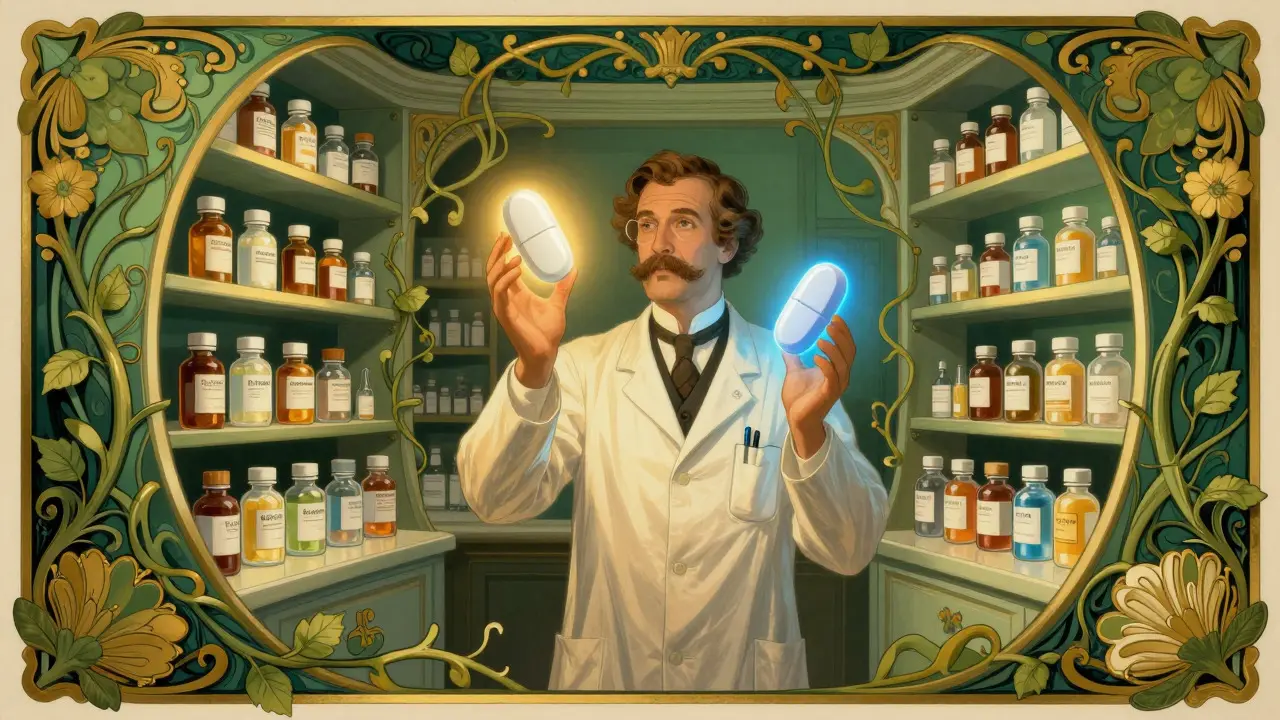
Walk into any pharmacy in the U.S., and you’ll likely see a rack of pills that look almost identical to their expensive brand-name counterparts. One might cost $100, while the other is under $5. If they’re so cheap, are they actually working? The short answer is yes, but only because of a strict, science-backed system designed by the U.S. Food and Drug Administration (FDA), which ensures every approved generic matches its original version in safety, strength, and effectiveness.
The confusion often stems from a simple assumption: if it’s cheaper, something must be missing. But for the vast majority of prescriptions, the difference isn’t in the medicine itself-it’s in the packaging, the marketing budget, and the patent status. To understand how these drugs earn their spot on the shelf, we need to look at the specific regulatory machinery that keeps quality high while keeping prices low.
The Legal Foundation: The Hatch-Waxman Act
You can’t talk about generics without mentioning the law that created them. Before 1984, getting a copycat drug approved was a nightmare. You had to prove your new pill was safe and effective from scratch, just like the original inventor did. That meant years of clinical trials and millions in costs.
Then came the Drug Price Competition and Patent Term Restoration Act of 1984, commonly known as the Hatch-Waxman Act. This legislation changed the game. It created a new pathway called the Abbreviated New Drug Application, or ANDA. Instead of repeating all the animal and human studies already done for the brand-name drug, manufacturers could rely on the FDA’s existing data. They just had to prove their version behaved the same way in the body. This shift is why generics exist today and why they make up roughly 90% of all prescriptions filled in America.
Proving Bioequivalence: The Core Test
So, what does "behaving the same way" actually mean? In pharmacology, this is called bioequivalence. It’s not enough for the tablet to look the same; the active ingredient has to hit your bloodstream at the right speed and in the right amount.
The FDA uses specific metrics to measure this. When a patient takes a pill, the drug dissolves and enters the blood. Scientists track two key values:
- AUC (Area Under the Curve): This measures the total exposure to the drug over time. Think of it as the total dose your body actually absorbs.
- Cmax (Maximum Concentration): This is the peak level of the drug in your blood.
For a generic to pass, its AUC and Cmax must fall within a specific range compared to the brand-name drug. Generally, the 90% confidence interval of the ratio between the generic and the brand must stay between 80% and 125%. If a generic absorbs too slowly or too fast, it fails. This isn’t a guesswork process; it’s based on rigorous statistical analysis from clinical studies involving healthy volunteers.
What Actually Changes in a Generic Pill?
If the active ingredient has to be identical, what’s different? The answer lies in the inactive ingredients, also known as excipients. These are the fillers, binders, colors, and coatings that hold the tablet together or mask a bad taste.
Brand-name companies often use proprietary blends of these excipients to create a unique look or feel. Generic manufacturers can swap these out for cheaper or more readily available alternatives. For example, one brand might use titanium dioxide for white color, while a generic uses calcium carbonate. As long as the new excipient is safe and doesn’t interfere with the drug’s absorption, the FDA allows the switch.
This is where most patient complaints come from. Some people claim they "feel different" on a generic. While psychological factors play a role, there are rare cases where an inactive ingredient causes a minor reaction, like a slight stomach upset or a change in how the tablet dissolves. However, the FDA maintains a database of over 500 approved excipients with strict concentration limits to ensure these changes don’t affect the drug’s core performance.

The ANDA Approval Process: Step-by-Step
Getting a generic approved isn’t instant. It’s a multi-stage review that typically takes 10 months from submission to decision, thanks to the Generic Drug User Fee Amendments (GDUFA). Here’s how the process unfolds:
- Filing Review: The FDA checks if the application is complete. About 35% of initial submissions get rejected here for missing documents or major errors.
- Substantive Review: Scientists dive deep into the chemistry, manufacturing, and bioequivalence data. They verify that the production facility follows Current Good Manufacturing Practices (cGMP).
- Facility Inspection: In many cases, FDA inspectors visit the factory to see the production line in action. They check equipment calibration, cleanliness, and record-keeping.
- Labeling Check: The instructions on the box must match the brand-name drug exactly, including warnings and dosage info.
- Approval Decision: If everything checks out, the drug gets approved. If not, the manufacturer receives a Complete Response Letter (CRL) detailing what needs fixing.
In fiscal year 2022, the FDA approved 777 ANDAs, including 107 first-time generics-drugs that had no generic version before. This steady flow ensures that as patents expire, affordable options quickly enter the market.
Narrow Therapeutic Index Drugs: The Exception to the Rule
Not all drugs have the same margin for error. Most medications have a wide safety window; taking a bit more or less won’t hurt you. But some drugs, known as Narrow Therapeutic Index (NTI) drugs, are different. Examples include warfarin (a blood thinner) and levothyroxine (for thyroid issues).
For NTI drugs, a small change in blood concentration can lead to serious side effects or treatment failure. Because of this, the FDA applies stricter rules. Instead of the standard 80-125% range, NTI generics often require tighter acceptance criteria, such as 90-111%. The FDA publishes a specific list of these drugs, requiring additional testing to ensure absolute consistency. This extra layer of scrutiny addresses the concerns of doctors who worry about switching patients between brands and generics for sensitive conditions.
Real-World Impact: Safety and Cost Savings
Does this rigorous process actually work? The data says yes. According to the Association for Accessible Medicines, generics save the U.S. healthcare system approximately $313 billion annually. That’s money that goes back into treating other patients or reducing insurance premiums.
Safety records are equally strong. The FDA’s Adverse Event Reporting System (FAERS) tracks side effects reported by doctors and patients. In 2022, the rate of adverse events per million prescriptions was 1.7 for generics and 1.6 for brand-name drugs. Statistically, that’s virtually identical. Large-scale analyses, including a 2023 study examining 15 million patient records, found no significant difference in clinical outcomes for common medications like atorvastatin and metformin. In fact, adherence rates were slightly higher for generics, likely because patients could afford to keep taking them consistently.
| Feature | Brand-Name Drug | Generic Drug |
|---|---|---|
| Active Ingredient | New molecule developed by innovator | Identical to brand-name |
| Strength & Dosage Form | Original formulation | Must match brand exactly |
| Inactive Ingredients | Proprietary mix | Can vary if safe and non-interfering |
| Clinical Trials | Full Phase I-III safety/efficacy studies | Bioequivalence studies only |
| Approval Pathway | New Drug Application (NDA) | Abbreviated New Drug Application (ANDA) |
| Average Cost to Patient | High (patent protected) | Low (competitive market) |
Why Do Doctors Still Have Questions?
Despite the scientific consensus, some hesitation remains. A 2020 analysis in JAMA Internal Medicine found that 11% of physicians still had concerns about substituting generics for NTI drugs. This isn’t necessarily a lack of trust in the FDA, but rather a cautionary approach to complex medical situations.
There are also challenges with "complex" generics, like inhalers or injectable emulsions. These products are harder to replicate because their delivery mechanism matters as much as the drug itself. The FDA has recognized this difficulty and issued specific guidance for these products, but they remain a smaller fraction of the market. For the vast majority of oral tablets and capsules, the science is solid.
The Future of Generic Regulation
The landscape is evolving. With the passage of GDUFA III, the FDA aims to reduce review times to 8 months for standard applications. There’s also a growing focus on biosimilars, which are generic versions of biologic drugs (like those used for cancer or autoimmune diseases). Unlike small-molecule drugs, biologics are large, complex proteins, making them harder to copy. The FDA is developing new pathways to approve these, aiming to bring down the cost of advanced therapies.
As patent cliffs loom for billions of dollars in branded drug revenue between 2024 and 2028, the demand for generics will surge. The system built over the last four decades is being stress-tested, but the core principle remains unchanged: if it works the same, it should cost less. The FDA’s job is to ensure that promise holds true, one pill at a time.
Are generic drugs really the same as brand-name drugs?
Yes, for the active ingredient. FDA-approved generics must contain the same active ingredient, strength, dosage form, and route of administration as the brand-name drug. They may differ in inactive ingredients like colors or fillers, but these do not affect the drug's therapeutic effect.
What is bioequivalence?
Bioequivalence is a scientific test that proves a generic drug releases its active ingredient into the bloodstream at the same rate and extent as the brand-name drug. It is measured using parameters like AUC (total exposure) and Cmax (peak concentration), which must fall within a specific statistical range (usually 80-125%).
Why are generic drugs cheaper?
Generics are cheaper because manufacturers don't have to repeat the costly research and development phases required for brand-name drugs. They also face intense competition from multiple producers, which drives prices down once the original patent expires.
Do I need a doctor's permission to switch to a generic?
Usually, no. Pharmacists in the U.S. are legally allowed to substitute a generic for a brand-name drug if it is listed as therapeutically equivalent. However, for Narrow Therapeutic Index drugs or if you have specific sensitivities, you can ask your doctor or pharmacist to specify the brand name on your prescription.
How long does it take for a generic drug to be approved?
The FDA targets a 10-month review cycle for standard Abbreviated New Drug Applications (ANDAs). However, this timeline can vary depending on the complexity of the drug and whether additional questions or inspections are needed during the review process.