

Have you ever switched pharmacies only to find your new pharmacist staring at a blank screen, unable to pull up your history? It’s frustrating, but it’s also dangerous. Prescription transfers aren’t just administrative chores; they are critical safety checkpoints. A single error in transferring data or printing a label can lead to a ten-fold dosing mistake, potentially costing lives. With the Drug Enforcement Administration (DEA) updating rules in August 2023 to allow electronic transfers of controlled substances, the landscape has changed. But the core responsibility remains: ensuring that what leaves one pharmacy arrives exactly as intended at the next.
This guide cuts through the regulatory jargon to show you how to handle prescription transfers safely, whether you are a patient initiating the move or a pharmacist executing it. We will look at the specific rules for controlled vs. non-controlled drugs, the technical standards that keep data intact, and the labeling details that prevent catastrophic errors.
The New Rules for Controlled Substances
For decades, transferring Schedule II controlled substances-like oxycodone or fentanyl-was nearly impossible once filled. The old rule prohibited any transfer. That changed with the DEA’s final rule effective August 28, 2023. Now, these prescriptions can be transferred electronically, but with strict limits.
Here is the catch: a Schedule II prescription can only be transferred once. If you try to move it again, the system should block it. This is different from Schedules III-V (like codeine or certain anabolic steroids), which can be transferred up to the number of refills authorized by the prescriber. Non-controlled substances usually face even fewer restrictions, often allowing multiple transfers depending on state laws.
Why does this matter? Because patients often assume their meds will follow them seamlessly. They don’t. You must initiate every transfer. Do not assume the new pharmacy can "just get it." For Schedule II drugs, you need to confirm the receiving pharmacy has the capability and inventory before requesting the transfer. In California, after similar modernization efforts began, 23% of initial transfer attempts failed simply because patients didn’t verify if the new pharmacy could actually fill the script beforehand.
Electronic Integrity: Why Fax Is Dead
If you are still using fax machines for prescription transfers, you are risking compliance and accuracy. The DEA’s 2023 rule mandates that transfers between retail pharmacies must remain in electronic format. Converting an electronic prescription to a facsimile (fax) or other form during the transfer is prohibited. This preserves the original data structure.
The industry standard for this is the NCPDP SCRIPT standard (specifically version 2017071 and newer). These systems are robust. A 2022 study by the University of Florida found that electronic transfers using these standards maintained 98.7% data integrity. Compare that to fax transfers, which hit only 82.3% accuracy, and telephone transfers, which dropped to a worrying 76.1%.
When data gets truncated or altered during a manual re-entry process, the prescription becomes invalid. The electronic record must include:
- The notation that a transfer action occurred.
- The identification of the transferring pharmacist.
- Dates of the original and transferred prescriptions.
- The first dispensing date.
- Complete refill records and remaining refills.
If any of this data is missing or altered, the transfer fails. For independent pharmacies, especially in rural areas, this creates a hurdle. Only 41% of rural pharmacies participate in electronic transfer networks, leading to a 15% higher prescription abandonment rate in those regions. If you live in a rural area, call ahead. Ask if they use an NCPDP-compliant system.
Label Accuracy: The Zero-Tolerance Zone
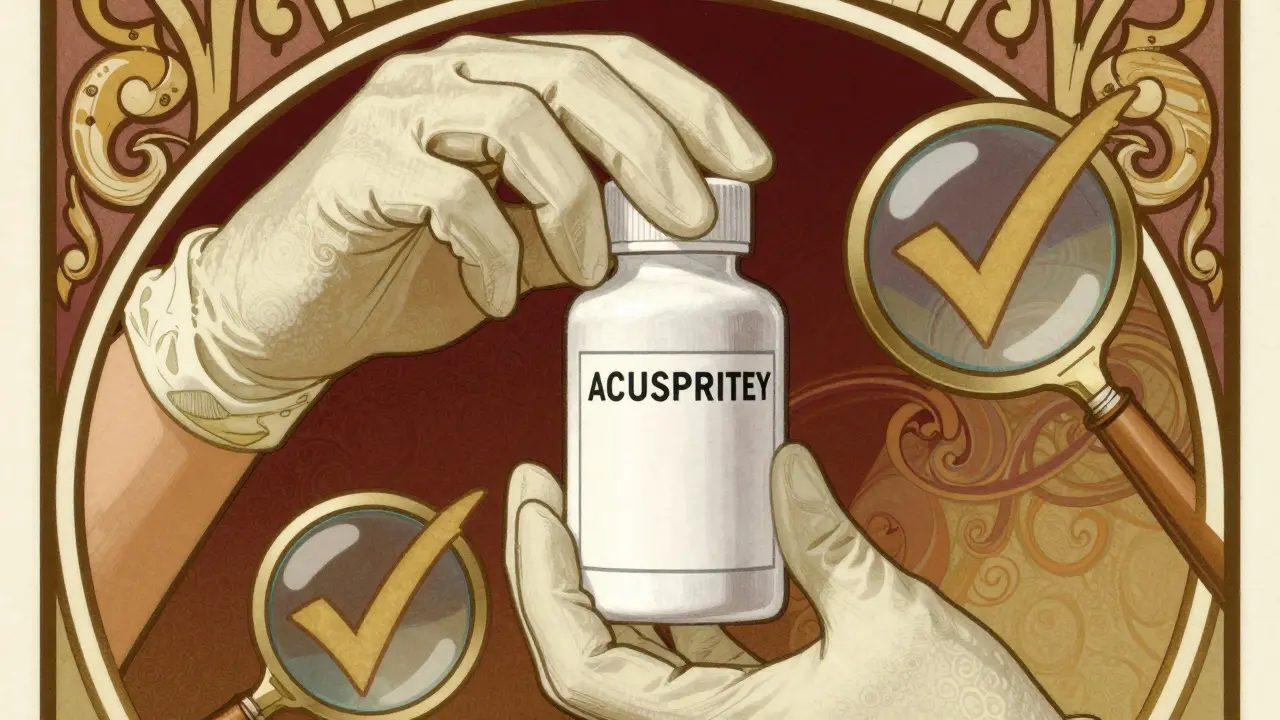
Once the data arrives, it needs to be printed on a label. This is where human error creeps in, despite digital safeguards. The FDA estimates that standardized labeling could prevent 1.5 million adverse drug events annually. To achieve this, pharmacists must adhere to strict formatting rules outlined in 21 CFR § 201.100 and 21 CFR § 1306.13.
The most critical rule involves zeros. Trailing zeros and leading zeros are major sources of confusion.
| Error Type | Incorrect Example | Correct Example | Risk Level |
|---|---|---|---|
| Trailing Zero | 1.0 mg | 1 mg | High (Ten-fold error risk) |
| Missing Leading Zero | .4 mg | 0.4 mg | High (Decimal misread) |
| Ambiguous Abbreviation | HCTZ | Hydrochlorothiazide | Medium (Drug mix-up) |
| Non-Metric Unit | grain 1 | 60 mg | High (Conversion error) |
Notice the trailing zero example. Writing "1.0 mg" instead of "1 mg" led to 327 documented medication errors between 2018 and 2022, according to FDA guidance. The decimal point can be missed, turning a 1 mg dose into a 10 mg dose. Similarly, writing ".4 mg" without the leading zero can cause a reader to see "4 mg." Always spell out units. Never use abbreviations like "MOM" for magnesium oxide mixture or "HCTZ" for hydrochlorothiazide. The National Coordinating Council for Medication Error Reporting and Prevention (NCCMERP) analyzed 2,300 error reports in 2022 and found that unclear abbreviations were a primary culprit.
Additionally, all strengths must be expressed in metric amounts (milligrams, grams), except for standard units like insulin. Mixing apothecary and metric systems accounted for 12% of dosage errors in ASHP’s 2021 hospital database. Stick to the metric system. It is universal and precise.
Patient Responsibilities in the Transfer Process
You play a bigger role than you think. The DEA places the burden of initiation on the patient. Here is how to do it right:
- Verify Capability: Before asking your current pharmacy to transfer, call the new one. Confirm they accept your insurance and have the medication in stock. For Schedule II drugs, this is non-negotiable.
- Provide Details: Have your prescription number and the name of the sending pharmacy ready. The receiving pharmacist needs to know who to contact if the electronic transfer hangs up mid-stream.
- Check the Label: When you pick up the transferred medication, read the label immediately. Does the name match? Is the dose correct? Are the directions clear? Dr. Michael Cohen of the Institute for Safe Medication Practices (ISMP) noted that standardized, patient-friendly labeling could prevent 30% of the 500,000 annual medication errors related to label misinterpretation.
If the label looks wrong, speak up. Pharmacists recommend double verification-checking the drug, label, packaging, quantity, dose, and instructions yourself before leaving the counter.

System Interoperability and Future Standards
Even with good intentions, technology sometimes fails. A 2022 survey by the National Community Pharmacists Association found that 18% of pharmacies experienced data truncation due to incompatible management systems. This is a growing pain as the industry moves toward greater interoperability.
Looking ahead, the FDA’s Patient Medication Information (PMI) rule, fully implemented by 2025, is changing the game. It requires paper labels as the default option, with electronic delivery available only upon request. More importantly, it mandates automated verification technology that scans labels for accuracy before they reach patients. Early adopters in California pilot programs spent between $12,500 and $18,750 per location to upgrade their systems. While costly, these upgrades include barcode scanning and text layout verification, which significantly reduce human error.
Furthermore, partnerships between major EHR providers like Epic Systems and Cerner with pharmacy chains are enabling real-time transfer authorization. ASHP forecasts this will reduce transfer errors by 75% by 2024. As multi-substance prescriptions increase-predicted to rise by 40% by 2030-these integrated systems will become essential for managing complex medication regimens safely.
Troubleshooting Common Transfer Issues
What happens when things go wrong? Here are common scenarios and how to resolve them:
- Transfer Failed Mid-Stream: If the electronic connection drops, the prescription is not valid. The patient must contact the original pharmacy to restart the process. Do not attempt to fax the partial data.
- Inventory Mismatch: The new pharmacy says they can’t fill it because they don’t carry that brand. Ask for a therapeutic alternative, but note that for controlled substances, the prescriber may need to authorize a switch. Never assume generic substitution is automatic for all scripts.
- Refill Count Discrepancy: If the label shows fewer refills than expected, check the transfer record. Sometimes, a previous partial fill isn’t recorded correctly in the sending system. Verify with the original pharmacy.
Remember, consistency is key. Frequent switching of pharmacies fragments your medical history. Try to stick with one provider unless necessary. If you must switch, ensure the transfer is complete and verified before discarding your old medication bottles.
Can I transfer a Schedule II prescription more than once?
No. Under the DEA’s 2023 rule, a Schedule II controlled substance prescription can only be transferred electronically once between retail pharmacies. After that single transfer, no further transfers are permitted.
Is it legal to fax a prescription for transfer?
For transfers between retail pharmacies, the DEA prohibits converting electronic prescriptions to facsimile (fax) format. Transfers must remain electronic to preserve data integrity. Faxing is generally only permissible for initial issuance in specific circumstances or for Schedule III-V substances under limited state-specific exceptions, but electronic is the mandated standard for transfers.
Why are trailing zeros banned on prescription labels?
Trailing zeros (e.g., 1.0 mg) can be misread as decimals, leading to ten-fold dosing errors. For example, 1.0 mg might be seen as 10 mg. The FDA and NCCMERP mandate removing trailing zeros for whole numbers to prevent these life-threatening mistakes.
Who initiates a prescription transfer?
The patient must initiate the transfer. Pharmacists cannot transfer a prescription without explicit patient authorization. This ensures the patient is aware of the change and can verify the receiving pharmacy’s capabilities.
What information must be on a transferred prescription label?
A compliant label must include the patient name, drug name, strength in metric amounts, dosage form, quantity, directions for use, prescriber name, prescription number, date of issue, number of refills, and pharmacy contact information. It must also indicate that it was a transfer.