
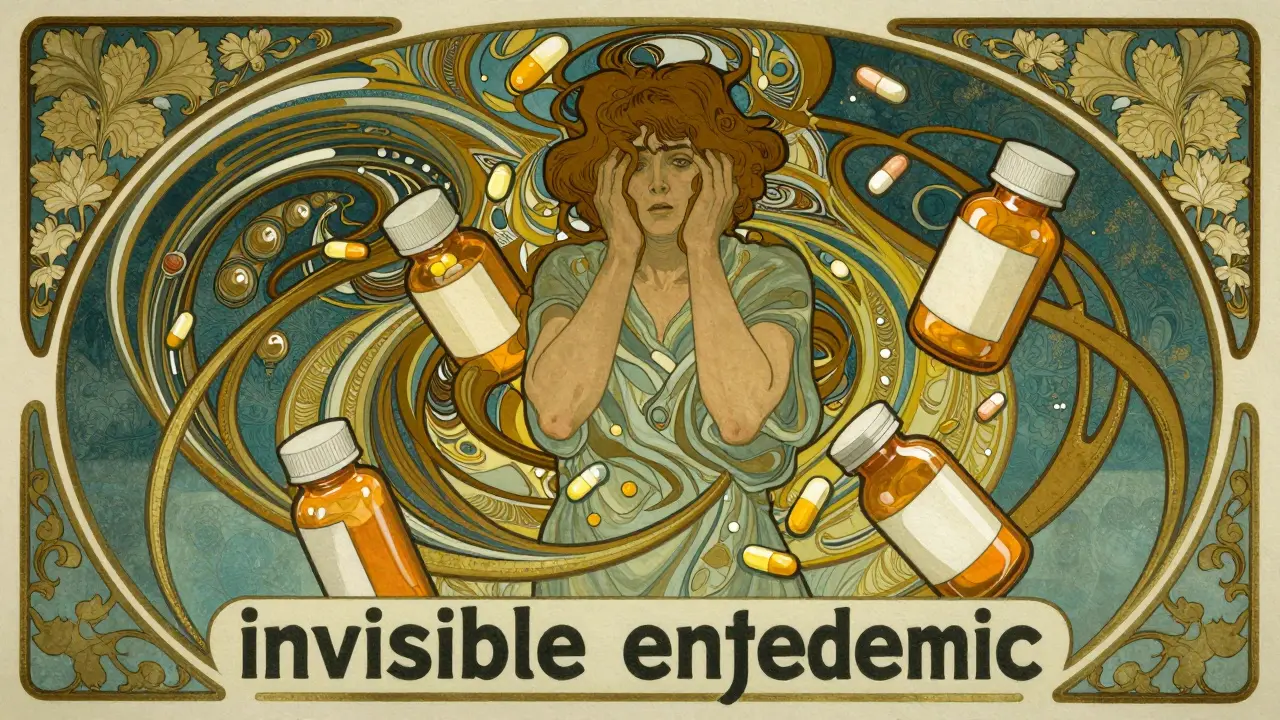
Imagine a scenario where a patient is prescribed a life-altering medication for schizophrenia, but they only take it half the time. This isn't a rare occurrence; it's a systemic crisis. In the world of psychiatry, medication adherence is the extent to which a patient takes their medications as prescribed by their healthcare provider . When this breaks down, the results are devastating. We are talking about an "invisible epidemic" that contributes to roughly 125,000 deaths annually in the US alone and accounts for up to 25% of all psychiatric hospitalizations. If you or a loved one struggle to keep up with a pill schedule, you aren't alone-global non-adherence rates in mental health range from 40% to 60%.
Why Staying on Track is So Difficult
It is easy to blame a patient for "forgetting" their meds, but the reality is far more complex. For someone dealing with severe depression, the very nature of the illness-feelings of worthlessness or a lack of energy-makes the simple act of opening a bottle feel like climbing a mountain. In elderly populations, depression can drop the likelihood of adherence by about 40%.
Then there are the structural barriers. For people experiencing homelessness, adherence rates plummet to between 26% and 41%. When you don't have a stable place to store your medication or a reliable way to get to a pharmacy, the clinical guidelines matter much less than survival. Even for those with stable housing, the complexity of the regimen plays a huge role. A survey by the National Alliance on Mental Illness a US-based grassroots organization dedicated to improving the lives of people affected by mental illness (NAMI) found that 87% of patients stuck to regimens that only required once-daily dosing, compared to just 52% for those with multiple daily doses.
The High Cost of Missing Doses
Non-adherence isn't just a medical failure; it's a financial drain. The economic burden is staggering, and improving adherence could potentially save between $100 and $300 billion annually in healthcare costs. This happens because missed doses lead to relapses, which lead to emergency room visits and long-term hospital stays.
To measure this, healthcare providers use a metric called the Proportion of Days Covered a pharmacy-based measure that calculates the number of days a patient's supply of medication would last (PDC). For a treatment to be considered "adequate," the World Health Organization (WHO) generally suggests an 80% adherence rate. However, for antipsychotic medications used in schizophrenia, the actual adherence rate is often closer to 50%. This gap is where most of the human suffering occurs.
| Population/Group | Adherence Rate | Threshold for Success |
|---|---|---|
| General Psychiatric Patients | 40% - 60% | 80% |
| Homeless Psychiatric Patients | 26% - 41% | 80% |
| Schizophrenia (Oral Meds) | ~50% | 80% |
| Schizophrenia (Injectables) | 87% | 80% |

What Actually Works: Evidence-Based Interventions
If the problem is this big, why aren't we fixing it? The answer lies in how we deliver care. Traditional "usual care"-where a doctor tells a patient to take a pill and checks in a month later-simply isn't enough. The most effective approach is collaborative care a healthcare model where primary care providers, specialists, and care managers work together to treat a patient , specifically when it involves a team-up between a psychiatrist and a pharmacist.
Recent data from 2025 shows that pharmacist-led interventions can increase adherence by up to 40% and save an average of $1,200 per patient annually. Why is the pharmacist so critical? They are the medication experts. They can spot drug interactions, suggest regimen simplifications, and provide patient-centered action plans. A study in Frontiers in Psychiatry found that the collaborative model showed a 142% greater improvement in adherence than standard care.
Another game-changer is the shift toward Long-Acting Injectables medications administered via injection that provide therapeutic levels of a drug over several weeks or months (LAIs). According to a 2023 JAMA Psychiatry study, injectables reached an 87% PDC, while oral versions languished at 56%. By removing the need for a daily pill, the "human error" element is virtually eliminated.
The Future of Adherence: AI and Digital Phenotyping
We are moving toward a world where we can predict a relapse before it happens. Digital phenotyping the use of passive data from smartphones and wearables to identify behavioral biomarkers of health is the new frontier. A 2025 study published in Nature Mental Health demonstrated that AI could predict adherence lapses 72 hours in advance with 82.4% accuracy just by analyzing passive smartphone data.
Imagine an app that notices a change in your sleep patterns, social interaction, or movement, and then alerts your care team to reach out. This proactive approach transforms treatment from reactive (fixing a crisis) to preventive (stopping the crisis from happening). Systems like Epic are already working to integrate these real-time analytics into electronic health records.

Practical Tips for Improving Your Own Adherence
Whether you are a patient or a caregiver, you don't have to wait for a high-tech AI system to improve things. There are concrete steps you can take today to bridge the gap:
- Simplify the Schedule: Ask your doctor if there is a once-daily version of your medication. As mentioned, simplified regimens have significantly higher success rates.
- Use a Medication Specialist: If your insurance allows, work with a pharmacist who specializes in psychiatric care. They can help manage side effects, which is a primary reason people stop taking their meds.
- Address the "Why": If you feel like the medication makes you "not yourself" or you don't believe the illness is real, talk about this specifically with your provider. Insight into the illness is a major predictor of success.
- Leverage Tech: While high-end phenotyping is new, simple pill organizers and alarm apps can provide the immediate structure needed for stability.
Why are adherence rates so much lower for mental health than for diabetes?
Mental health conditions often impair the very cognitive functions needed to maintain a regimen, such as memory, motivation, and insight. For example, someone in a severe depressive episode may lack the willpower to take a pill, whereas a diabetic patient can often see the immediate physical result of a blood sugar spike, providing a clearer incentive for adherence.
Are long-acting injectables better than pills?
From a purely statistical standpoint, yes. Data shows a jump from roughly 56% adherence with oral meds to 87% with injectables. However, the "best" option depends on the patient's preference, medical history, and access to a clinic for the injections.
What is the "80% threshold" mentioned by the WHO?
The World Health Organization suggests that for most chronic treatments, a patient needs to take their medication correctly at least 80% of the time to see the full therapeutic benefit. Falling below this threshold often leads to a return of symptoms or treatment resistance.
Can pharmacists actually help with psychiatric meds?
Absolutely. Pharmacist-led Medication Therapy Management (MTM) has been shown to increase adherence by up to 40%. They can simplify dosing, manage side effects, and act as a more accessible point of contact than a psychiatrist.
How does homelessness affect medication adherence?
Homelessness creates immense logistical barriers. Without secure storage, a way to keep meds cool (if required), or a steady way to reach a pharmacy, adherence rates drop significantly, often falling below 40% for psychiatric patients.
Next Steps for Better Outcomes
If you are a healthcare provider, the move toward value-based payment models means that adherence is no longer just a clinical goal-it's a financial one. Integrating adherence metrics into performance evaluations and adopting collaborative care models is the most effective path forward.
For patients, the first step is honesty. If you are missing doses, tell your doctor why. Is it the cost? The side effects? The feeling that it isn't working? Once the specific barrier is identified, whether it's a switch to a long-acting injectable or a simplified once-daily pill, the path to stability becomes much clearer.





Sue Stoller
April 22, 2026 AT 16:34Omg this is such a vital conversation!! 🌟 It's so important to remember that everyone's journey is different and we just need to keep supporting each other through the ups and downs! Keep fighting the good fight everyone! ✨💖
Ajinkya Joshi
April 22, 2026 AT 23:04Oh sure, because the absolute peak of medical innovation is just an app that spies on your sleep patterns to tell your doctor you're failing at life. Truly a utopian vision of healthcare.
Rick Brewster
April 23, 2026 AT 11:35the ontological reduction of a human psyche to a mere series of digital biomarkers is a fascinatng exercise in futility really because it assumes the essence of suffering can be quantified by a smartphone and we are just data points in a ledger of behavioral anomolies without any real regard for the soul
Emma Cozad
April 24, 2026 AT 17:25Typical US gov stats probly inflated to sell more lais and make us all drug zombies lol
Chidi Prosper
April 25, 2026 AT 09:09The point about pharmacist-led interventions is spot on. Integrating that specialized knowledge directly into the patient's routine is the only way to actually move the needle on these numbers.
Sarah Watters
April 25, 2026 AT 20:09Digital phenotyping is just a fancy word for government surveillance. They want to track your every move and then decide if you're "stable" enough to keep your rights. It's a slippery slope to a total control state.
RAJESH MARAVI
April 26, 2026 AT 00:51Who cares about the 80% thing?? Its all a scam by big pharma to keep us hooked on thier junk anyway these studies are probably fake news lol
Anantha Lakshmi
April 27, 2026 AT 20:35We need to push for more accessibility to these long-acting injectables in underserved communities! 🌈 It's a game changer for stability! 💪✨
Divyanshu Giri
April 28, 2026 AT 11:10Just smash those goals and keep your head high! A little pill box can be a big win for the day! Go get em!
Olayinka Ibukunoluwa Mercy
April 28, 2026 AT 12:20It is so crucial to have a support system that understands these struggles...!!! Please remember to be gentle with yourselves while navigating your treatment...!!! 🌸🙏✨
Caroline Duvoe
April 29, 2026 AT 02:06everyone knows lais are better just say that 🙄💅
Anastasios Kyriacou
April 30, 2026 AT 01:46probs just forgettin the pills lol
Dan Wizard
April 30, 2026 AT 20:51I find the correlation between homelessness and adherence to be a stark reminder of how the social determinants of health often outweigh the clinical efficacy of a drug, as it's nearly impossible to maintain a complex medical regimen when the basic human need for shelter is not being met.
Ally Warren
May 1, 2026 AT 07:47The paradox of mental health is that the cure often requires the very stability that the illness destroys. We are attempting to use a tool that requires a steady hand to fix the hand that is shaking.
Odicha ude Somtochukwu
May 2, 2026 AT 07:25This is a most profound analysis of the systemic challenges we face...!!! It is imperative that we maintain a spirit of compassion and collaboration across all healthcare sectors...!!!