

Most people think sunscreen is just for beach days. But if you’re not using it every day, you’re leaving your skin exposed to damage you can’t see - and it’s adding up. UV rays don’t wait for sunny weather. They cut through clouds, bounce off snow, and slip through windows. The truth? You’re getting hit with UVA radiation even when you’re sitting at your desk or driving to work. And that’s where sunscreen science becomes essential, not optional.
What SPF Really Means (And Why Higher Isn’t Always Better)
SPF stands for Sun Protection Factor. It measures how well a sunscreen blocks UVB rays - the ones that burn your skin and cause most skin cancers. An SPF 30 product doesn’t mean you can stay out three times longer than without protection. It means it takes 30 times longer for your skin to burn if applied correctly.
Here’s the math: SPF 15 blocks 93.3% of UVB rays. SPF 30 blocks 96.7%. SPF 50 blocks 98%. That’s it. Going from SPF 30 to SPF 50 gives you just 1.3% more protection. But here’s the catch: most people apply only a quarter to half the amount they should. When you underapply, SPF 30 drops to the equivalent of SPF 7.5. That’s why dermatologists recommend SPF 30+ - it gives you a buffer for sloppy application.
Higher SPFs like 70 or 100 don’t mean double the protection. They’re mostly marketing. The FDA even considered capping labels at SPF 60+ because people think SPF 100 is twice as good as SPF 50 - it’s not. And that false sense of security leads to longer sun exposure without reapplying.
UVA vs. UVB: The Silent vs. The Burn
Not all UV rays are the same. UVB is the short-wavelength ray that causes sunburn. It’s strongest between 10 a.m. and 4 p.m. and varies by season. But UVA? That’s the quiet destroyer. It makes up 95% of UV radiation reaching Earth. It doesn’t burn you - it ages you. UVA penetrates deep into the dermis, breaking down collagen and elastin. That’s why you get wrinkles, sagging, and sunspots even if you never get a red face.
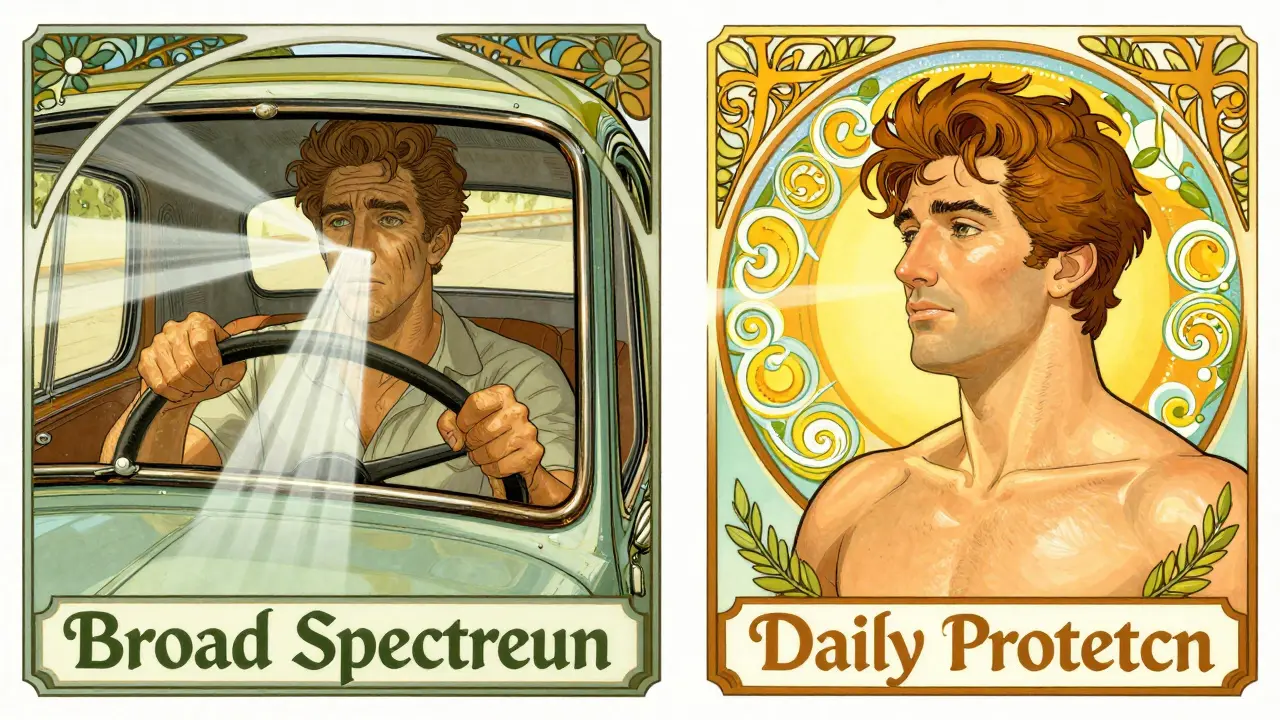
UVA rays are constant. They’re just as strong in winter, on cloudy days, and through windows. You can’t feel them. You can’t see them. But they’re changing your skin right now. That’s why broad-spectrum protection isn’t a bonus - it’s the baseline. A sunscreen labeled “broad spectrum” must pass FDA testing to prove it protects against UVA at least one-third as much as it does UVB. For SPF 50, that means UVA protection should be at least 16.7. The Skin Cancer Foundation updated its standards in 2023 to require even higher UVA protection for SPF 50+ products - now at least 20 UVA-PFdx.
Mineral vs. Chemical: Which One Actually Works?
There are two main types of sunscreen: mineral (physical) and chemical. Mineral sunscreens use zinc oxide and titanium dioxide. They sit on top of your skin and reflect UV rays like a shield. Chemical sunscreens use ingredients like avobenzone, octinoxate, and octocrylene. They absorb UV rays and turn them into harmless heat.
Mineral sunscreens are gentler. They’re less likely to irritate sensitive skin or cause breakouts. That’s why 78% of users with acne or rosacea report fewer reactions when switching to mineral formulas. But they often leave a white cast - especially on darker skin tones. That’s changed in recent years. Brands like CeraVe and La Roche-Posay now use micronized zinc oxide that blends better. Still, it takes practice to rub it in properly without streaking.
Chemical sunscreens tend to feel lighter and invisible. But they can sting your eyes, cause allergic reactions, or clog pores. Oxybenzone, a common chemical filter, is linked to hormone disruption and coral reef damage. That’s why many eco-conscious brands now avoid it. If you have sensitive skin, acne-prone skin, or are pregnant, mineral is usually the safer bet. If you hate the white cast and don’t react to chemicals, a good chemical sunscreen works fine.
How to Apply Sunscreen So It Actually Works
Here’s the biggest reason sunscreen fails: people don’t use enough. Dermatologists say you need 2 milligrams of sunscreen per square centimeter of skin. That’s about a quarter teaspoon for your face and neck. Most people use half that - or less. And that cuts protection in half. If you think SPF 30 is enough, you’re only getting SPF 15.
Reapply every two hours. If you’re sweating, swimming, or wiping your face, reapply immediately. No sunscreen is truly waterproof. “Water resistant” means it holds up for 40 or 80 minutes in water - then it’s done. And don’t forget your ears, neck, hands, and lips. Lip balms with SPF 30+ are a must.
Apply sunscreen as the last step in your morning routine - after moisturizer, before makeup. Let it sit for 15 minutes before adding anything else. If your sunscreen pills under foundation, it’s either not fully absorbed or the formula doesn’t mix well. Try switching to a gel or fluid texture. Many dermatologists recommend La Roche-Posay Anthelios or CeraVe Hydrating Mineral Sunscreen for this reason.
Daily Use Isn’t Optional - It’s Medical
The American Academy of Dermatology says daily sunscreen use reduces your risk of melanoma by 50%. It also cuts signs of photoaging by 24% over four years. That’s not hype - it’s science. UVA damage is cumulative. Every day you skip sunscreen, you’re adding to your lifetime risk.
Even in the UK, where the sun isn’t as strong, UVA levels remain high year-round. You don’t need to be tanning to get damage. Just walking to the bus, sitting by a window, or gardening for 20 minutes adds up. That’s why dermatologists in Bristol, London, and beyond now treat sunscreen like toothpaste - something you use every single day, rain or shine.
What to Look for on the Label (2025 Standards)
By December 2025, the FDA will require all sunscreens sold in the U.S. to clearly state “broad spectrum” on the front label. If it doesn’t say that, it’s not protecting you from UVA. Also check for:
- SPF 30 or higher
- “Broad spectrum” - no exceptions
- Water resistance (40 or 80 minutes)
- Mineral filters: zinc oxide, titanium dioxide (if you prefer physical blockers)
- Chemical filters: avobenzone, ecamsule, octocrylene - avoid oxybenzone if you’re concerned about health or reefs
Look for the Skin Cancer Foundation’s Seal of Recommendation. It’s not just a logo - it means the product passed independent testing for both SPF and UVA protection. In 2023, they raised the bar: Daily Use sunscreens must now be SPF 30+ (up from SPF 15), and Active sunscreens must be SPF 50+ (up from SPF 30).
Top Picks Based on Real-World Use
Based on user reviews from Amazon, Reddit, and dermatologist recommendations:
- Best for sensitive skin: CeraVe Hydrating Mineral Sunscreen SPF 30 - no fragrance, no irritation, blends well on medium to deep skin tones.
- Best for daily wear: La Roche-Posay Anthelios SPF 50 - lightweight, invisible, no white cast, trusted by dermatologists.
- Best for acne-prone skin: Neutrogena Clear Face SPF 50 - oil-free, non-comedogenic, absorbs fast.
- Best mineral for dark skin: Suntribe Mineral Sunscreen SPF 30 - tinted formula, zero white cast, reef-safe.
Don’t get stuck on brand names. Find one you like the way it feels. If you hate it, you won’t use it. And that’s worse than using nothing.
What’s Coming Next?
The future of sunscreen isn’t just about UV. Dermatologists are already studying blue light from screens and infrared radiation from the sun. Early research suggests these may also contribute to skin aging. Some new formulas now include antioxidants like vitamin C and niacinamide to fight free radicals from all sources. Within five years, multi-spectrum protection could become standard.
For now, stick with the basics: broad spectrum SPF 30+, applied daily, reapplied every two hours. You don’t need expensive products. You don’t need to be perfect. Just be consistent. Your skin doesn’t care if you’re using a $50 bottle or a $12 one - it only cares that you showed up with protection.
Do I need sunscreen on cloudy days?
Yes. Up to 80% of UV rays penetrate cloud cover. UVA rays, which cause aging and skin cancer, are present year-round, even when the sun isn’t visible. Skipping sunscreen because it’s overcast is one of the biggest mistakes people make.
Can I rely on makeup with SPF instead of sunscreen?
No. Most makeup with SPF is applied too thinly to offer real protection. You’d need to use several layers - which isn’t practical. SPF in makeup is a bonus, not a replacement. Always apply a dedicated sunscreen underneath.
Is higher SPF better for darker skin tones?
Everyone benefits from SPF 30+, regardless of skin tone. Darker skin has more melanin, which offers some natural protection - but not enough. Skin cancer is often diagnosed later in people of color, leading to worse outcomes. UVA damage still causes hyperpigmentation, dark spots, and premature aging. SPF 30+ is essential for all skin tones.
Does sunscreen prevent vitamin D production?
Studies show sunscreen doesn’t significantly block vitamin D synthesis. Most people don’t apply enough to fully block UVB, and short daily exposure - like walking to your car - is enough. If you’re worried, get vitamin D from food or supplements. Don’t skip sunscreen to chase vitamin D.
How long does sunscreen last before expiring?
Most sunscreens are effective for three years from the date of manufacture. Check the expiration date on the bottle. If it’s past that, throw it out. Heat and sunlight can break down the active ingredients faster. If the texture, color, or smell changes, toss it - even if it’s not expired.





Jane Wei
December 16, 2025 AT 11:48Just started using CeraVe mineral sunscreen and holy crap, no more white cast. I thought I’d have to sacrifice comfort for protection, but this thing blends like magic. Now I actually remember to reapply. 🙌
Martin Spedding
December 16, 2025 AT 21:24spf 50 is a scam. i use spf 15 and never burn. also clouds dont block uv. duh. why are we paying for marketing?
Peter Ronai
December 18, 2025 AT 19:43Oh great, another article telling me I need to slather chemical goop on my face like some kind of toxic sacrament. Newsflash: melanin exists. You think your SPF 50 is doing more than a placebo? My grandmother never wore sunscreen and lived to 98. You’re selling fear, not science.
Brooks Beveridge
December 19, 2025 AT 21:25Hey Peter, I hear you - but let’s not throw out the baby with the bathwater. Your grandma’s skin might’ve looked different because she didn’t sit in front of screens all day or live under ozone-depleted skies. Sun damage isn’t just about burns - it’s the silent creep of aging and cancer risk. SPF isn’t about fear, it’s about stewardship. Start small: just your face, every morning. You might be surprised how your skin feels in a year.
Salome Perez
December 21, 2025 AT 11:44As someone who grew up in the Caribbean and now lives in Seattle, I’ve seen the spectrum. Sunscreen isn’t a luxury - it’s a cultural necessity. In my community, we’ve long known that hyperpigmentation isn’t just ‘a tan’ - it’s damage. The science here is undeniable. And honestly? The new tinted mineral formulas? They’re a game-changer for melanin-rich skin. No more ghostly masks. Just clear, protected skin. Thank you for writing this - it’s the kind of clarity we need.
Anna Giakoumakatou
December 21, 2025 AT 23:09Oh, so now we’re all supposed to become dermatological acolytes, bowing before the altar of SPF 30+? How quaint. I suppose next you’ll tell me to meditate while applying zinc oxide and chant mantras to the sun god. The real tragedy? People are paying $40 for a tube of sunscreen while their rent doubles. Priorities, darling.
Anu radha
December 23, 2025 AT 03:43My mother in India always said, ‘Sun is good, but not too much.’ I never used sunscreen till I moved to US. Now I use it every day. My face doesn’t get dark spots anymore. Simple. Works.
Sachin Bhorde
December 23, 2025 AT 23:15Bro, SPF 50 is overkill unless you're in the desert or doing alpine skiing. The real issue? UVA penetration through windows. Most people don't know that. Also, avobenzone degrades fast - if your sunscreen isn't photostable, it's useless. Look for Tinosorb or Mexoryl - those are the real MVPs. And yeah, zinc oxide > chemical filters if you're acne-prone. Just don't forget the damn reapplication.
Virginia Seitz
December 25, 2025 AT 01:07Just bought the Suntribe tinted one 😍 no white cast, smells like coconut, and my acne cleared up. 10/10 would slap this on my neck while crying over my spreadsheet. ☀️🧴
Erik J
December 26, 2025 AT 04:08I’ve been using La Roche-Posay Anthelios for 3 years. The texture is perfect. But I’m curious - does the SPF rating change if you layer it over moisturizer with SPF? Or does it just add up?
Steven Lavoie
December 27, 2025 AT 08:41Good question, Erik. Layering doesn’t stack SPF values - it’s not additive. If you use SPF 15 moisturizer and SPF 30 sunscreen, you’re still only getting around SPF 30, assuming you applied both properly. But if you underapply the moisturizer, your actual protection drops further. The key is consistency, not multiplication. Apply the thickest layer last, and make sure it’s broad spectrum.
Evelyn Vélez Mejía
December 27, 2025 AT 09:02Let us not confuse protection with perfection. Sunscreen is not a panacea, nor is it a moral obligation - it is, however, a statistically significant mitigant against cumulative cellular trauma. The skin is not merely an organ; it is the ledger of our environmental exposure. To neglect it is to ignore the very architecture of our biological narrative. The data does not lie - and neither should we.
Michael Whitaker
December 28, 2025 AT 03:42Actually, Evelyn, your poetic framing is charming - but let’s not romanticize the science. The truth is, most people don’t care about ‘cellular trauma.’ They care if their face looks tired or if their foundation pills. The real breakthrough isn’t SPF 50 - it’s making sunscreen feel like self-care, not a chore. That’s why tinted, scentless, non-greasy formulas are winning. People don’t change behavior for data. They change it for comfort.
Joe Bartlett
December 30, 2025 AT 03:38UK sun? Pfft. We get less UV than your average garden gnome. Why are we all panicking? Just wear a hat and stop buying overpriced lotion. We’ve survived for centuries without SPF 50.
Marie Mee
December 31, 2025 AT 05:18they’re lying about the sunscreen thing i read on a forum that the government puts something in it to make you docile and buy more stuff i think its in the water too