
Medication Side Effect Tracker
Report Your Symptoms
Track side effects from medications like blood thinners, antidepressants, or heart medications. This tool helps identify when you should contact your provider.
Reported Symptoms:
Next Steps
For people living in rural and remote areas, taking medication for chronic conditions like high blood pressure, depression, or blood thinners isn’t just about popping pills. It’s about watching for warning signs that could turn dangerous-without easy access to a doctor. Side effects don’t wait for office hours. They don’t care if the nearest clinic is 60 miles away. That’s where telehealth comes in-not as a luxury, but as a lifeline.
Why Rural Patients Are at Higher Risk
Rural patients face a perfect storm when it comes to medication safety. About 60 million Americans live in areas with limited healthcare access. Since 2010, over 120 rural hospitals have shut down. Those who stay often rely on primary care providers who are already stretched thin. A 2020 study in Health Affairs found rural patients experience 23% more preventable adverse drug events than urban ones. Why? Delayed care. Lack of specialists. Fewer pharmacies. And sometimes, just not knowing what to look for.Psychiatric meds are especially tricky. Up to 70% of patients on antidepressants or antipsychotics report side effects like dizziness, tremors, weight gain, or suicidal thoughts. But seeing a psychiatrist in a rural town? That’s often impossible. Telehealth fills that gap. In fact, nearly 80% of rural telehealth visits in 2019 were for mental health-showing just how critical remote monitoring has become.
How Telehealth Tracks Side Effects in Real Time
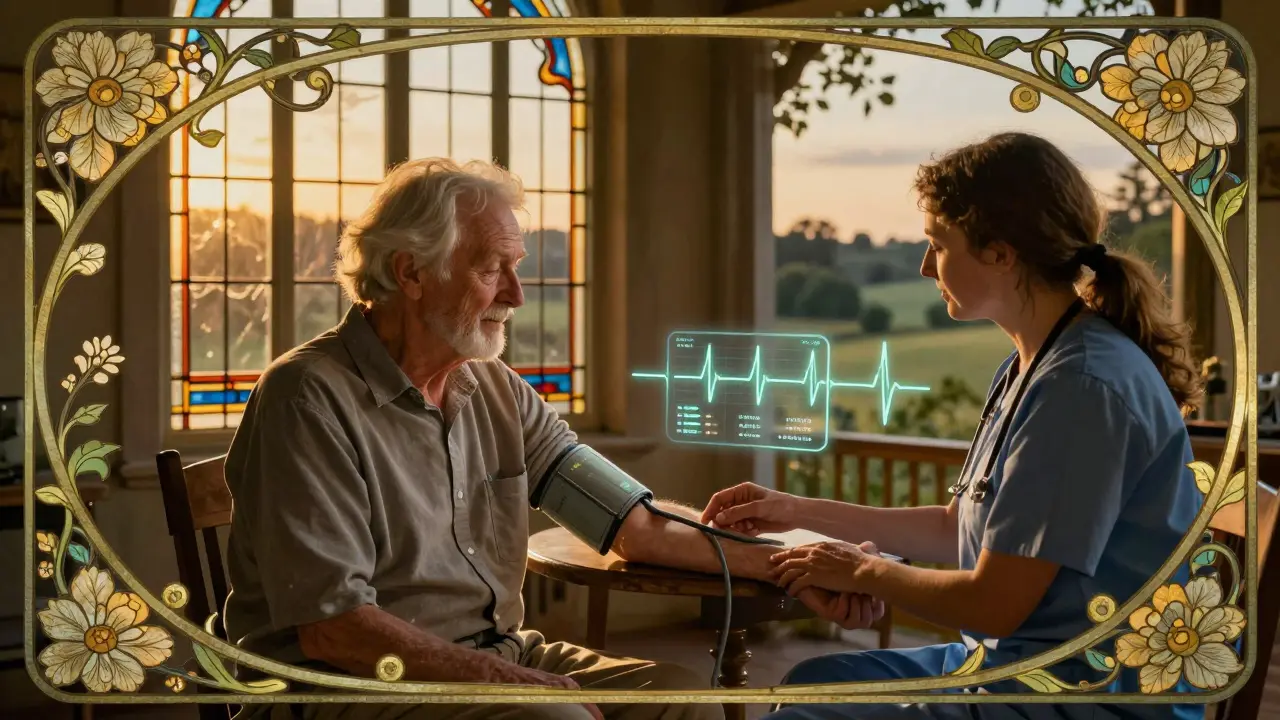
Modern telehealth isn’t just video calls. It’s a system. A combination of devices, apps, and trained staff working together to catch problems before they become emergencies.Remote patient monitoring (RPM) tools are at the core. Bluetooth-enabled blood pressure cuffs, smart scales that track weight gain (a red flag for heart failure meds), and wearable heart rate monitors send data directly to a provider’s dashboard. These devices are FDA-cleared and accurate within ±3% for blood pressure and ±2 beats per minute for heart rate. When an INR level (a blood clotting measure for patients on warfarin) spikes, the system flags it. A pharmacist gets an alert. Within hours, the patient gets a call-not days later, after they’ve collapsed.
Smart pill dispensers like Hero Health track when pills are taken. If a patient misses a dose, the system sends a reminder. If they miss two in a row, a nurse calls. Studies show these systems detect missed doses with 85% accuracy. That’s huge when you’re on a drug where skipping even one dose can lead to a stroke or seizure.
Patients also use simple apps to report symptoms: “I feel dizzy,” “My legs are swollen,” “I can’t sleep.” These entries are reviewed daily. One 2022 study found patient-reported symptoms matched in-person clinical assessments 78% of the time. That’s better than many rural clinics can manage with limited staff.
What You Need to Make It Work
It sounds simple, but not everyone can use it. Only 72% of rural Americans have broadband that meets the FCC’s minimum standard of 25 Mbps download, 3 Mbps upload. Many rely on 3G or slower connections. Video calls stutter. Apps crash. Patients give up.That’s why successful programs don’t just use video. They offer audio-only calls-now covered by Medicare since early 2024. For older patients or those with poor vision or dexterity, a simple phone call to report symptoms works. A 2023 survey found 58% of rural seniors prefer this method.
Device compatibility isn’t an issue-92% of smartphones today run iOS 14+ or Android 10+. But here’s the catch: 34% of rural seniors say they struggle to use smartphones. That’s why training matters. Patients need at least two sessions to learn how to use the tech. Older adults average 3.2 sessions. Nurse navigators spend nearly an hour with each patient during setup. It’s time-consuming, but it’s what turns a failed tech experiment into a life-saving tool.

What Telehealth Can’t Do
It’s not magic. Some side effects need hands-on checks. A rash that’s spreading. A swollen joint. A change in skin color. A tremor so subtle it’s only visible up close. About 22% of adverse reactions require physical exams that telehealth can’t replicate.And then there’s health literacy. Nearly 36% of rural adults struggle to understand medical instructions. If a patient doesn’t know what “tachycardia” means-or even that “fast heartbeat” is something to report-they won’t say anything. That’s why programs that succeed use plain language, visual guides, and multilingual support. Eighty-seven percent of top-performing programs offer materials in Spanish, Navajo, or other local languages.
Another blind spot: communication gaps. A patient might report “feeling weird,” but without clear prompts or structured forms, providers miss the signal. That’s why structured symptom checklists-like “Rate your nausea from 1 to 10,” “Did you fall today?”-are now standard in effective programs.
Who’s Doing It Right
The University of Mississippi Medical Center runs one of the most successful programs. Since 2019, they’ve monitored anticoagulation therapy for rural patients using Bluetooth INR monitors and weekly video calls with pharmacists. Patient retention? 92%. Hospitalizations for bleeding events? Down 40%.They didn’t just buy devices. They built a team: pharmacists, nurse navigators, tech support, and community health workers who visit patients in person to help set up the tech. They integrate everything into Epic or Cerner electronic health records so no data falls through the cracks.
Another model: pharmacist-led monitoring. The American Pharmacists Association found programs where pharmacists lead side effect checks hit 89% medication adherence-compared to just 62% in usual care. Pharmacists know drugs inside and out. They spot interactions. They adjust doses. They answer questions patients are too shy to ask their doctor.
The Hidden Costs and Challenges
Telehealth isn’t free-for providers or patients. Medicare pays $51 for every 20 minutes of remote monitoring. But only 63% of private insurers follow that rate. Many rural clinics can’t afford to run these programs without reimbursement.Staffing is another problem. Seventy-eight percent of rural clinics say they don’t have enough staff to manage telehealth monitoring properly. One nurse can’t monitor 200 patients alone. That’s why tiered response systems are key: critical symptoms (like chest pain or trouble breathing) get an immediate call-back. Moderate issues (like nausea or dizziness) get a 24-hour response. Mild ones (headache, fatigue) get a 72-hour follow-up.
There’s also a quiet threat: urban telehealth companies expanding into rural markets. They offer cheaper, scalable services-but they don’t pay local hospitals. A 2022 study found rural hospital revenue dropped 15% when patients started using out-of-town telehealth providers. That means fewer local clinics, fewer jobs, and eventually, less access for everyone.
The Future Is Here-But It’s Unequal
New tools are emerging. In 2023, the FDA approved AI systems like IBM Watson Health’s MedSafety, which predicts side effects before they happen-with 84% accuracy. Wearable sensors now detect subtle movement changes linked to antipsychotic side effects, catching problems earlier than patients can describe them.But progress isn’t evenly spread. Black rural patients are 1.8 times less likely to get telehealth monitoring than white patients. Older adults, low-income families, and non-English speakers still fall through the cracks. The FCC’s $20.4 billion Rural Digital Opportunity Fund aims to fix broadband gaps by 2025. But until then, tech won’t reach everyone.
Pharmaceutical companies are stepping in. Pfizer and Merck have invested $450 million since 2022 in telehealth adherence programs for rural populations. That’s not charity-it’s smart business. Fewer hospitalizations mean lower costs. Better outcomes mean better brand trust.
By 2025, 92% of rural health systems plan to expand telehealth monitoring. The demand is there. The tech is proven. The question is: who will be left behind if we don’t fix access, reimbursement, and equity?
What Patients Can Do Today
If you’re managing meds in a remote area:- Ask your provider if they use remote monitoring for your medication.
- Request a simple device-like a Bluetooth blood pressure cuff or smart pill dispenser-if you’re on a high-risk drug.
- Use audio-only calls if video is unreliable.
- Keep a written log of symptoms-even small ones-between visits.
- Don’t be afraid to ask for help setting up tech. Many clinics offer free in-person training.
Side effects don’t announce themselves with sirens. They whisper. And in rural areas, those whispers can turn into screams if no one’s listening. Telehealth gives patients a voice-and providers the tools to hear them.



Swapneel Mehta
December 22, 2025 AT 04:59This is one of those topics that doesn’t get enough attention. I’ve seen firsthand how rural patients fall through the cracks-my uncle in Bihar was on warfarin and had no way to monitor his INR until a mobile health unit started visiting monthly. Telehealth isn’t perfect, but it’s the closest thing to a safety net we’ve got out here.
Cameron Hoover
December 23, 2025 AT 10:16Let me tell you-I’ve been on antidepressants for six years. In rural Montana, the nearest psychiatrist was 140 miles away. I started using a Bluetooth BP cuff and a symptom tracker app. Within three months, my doctor caught a dangerous interaction I didn’t even know was possible. This isn’t sci-fi. It’s survival.
Stacey Smith
December 24, 2025 AT 10:01Stop pretending telehealth is some miracle cure. It’s just another way for big pharma and tech giants to profit off desperate people while gutting local clinics. If you want real solutions, fund rural hospitals-not apps.
Sandy Crux
December 25, 2025 AT 22:57While the article presents a superficially compelling narrative, it conspicuously omits the epistemological limitations of algorithmic health monitoring-particularly the ontological reductionism inherent in quantifying subjective symptoms like ‘feeling weird’ into ordinal scales. The reliance on FDA-cleared devices, while statistically reassuring, ignores the hermeneutic gap between biomedical data and lived experience. Moreover, the uncritical endorsement of corporate-backed telehealth models (e.g., Pfizer’s $450M investment) reveals a troubling neoliberal co-optation of public health necessity.
Hannah Taylor
December 27, 2025 AT 00:36theyre using this telehealth stuff to track you. i heard the feds are using the smart pill dispensers to log when you take your meds-then they use it to flag you as ‘high risk’ for gov programs. and the bluetooth cuffs? they send your vitals to a private company that sells it to insurance firms. you think this is helping? its surveillance with a smiley face.
Jason Silva
December 27, 2025 AT 08:52Bro, this is literally life or death. I’m not joking. My mom was on blood thinners, and her smart scale caught a 5-pound weight gain in 48 hours-she had fluid buildup from her heart med. They called her before she even felt dizzy. 🙏 If you’re not supporting this, you’re basically saying it’s okay for people to die because they live too far from a hospital. That’s not just ignorant-it’s cruel.
mukesh matav
December 28, 2025 AT 05:27I’ve worked in rural India for over a decade. We don’t have Bluetooth cuffs or AI. We have community health workers with clipboards and phone calls. Sometimes, that’s enough. The real issue isn’t tech-it’s respect. If you treat people like data points, no app will save them.
Peggy Adams
December 29, 2025 AT 16:07why are we spending money on fancy gadgets when half the people in these areas can’t even afford insulin? this feels like a rich person’s solution to a poor person’s problem.
Theo Newbold
December 31, 2025 AT 04:06Let’s break this down. 85% accuracy on missed doses? That’s still 15% of patients slipping through. 78% symptom match rate? That means over 1 in 5 cases are misclassified. And the 40% reduction in hospitalizations? That’s only meaningful if you assume the baseline was catastrophically bad-which it was. So yes, it’s better than nothing, but calling it ‘effective’ is a stretch. This isn’t innovation-it’s damage control.
Jay lawch
December 31, 2025 AT 12:52Look, the west thinks it can solve everything with tech, but this is colonial thinking wrapped in a Bluetooth cuff. In India, we’ve had Ayurvedic practitioners and village healers managing chronic conditions for centuries without a single app. The real crisis isn’t lack of monitoring-it’s the erasure of indigenous health knowledge by Silicon Valley’s one-size-fits-all algorithm. They don’t care about your culture, your language, your rhythm of life-they care about data points to monetize. This isn’t progress. It’s cultural imperialism disguised as healthcare.
Christina Weber
January 2, 2026 AT 11:44There are multiple grammatical errors in this article, including the improper use of ‘that’ versus ‘which,’ and the inconsistent capitalization of ‘INR’ after its initial definition. Furthermore, the claim that ‘87% of top-performing programs offer materials in Spanish, Navajo, or other local languages’ is statistically misleading without a citation for the definition of ‘top-performing.’ The entire piece reads like a marketing brochure masquerading as public health analysis.
Cara C
January 2, 2026 AT 21:34I appreciate how thoughtful this is. I work with rural seniors, and I’ve seen how hard it is to get them to use tech. But when you sit with them, show them how it works, and let them go at their own pace-it changes everything. One woman told me, ‘I didn’t think I could do it, but now I feel like I’m not alone.’ That’s the real win. Not the data. Not the devices. The connection.