

Prednisone Mood Swing Risk Calculator
This calculator estimates your risk of mood swings based on prednisone dosage and duration. Remember: mood changes can occur even at low doses and may persist after stopping the medication.
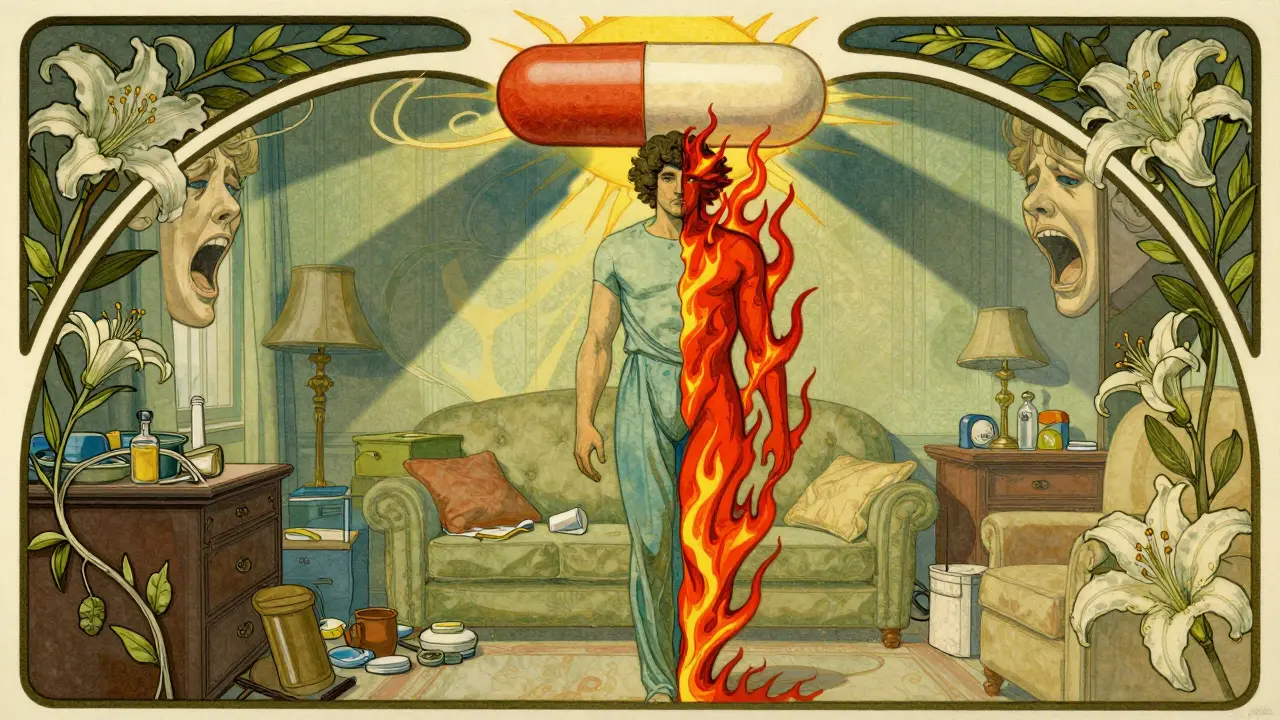
When you start taking prednisone, you might expect swelling, weight gain, or trouble sleeping. But few people warn you about the prednisone mood swings-the sudden anger, crying spells, anxiety, or feeling like you’re not yourself anymore. If you’ve been on this medication and felt like you’ve lost control of your emotions, you’re not alone. In fact, up to 47% of people taking prednisone experience some kind of mood disturbance, according to clinical studies. These aren’t just "bad days." They’re real, measurable changes in brain chemistry caused by how prednisone interacts with your nervous system.
Why Prednisone Changes Your Mood
Prednisone isn’t just an anti-inflammatory drug. It’s a synthetic version of cortisol, your body’s natural stress hormone. When you take it, your brain doesn’t know the difference. Cortisol floods your limbic system-the part of your brain that controls emotions, memory, and fear. This directly affects serotonin and dopamine, the chemicals that help you feel calm, focused, and happy.
Studies show that within 72 hours of starting prednisone, brain scans reveal increased activity in the amygdala (your emotional alarm system) and reduced activity in the prefrontal cortex (the part that helps you think clearly and control impulses). That’s why you might snap at your partner over something small, feel panicky for no reason, or suddenly feel unrealistically happy-even when everything’s going wrong.
The higher the dose, the worse it gets. At doses above 20mg daily, the risk of mood swings jumps 3.2 times compared to lower doses. And it doesn’t stop when you finish the pills. Some people report panic attacks or deep sadness starting 5 to 14 days after stopping prednisone, because the brain takes time to reset its chemical balance.
What Prednisone Mood Swings Really Look Like
People describe it in different ways:
- Feeling angry all the time, even toward people you love
- Crying for no reason, then laughing uncontrollably minutes later
- Being overly confident or reckless, like spending money you can’t afford
- Feeling hopeless, worthless, or having thoughts you’d never normally have
- Being unable to sleep even when exhausted
One woman on MyCrohnsAndColitisTeam said, "I’ve never been angrier in my life." Another on Reddit wrote, "I yelled at my kid and felt like a monster afterward-I didn’t recognize myself." These aren’t personality flaws. They’re side effects.
The American Psychiatric Association classifies this as a "substance-induced mood disorder." That means it’s caused by the drug, not an underlying mental illness-though if you already have depression, bipolar disorder, or anxiety, your risk goes up nearly five times.
When to Call Your Doctor
Not every mood swing needs emergency care. But some signs mean you need help right away:
- Thoughts of hurting yourself or others
- Severe confusion or hallucinations
- Manic behavior-like going days without sleep, talking nonstop, or making wild financial decisions
- Panic attacks that don’t go away
These aren’t "just stress." They’re medical emergencies. The FDA and NHS both say: tell your doctor immediately if you notice mental changes. Many doctors don’t bring this up during the initial consultation. A 2021 survey found only 32% of primary care providers routinely warn patients about mood side effects. Don’t wait for them to ask-speak up.
Practical Ways to Cope
You can’t always stop prednisone, but you can manage how it affects you. Here’s what actually works:
1. Stick to a Sleep Schedule
Prednisone messes with your circadian rhythm. Taking it in the morning helps, but if you’re still awake at 2 a.m., don’t just lie there. Get up, turn on a dim light, and do something quiet-read, stretch, or listen to calming music. Avoid screens. Poor sleep makes mood swings worse. Studies show people who maintain regular sleep patterns report 40% less emotional volatility.
2. Move Your Body-Even a Little
You don’t need to run a marathon. A 30-minute walk every day reduces cortisol levels by 27%, according to a 2022 study in the Journal of Psychiatric Research. Walking outside helps even more-sunlight boosts serotonin naturally. If you’re too tired, try gentle yoga or tai chi. Movement helps your brain rebalance.
3. Keep a Mood Journal
Write down how you feel each day: time of day, dose taken, what happened, how you reacted. You might notice a pattern-like being more irritable after lunch or after skipping a meal. This helps you predict rough patches and plan ahead. It also gives your doctor concrete data, not just "I feel bad."
4. Talk to Someone You Trust
Let your partner, parent, or close friend know what’s happening. Say: "I’m on prednisone, and it’s making me short-tempered. If I snap, it’s the medicine, not you." Most people don’t understand unless you explain it. One patient told her family, "I’m not mad at you-I’m mad at the pill." That changed everything.
5. Practice Mindfulness for 15 Minutes Twice a Day
Not meditation in the spiritual sense-just focused breathing. Sit quietly. Breathe in for four counts, hold for four, out for six. Repeat. Do this once in the morning and once before bed. A 2023 survey of Crohn’s and colitis patients found that 43% saw a drop in mood swings after doing this consistently. It doesn’t fix everything, but it gives you a pause button between impulse and reaction.
6. Avoid Alcohol and Caffeine
Both make mood swings worse. Alcohol lowers serotonin and disrupts sleep. Caffeine spikes anxiety and can trigger panic attacks. If you’re already feeling wired, a cup of coffee might push you over the edge.
When Medication Might Help
If lifestyle changes aren’t enough, talk to your doctor about options. Some patients benefit from low-dose SSRIs (like sertraline or escitalopram) taken alongside prednisone. A 2024 study showed this reduced mood swings by 58% in people on long-term steroid therapy. This isn’t officially approved for this use yet, but doctors are starting to prescribe it off-label when the risks of untreated mood swings outweigh the risks of the antidepressant.
Other options include short-term use of anti-anxiety meds or mood stabilizers-but only under close supervision. Never adjust your prednisone dose yourself. Stopping suddenly can cause adrenal crisis, which is life-threatening.

Support That Actually Helps
You’re not alone. Online communities like MyCrohnsAndColitisTeam and Reddit’s r/prednisone have thousands of people sharing what works. Many say the most helpful thing was finding others who said, "I felt the same way."
Consider asking your doctor for a referral to a therapist who understands medication-induced side effects. Cognitive behavioral therapy (CBT) teaches you how to recognize distorted thoughts and respond differently. It doesn’t change the drug-but it changes how you react to it.
Hospital-based support groups exist too, especially for people on long-term steroids for autoimmune diseases. Ask your rheumatologist, gastroenterologist, or nurse practitioner. They often know local resources.
What to Expect When You Stop
Even after you finish your last pill, the mood swings might stick around for days or weeks. Your brain is rewiring itself back to normal. Be patient. Don’t make big decisions during this time-like quitting your job or ending a relationship. Wait until you feel steady.
Some people report a "crash" after stopping: fatigue, sadness, loss of appetite. That’s your body adjusting to low cortisol levels again. Eat regular meals, keep moving, and sleep as much as you can. Most people return to baseline within two weeks.
Final Thoughts
Prednisone saves lives. It stops flare-ups, reduces pain, and keeps people out of the hospital. But it comes with a hidden cost: your emotional well-being. The fact that so few doctors warn patients about this is a gap in care-and you have the right to be prepared.
If you’re on prednisone and feeling off emotionally, it’s not weakness. It’s biology. You’re not broken. You’re reacting to a powerful drug. The goal isn’t to avoid prednisone-it’s to use it safely, with awareness and support. Track your moods. Talk to your team. Use the tools that help. And remember: this phase won’t last forever. You’ll get through it.
Can prednisone cause depression or suicidal thoughts?
Yes. While not everyone experiences this, prednisone can trigger severe depression, including suicidal ideation, especially at higher doses or in people with a history of mental health conditions. The FDA and NHS both list depression as a known side effect. If you have thoughts of harming yourself, contact your doctor immediately or call a crisis line. Don’t wait to see if it passes.
How long do prednisone mood swings last?
Mood swings usually start within 5-7 days of beginning treatment. They can last as long as you’re taking the medication and may continue for 5-14 days after stopping. In rare cases, symptoms linger for weeks, especially after long-term or high-dose use. Most people return to normal within two weeks after finishing the course.
Is there a safe dose of prednisone that won’t affect my mood?
There’s no completely risk-free dose. Even low doses (5-10mg daily) can cause mood changes in sensitive individuals. The risk increases significantly above 20mg daily. Some people tolerate 5mg without issues; others feel anxious at 2.5mg. It depends on your brain chemistry, genetics, and medical history. Always assume mood changes are possible, no matter the dose.
Should I stop taking prednisone if I’m having mood swings?
No. Stopping prednisone suddenly can cause adrenal insufficiency, which is life-threatening. Symptoms include extreme fatigue, low blood pressure, vomiting, and confusion. Always talk to your doctor first. They may adjust your dose, add a support medication, or create a safer tapering plan. Never stop on your own.
Can prednisone cause permanent mood changes?
In most cases, no. Mood changes from prednisone are temporary and reverse after stopping the drug. However, in rare cases, especially with prolonged high-dose use or pre-existing mental health conditions, some people experience lasting anxiety or depression. This is why early intervention matters-getting support early reduces the chance of long-term effects.
Are there alternatives to prednisone that don’t cause mood swings?
Some conditions have alternatives, like biologic drugs for autoimmune diseases or localized treatments like inhalers or creams. But prednisone is often the fastest, most effective option for acute flare-ups. Alternatives may take weeks to work, aren’t always available, or can be very expensive. The choice depends on your condition, severity, and medical history. Talk to your specialist about options, but don’t assume alternatives are automatically better or safer.



chandra tan
January 11, 2026 AT 03:17Man, I was on prednisone for my Crohn’s flare last year and I thought I was going crazy. One minute I’m laughing at a cat video, next I’m screaming at my little brother for leaving the toilet seat up. Didn’t even recognize myself. Turns out it’s the drug, not me. Found out later my cousin went through the same thing. You’re not broken, just chemically hijacked.
Dwayne Dickson
January 12, 2026 AT 12:21While I appreciate the anecdotal nature of this exposition, I must emphasize the neuroendocrinological underpinnings: exogenous glucocorticoid administration induces a dysregulation of the hypothalamic-pituitary-adrenal (HPA) axis, leading to supraphysiological cortisol receptor occupancy in the limbic system, particularly the amygdala and orbitofrontal cortex. This results in a significant attenuation of top-down emotional regulation, manifesting clinically as disinhibited affective lability. The 47% incidence rate cited is corroborated by the 2020 Lancet Rheumatology meta-analysis.
Ted Conerly
January 13, 2026 AT 10:04First off - you’re not alone. Seriously. I’ve seen so many patients go through this, and the first thing they say is, 'I’m losing my mind.' But you’re not. You’re just on a drug that’s basically flooding your brain with stress hormones. Sleep schedule? Non-negotiable. Walk outside every day. Even 15 minutes. Cut out caffeine. And if you’re feeling off, tell someone - your doctor, your partner, your dog. Doesn’t matter who. Just say it out loud.
Faith Edwards
January 13, 2026 AT 21:32How utterly irresponsible of the medical establishment to not universally mandate pre-prescription psychiatric screening for glucocorticoid therapy. One would assume, given the well-documented neurobehavioral sequelae, that informed consent would include a detailed risk assessment for emotional destabilization - not merely a footnote buried in a 12-page pamphlet. This is not merely negligence; it is a systemic failure of patient autonomy.
Jay Amparo
January 14, 2026 AT 11:27I was on 40mg for 6 weeks after my transplant. I cried during a commercial for laundry detergent. Then I bought three new cars online. Then I called my mom at 3 a.m. to tell her I was a genius. She just said, 'You’re on steroids, baby.' And that was it. She didn’t panic. She didn’t judge. She just knew. That’s the kind of support you need. Not a therapist. Not a journal. Just someone who says, 'Yeah, I know it’s you - but it’s also the pills.'
Lisa Cozad
January 15, 2026 AT 07:54I started keeping a mood log like the article said. Wrote down every time I snapped, cried, or felt weirdly euphoric. After a week, I noticed a pattern - every time I took my pill after lunch, I’d get anxious by 4 p.m. So I switched to taking it with breakfast. Huge difference. Also, walking my dog for 20 minutes every morning helped more than I expected. Small changes, big impact.
Saumya Roy Chaudhuri
January 16, 2026 AT 15:53Let me tell you something - if you’re having mood swings on prednisone, you’re either sensitive, weak, or not following the protocol properly. I’ve been on it for years at 15mg daily and I’m perfectly fine. You need discipline. No alcohol. No junk food. No excuses. And if you’re crying over a TV show, maybe you need to get your priorities straight. This isn’t therapy, it’s medicine.
Ian Cheung
January 17, 2026 AT 00:02They don’t tell you about the crash after you stop. I thought I was fine after my last pill but two weeks later I was sitting on the floor of my bathroom sobbing because I couldn’t remember my kid’s favorite color. That’s not grief. That’s your brain relearning how to be human again. Don’t rush it. Don’t pressure yourself. Just breathe. And drink water. Lots of water.
anthony martinez
January 18, 2026 AT 12:04Wow. So basically, steroids turn you into a human mood ring. Thanks for the 2000-word essay on something that’s been common knowledge since the 70s. I’m sure the FDA is weeping with gratitude.