
Most people assume liver damage happens all at once. You drink too much one night, and the next day you feel terrible. But alcoholic liver disease is a slow-moving process that unfolds over years, not days. It starts with invisible fat buildup, moves into painful inflammation, and ends in permanent scarring if you keep drinking. The good news? The early stages are fully reversible. The bad news? By the time you see yellow skin or swollen belly, the damage might be hard to undo.
This guide breaks down the three main stages of ALD, what your body is actually doing during each phase, and how fast you can reverse it. We’ll look at real data on survival rates, treatment options, and why women get sick faster than men. No jargon, just clear facts so you know exactly where you stand.
Key Takeaways
- Hepatic steatosis (fatty liver) affects 90% of heavy drinkers but is completely reversible within 4-6 weeks of stopping alcohol.
- Alcoholic hepatitis strikes about 30-35% of those who ignore fatty liver; severe cases carry a 30-40% short-term mortality rate without treatment.
- Cirrhosis develops in 10-20% of chronic drinkers; while often irreversible, abstinence can boost 5-year survival from 30% to over 70%.
- Women develop ALD after significantly less alcohol exposure than men due to differences in how their bodies metabolize ethanol.
- Early detection via blood tests or FibroScan can catch damage before symptoms appear, which is critical because 95% of fatty liver patients have no visible signs.
Stage One: Hepatic Steatosis (Fatty Liver)
This is where it all begins. Hepatic steatosis, commonly called fatty liver, happens when your liver stores more fat than it can process. For most people, this occurs after consuming more than 4 units of alcohol daily (about 32 grams of pure alcohol). A study published in the Journal of Hepatology showed that fat accumulation starts within just 72 hours of sustained heavy drinking. That’s three days. Your liver doesn’t need years to start storing excess fat; it needs only a few days of consistent overload.
Here’s the tricky part: 95% of people with this stage feel absolutely fine. There’s no pain, no fatigue, no yellowing of the eyes. The only clue might be slightly elevated liver enzymes in a routine blood test, specifically an AST-to-ALT ratio greater than 2. If you’re a regular drinker, this silent stage is likely happening right now. The silver lining? This stage is 100% reversible. A 2017 clinical trial found that 85% of participants saw complete resolution of liver fat after six weeks of total abstinence. Stop drinking, and your liver cleans itself out. Keep drinking, and you move to Stage Two.
Stage Two: Alcoholic Hepatitis
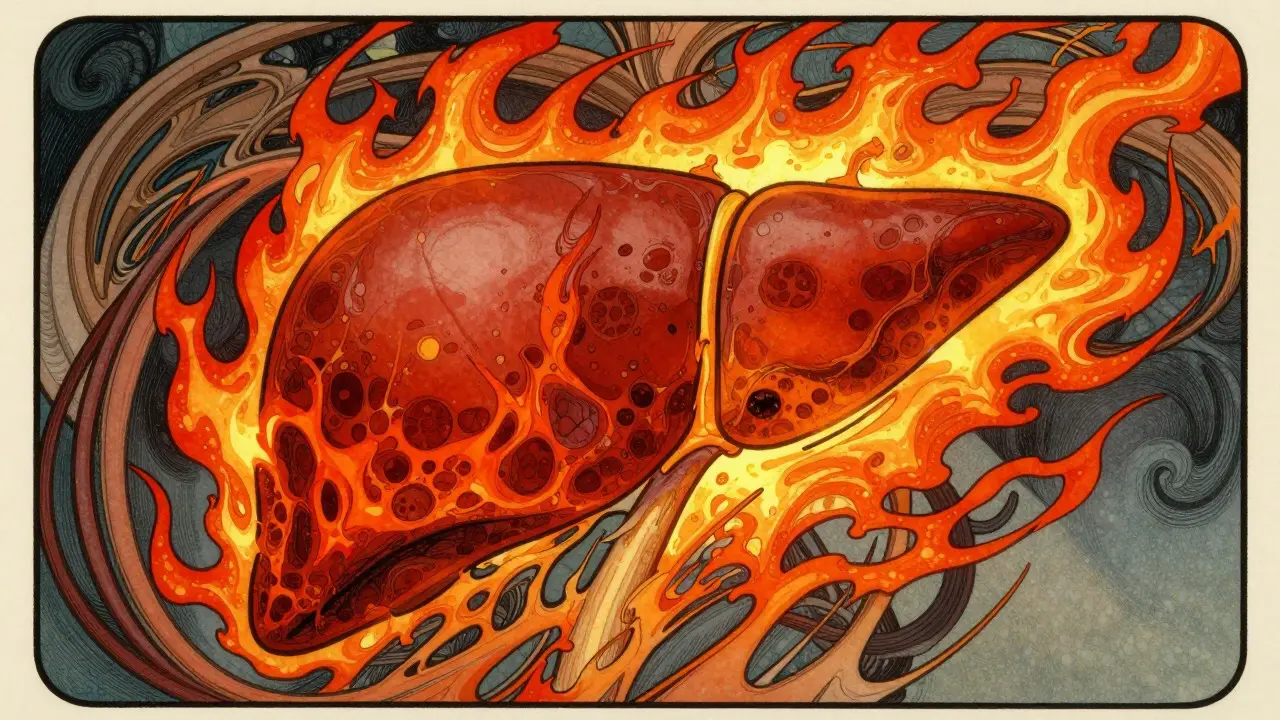
If you ignore the fatty liver warning, about 30-35% of heavy drinkers will progress to alcoholic hepatitis. This isn’t just “a little inflamed.” It’s active, aggressive inflammation where immune cells attack liver tissue, causing cell death. This stage typically appears after 5-10 years of drinking 60-80 grams of alcohol daily, though acute binge episodes exceeding 100 grams in 24 hours can trigger it faster.
Symptoms finally become impossible to ignore. About 75% of patients report jaundice (yellow skin and eyes), fever, and right upper quadrant pain. In severe cases, ascites (fluid buildup in the abdomen) and confusion (hepatic encephalopathy) show up. Doctors use the Maddrey Discriminant Function (mDF) score to gauge severity. An mDF score of 32 or higher indicates severe hepatitis, carrying a 30-40% chance of death in the short term if untreated. Mild cases (mDF below 32) have a much lower mortality rate (4-10%) and can often be reversed by quitting alcohol immediately. Severe cases usually require corticosteroids like prednisolone to calm the immune response. The STOPAH trial showed steroids reduced 28-day mortality from 20.2% to 17.6%, but only 40% of patients responded. So, while treatable, it’s a dangerous checkpoint.
Stage Three: Cirrhosis
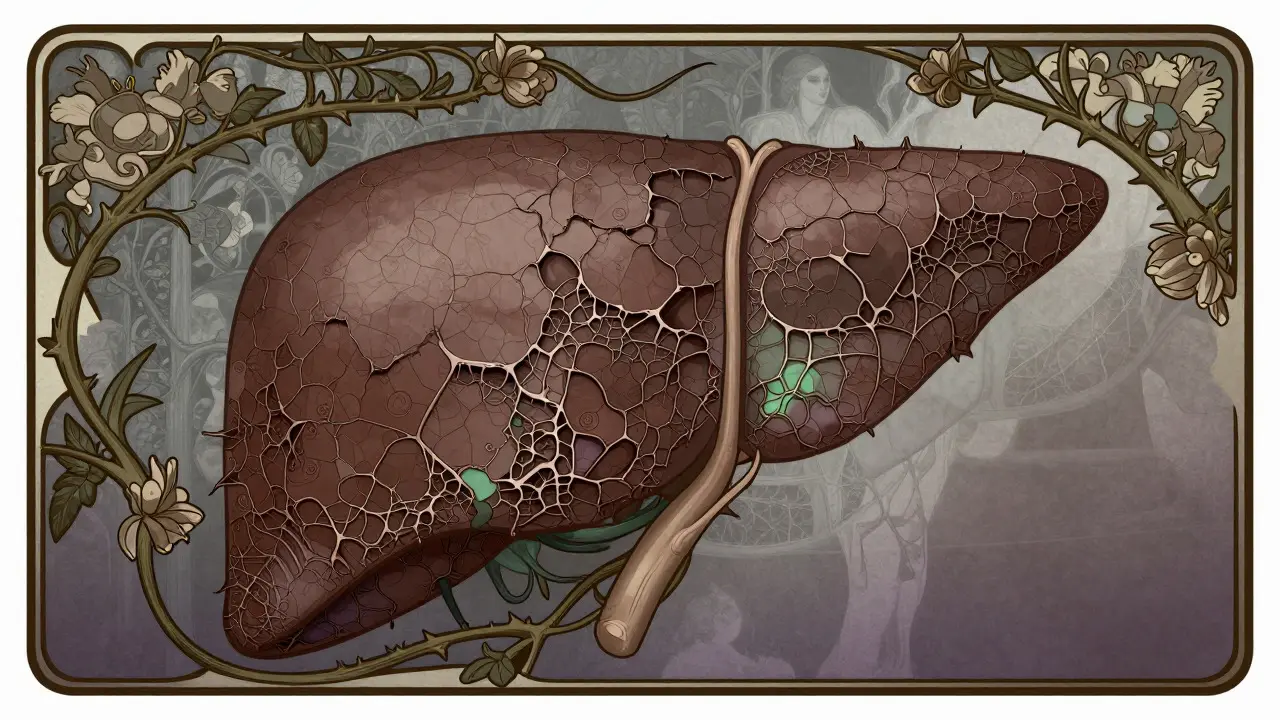
This is the endgame for many. Cirrhosis occurs when repeated injury leads to extensive scarring. More than 75% of normal liver architecture is replaced by fibrous tissue. On the Metavir scoring system, this is classified as F4 fibrosis. Unlike the first two stages, cirrhosis is generally considered irreversible. The scar tissue doesn’t heal back into healthy liver cells. However, “irreversible” doesn’t mean “fatal.”
Cirrhosis has two sub-stages: compensated and decompensated. In compensated cirrhosis, your liver still functions well enough to handle daily tasks, though you might feel tired or lose appetite. If you stop drinking here, 50-60% of patients stabilize, and 5-year survival jumps from 30% to 70-90%. In decompensated cirrhosis, complications explode. Variceal bleeding (burst veins in the esophagus), kidney failure (hepatorenal syndrome), and brain fog (encephalopathy) become common risks. Without a liver transplant, the 2-year mortality rate for decompensated cases hits 50%. Even then, liver transplantation offers a 5-7 year survival rate of 70-75% for eligible candidates. The key takeaway: catching cirrhosis before it decompensates is your best shot at long-term survival.
Why Women Get Sicker Faster
You’ve probably heard that men drink more and get sicker. That’s true, but women are at a distinct disadvantage. Men make up 60-70% of ALD cases, but women develop the disease after significantly less alcohol exposure. Why? It comes down to physiology. Women have less gastric alcohol dehydrogenase (the enzyme that breaks down alcohol in the stomach) and more body fat relative to muscle mass. Alcohol is water-soluble, so it distributes more easily into fat tissue, leading to higher peak blood alcohol concentrations. Additionally, estrogen increases the absorption of alcohol and its toxic byproduct, acetaldehyde. This means a woman drinking the same amount as a man suffers roughly 2-3 times more liver damage per unit of alcohol consumed. If you’re a woman, the threshold for “safe” drinking is effectively zero when it comes to liver health.
Diagnosis and Early Detection
The biggest problem with ALD is that it hides. Most people don’t seek help until they’re jaundiced or hospitalized. Data from the British Liver Trust shows 65% of individuals first see a doctor only when symptoms are advanced. To catch it early, you need screening. Standard blood tests check ALT and AST levels. An AST/ALT ratio above 2 is a classic red flag for alcohol-related injury. But blood tests alone aren’t enough. They tell you there’s damage, not how much. That’s where imaging comes in. Ultrasound can detect fatty liver, but it misses early fibrosis. Transient elastography, commonly known as FibroScan, is the game-changer. It measures liver stiffness and detects significant fibrosis (Metavir F2-F4) with 85-90% accuracy, matching biopsy results without the needle. If you’re a regular drinker, ask your GP for a FibroScan scan. It’s non-invasive, quick, and could save your life.
Treatment Options by Stage
Treatment depends entirely on which stage you’re in. There’s no one-size-fits-all pill. Here’s how medical professionals approach each phase:
| Stage | Primary Goal | Standard Treatment | Reversibility |
|---|---|---|---|
| Hepatic Steatosis | Remove fat deposits | Total alcohol abstinence for 4-6 weeks | Fully reversible (85% success rate) |
| Alcoholic Hepatitis | Reduce inflammation | Corticosteroids (for severe cases) + Abstinence | Mild: Reversible. Severe: Partially reversible |
| Cirrhosis | Manage complications | Beta-blockers, Lactulose, Liver Transplant (if decompensated) | Irrversible scarring, but stable function possible |
For fatty liver, the prescription is simple: quit. Add a balanced diet and weight loss if you’re overweight, and your liver will clean house. For hepatitis, you might need medication to suppress the immune system, but quitting remains the cornerstone. For cirrhosis, the focus shifts to damage control. Propranolol reduces variceal bleeding risk by 45%. Lactulose helps clear toxins from the brain, reducing encephalopathy recurrence by 50%. And if things go badly, a liver transplant is the only cure. Emerging therapies like gut microbiome modulation and anti-inflammatory agents like emricasan show promise in trials, but they’re not standard care yet. Stick to the proven methods: abstinence, monitoring, and complication management.
Prognosis and Survival Rates
Numbers can be scary, but they also highlight the power of action. Complete abstinence after a cirrhosis diagnosis increases median survival from 2 years to over 12 years. Continue drinking, and that median drops to 1.8 years. That’s a massive difference driven by one choice. For alcoholic hepatitis, the Glasgow Alcoholic Hepatitis Score (GAHS) helps predict outcomes. A GAHS score of 9 or higher indicates a 6-month mortality rate exceeding 50% without transplant. These scores aren’t just academic; they guide doctors on whether to push for aggressive treatment or consider transplant listing. The bottom line? Time matters. Every month you delay quitting, the odds shift against you.
Frequently Asked Questions
Can you reverse alcoholic liver disease?
Yes, but only in the early stages. Hepatic steatosis (fatty liver) is fully reversible with 4-6 weeks of abstinence. Alcoholic hepatitis can be partially reversed if caught early. Cirrhosis involves permanent scarring, but stopping alcohol can stabilize the condition and extend life significantly.
How much alcohol causes liver damage?
There is no truly safe amount, but risk increases sharply above 4 units per day for men and 2 units for women. Heavy drinking is defined as more than 40-80 grams of pure alcohol daily (3-6 standard drinks). Women are more susceptible due to metabolic differences, so even moderate drinking carries higher risk for them.
What are the first signs of alcoholic liver disease?
Often, there are none. Fatty liver is asymptomatic in 95% of cases. As it progresses to hepatitis, you might notice fatigue, unexplained weight loss, nausea, or tenderness in the upper right abdomen. Jaundice (yellow skin/eyes) usually appears in later, more severe stages.
Is cirrhosis always fatal?
No. Many people live for years with compensated cirrhosis, especially if they stop drinking. The danger lies in decompensation, where complications like bleeding or kidney failure occur. With proper management and abstinence, 5-year survival rates for compensated cirrhosis can reach 70-90%.
How is alcoholic liver disease diagnosed?
Doctors use a combination of blood tests (checking AST/ALT ratios), imaging (ultrasound or CT scans), and non-invasive fibrosis tests like FibroScan. Liver biopsy is the gold standard but rarely needed today due to accurate non-invasive alternatives. History of alcohol use is also a key diagnostic factor.