
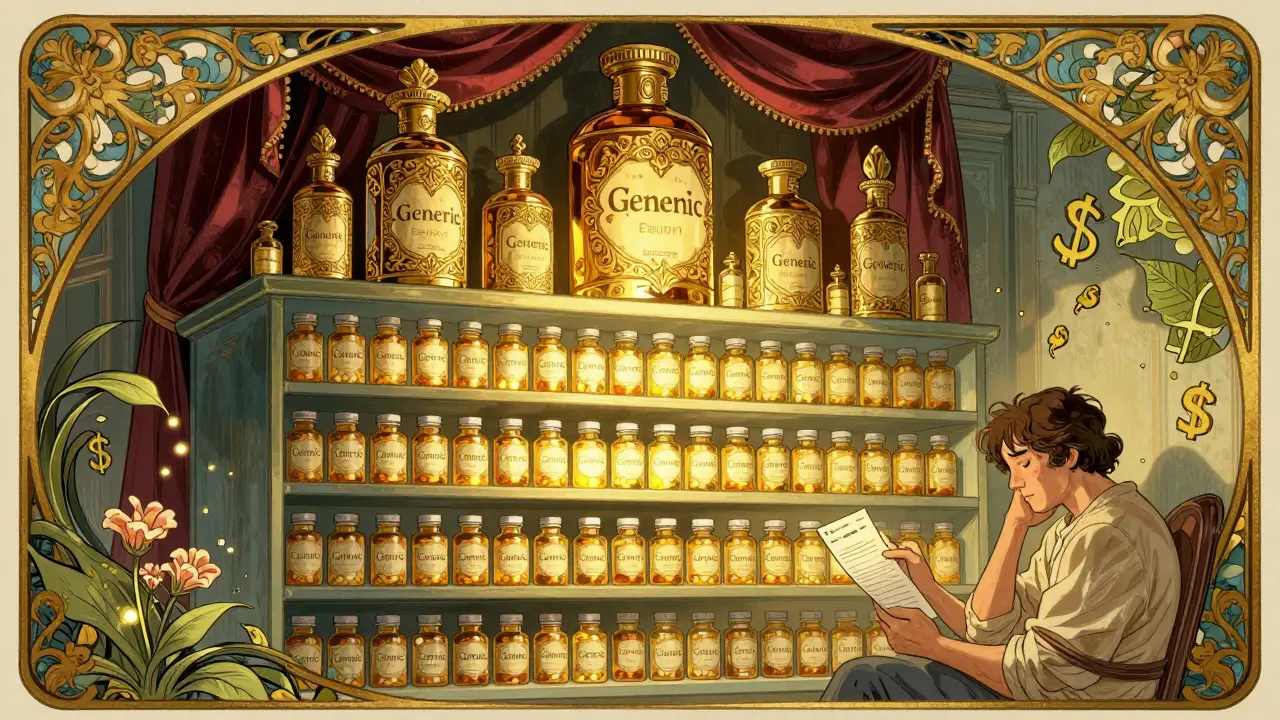
Every year, Americans spend over $700 billion on prescription drugs. But here’s the twist: 90% of the pills and capsules people take aren’t the expensive brand-name versions. They’re generics. And that’s where the real savings happen.
How Generic Drugs Save $482 Billion a Year
In 2024, generic drugs made up 9 out of every 10 prescriptions filled in the U.S. That’s 3.9 billion prescriptions. Yet they only cost $98 billion-just 12% of total prescription drug spending. Meanwhile, brand-name drugs, which accounted for only 10% of prescriptions, sucked up $700 billion-88% of the total. That gap isn’t a mistake. It’s a system working as designed: generics deliver the same clinical results at a fraction of the cost.
The math is simple. In 2024 alone, generic drugs saved the U.S. healthcare system $482 billion. That’s up from $445 billion in 2023. These aren’t theoretical numbers. They’re real dollars pulled out of hospital bills, insurance premiums, and out-of-pocket costs for patients. Think of it this way: every time someone fills a generic version of a blood pressure pill instead of the brand, the system saves $50 or more per prescription. Multiply that by millions of doses, and you’ve got a massive financial relief valve.
Biosimilars: The Next Wave of Savings
Generics aren’t the only story. Biosimilars-medications modeled after complex biologic drugs like Humira, Enbrel, or Stelara-are now entering the market in force. Unlike traditional generics, which copy simple chemical compounds, biosimilars replicate large, intricate proteins made from living cells. They’re harder to make, but they’re still far cheaper.
In 2024, Humira biosimilars went from being used in just 3% of eligible cases to 28%. That shift saved health plans billions. And it’s just getting started. Seven biosimilars for Stelara, a $6 billion-a-year drug, hit the market in 2025. Each one costs over 80% less than the original. Once fully adopted, those seven biosimilars could save $4.8 billion annually.
Since 2015, biosimilars have enabled more than 460 million extra days of patient therapy-treatments that would’ve been too expensive otherwise. That’s not just cost control. That’s better access to life-changing care.
Why Brand-Name Drugs Cost So Much
Why do brand-name drugs cost so much more? It’s not because they’re better. It’s because they’re protected.
Pharmaceutical companies use legal tricks to delay generic competition. One of the most common is called “pay for delay.” Brand-name manufacturers pay generic makers to hold off on launching cheaper versions. The Federal Trade Commission estimates these deals cost consumers $3.5 billion a year. In 2024, brand-name companies spent an average of $1.2 billion per year on these settlements.
It gets worse. Americans pay more than three times what people in other wealthy countries pay for the exact same brand-name drugs. In Canada, Germany, or the UK, a prescription for the same medication might cost $20. In the U.S., it’s $80-or $300. That’s not market efficiency. That’s pricing power.
Patients Are Feeling the Pinch
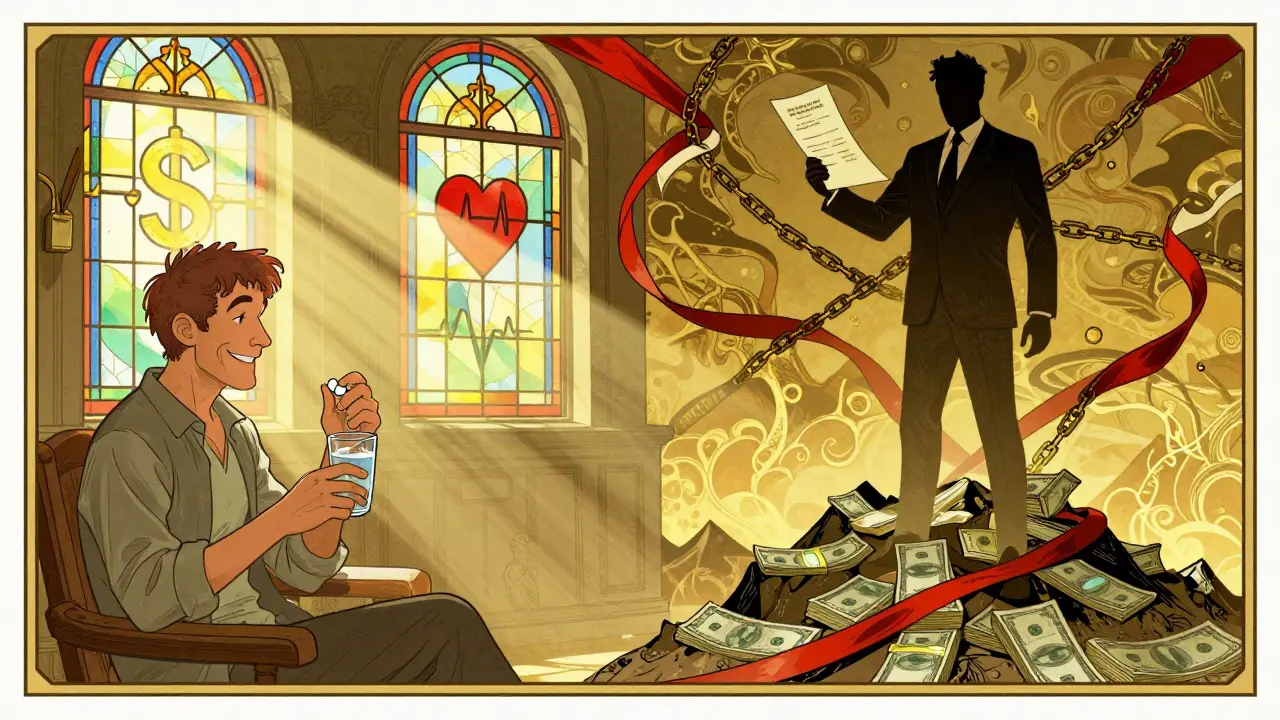
Behind every dollar saved is a person who can afford their medicine. According to GoodRx’s 2025 report, nearly 1 in 12 Americans has medical debt because of prescription costs. For many, switching to a generic isn’t just a smart financial move-it’s the only way to stay alive.
One Reddit user wrote: “Switching from brand albuterol to generic saved me $300 a month. I was choosing between my inhaler and groceries.” Another shared: “My insulin was $275. Now I pay $25. I didn’t know I could breathe again until I got the generic.”
Medicare data shows that less than 1% of beneficiaries who hit the catastrophic coverage phase use only generics. That means most of their out-of-pocket costs come from brand-name drugs. When insulin was capped at $35 per month for Medicare patients in 2025, it wasn’t because the drug got cheaper-it was because the system finally stopped letting companies charge whatever they wanted.
The Big Miss: The Biosimilar Void
Here’s the scary part: 90% of brand-name biologics that will lose patent protection over the next 10 years have no biosimilar in development. That’s $234 billion in potential savings sitting idle.
Why? Because developing biosimilars is expensive and risky. It can cost $100 million to $250 million to get one approved. And if the brand-name company fights back with legal battles or rebate deals with pharmacies, the biosimilar maker might never recoup their investment.
Health plans and pharmacies are starting to help. Some now require prior authorization for brand-name biologics unless a biosimilar is available. Others pay pharmacists a bonus for switching patients. But without faster regulatory approval and stronger competition rules, that $234 billion could vanish.
What’s Working: Price Negotiation and Policy
Policy changes are starting to match the scale of the problem. The Inflation Reduction Act lets Medicare negotiate prices for 10 drugs in 2026, ramping up to 30 by 2030. The Congressional Budget Office estimates this could save $500-550 billion over a decade. If those same rules applied to Medicaid and private insurance, total savings could top $1 trillion.
President Trump’s Most-Favored-Nation initiative in late 2025 forced Eli Lilly and Novo Nordisk to slash the price of Ozempic from $1,000 to $350 and Wegovy from $1,350 to $350. That’s not a generic-it’s a brand-name drug, but the price was forced down by federal pressure. It proves one thing: when the system stops letting companies set their own prices, savings follow.
The Real Cost of Doing Nothing
Prescription drug spending is projected to hit $776 billion by 2033. Without generics and biosimilars, it could be $1.2 trillion. That’s not inflation. That’s a broken pricing model.
Generic drugs don’t just save money. They keep people healthy. When someone can afford their asthma inhaler, their diabetes pill, or their heart medication, they go to the doctor less, skip fewer workdays, and avoid costly hospitalizations. That’s savings beyond the pharmacy counter.
The generic drug industry supports 350,000 jobs across 46 states. It’s not a fringe sector. It’s a backbone of the healthcare system. But it’s under constant pressure-from patent extensions, from pay-for-delay deals, from supply chain disruptions, and from FDA inspections that turned up 1,247 quality issues in 2024.
Here’s the bottom line: generic drugs are the only part of the U.S. healthcare system that consistently reduces spending without reducing care. They’re not perfect. They’re not always easy to access. But when they’re available, they’re the most powerful tool we have to make medicine affordable.
If you want to see where the real savings are in American healthcare, look at the pill bottle. The label might say “generic.” But the impact? It’s massive.
How much do generic drugs save the U.S. healthcare system each year?
In 2024, generic drugs saved the U.S. healthcare system $482 billion, up from $445 billion in 2023. These savings come from the fact that generics make up 90% of prescriptions but cost only 12% of total drug spending, while brand-name drugs account for just 10% of prescriptions but 88% of costs.
Are generic drugs as effective as brand-name drugs?
Yes. The FDA requires generic drugs to have the same active ingredients, strength, dosage form, and route of administration as the brand-name version. They must also prove they’re absorbed into the body at the same rate and to the same extent. Thousands of studies confirm they work the same way. The only differences are in inactive ingredients, like fillers or dyes, which don’t affect how the drug works.
What’s the difference between generics and biosimilars?
Generics are exact copies of simple chemical drugs, like aspirin or metformin. Biosimilars are highly similar versions of complex biologic drugs, like Humira or Enbrel, which are made from living cells. Biosimilars aren’t exact copies because biologics are too complex to replicate perfectly-but they’re proven to have no clinically meaningful differences in safety or effectiveness. They’re also much cheaper than the original biologics.
Why don’t more biosimilars exist if they save so much money?
Developing a biosimilar costs $100 million to $250 million, and brand-name companies often delay entry through legal battles, rebate deals with pharmacies, or pay-for-delay agreements. Right now, 90% of biologics set to lose patent protection in the next decade have no biosimilar in development. That’s a $234 billion missed opportunity.
Can I ask my pharmacist to switch me to a generic?
Yes, in most cases. Pharmacists can substitute a generic unless the doctor writes “dispense as written” or “no substitution.” Many insurance plans require generics unless there’s a medical reason not to use them. If you’re unsure, ask your pharmacist or check your plan’s formulary. Switching can save you hundreds a year.
What’s being done to increase access to affordable generics?
The Inflation Reduction Act allows Medicare to negotiate prices for 30 drugs annually starting in 2026, which could save $500-550 billion over 10 years. The FDA is also speeding up generic approvals. Health plans are now incentivizing biosimilar use through fair reimbursement and streamlined prior authorization. But progress is slow-especially when brand-name companies spend billions to block competition.
paul walker
January 28, 2026 AT 23:30Generics saved me $400/month on my asthma meds. I was choosing between breathing and eating. Now I do both. 🙌
Paul Adler
January 30, 2026 AT 05:10The data presented here is both compelling and meticulously sourced. It is evident that the systemic undervaluation of generic pharmaceuticals has persisted for decades, despite overwhelming clinical equivalence. The economic implications are not merely fiscal but deeply ethical, as access to life-sustaining medication should not be contingent upon financial privilege.
Kristie Horst
January 31, 2026 AT 11:48Oh wow, so the reason I can afford my insulin is because Big Pharma decided to let us have $25 instead of $275? How generous of them. 🙃
Meanwhile, their CEO just bought a third yacht. But hey, at least we got a *generic* version of dignity.
Andy Steenberge
January 31, 2026 AT 15:24It’s fascinating how the same people who scream about government overreach will defend Big Pharma’s pricing power like it’s a constitutional right. Generics aren’t ‘cheap’-they’re fair. The fact that we need legislation to force companies to compete with themselves says everything about how broken this system is.
And biosimilars? We’ve had the science for years. What’s missing is political will. The $234 billion in potential savings isn’t a hypothetical-it’s a moral failure waiting to be addressed.
Also, the FDA approved over 1,200 generics last year. That’s not a bug. That’s the system working. The problem isn’t the generics-it’s the gatekeepers.
Laia Freeman
February 1, 2026 AT 07:26OMG I JUST REALIZED I’VE BEEN PAYING $300 FOR MY BP MEDS FOR 3 YEARS 😭
My pharmacist just told me the generic is $12?? I feel like an idiot. And also so angry. Why didn’t anyone tell me?!?!!?!!
Also, can we make this a national holiday? Generic Drug Appreciation Day?? 🎉💊
rajaneesh s rajan
February 1, 2026 AT 12:19In India, generics are the default. We don’t have the luxury of paying $1,000 for a pill. But here’s the irony: the same companies that sell us $2 insulin here charge $300 in the US.
So is this a healthcare issue? Or just a greed issue dressed up as capitalism? I’ve seen people die because they couldn’t afford a $50 pill. In the US, they call it ‘market dynamics.’ In my village, we call it murder by invoice.
Laura Arnal
February 1, 2026 AT 20:27This is why I love healthcare advocates! 💙
Generics are the unsung heroes. I used to think brand-name meant better-turns out it just meant ‘better marketing.’
My kid’s ADHD med switched to generic and we saved $200/month. Now we can afford braces. 🥹
Thank you for sharing this. More people need to know!
Jasneet Minhas
February 3, 2026 AT 02:33Interesting how the U.S. spends more per capita on healthcare than any other nation, yet outcomes are worse. The solution isn’t more innovation-it’s more competition. Biosimilars are the future. But only if the system stops protecting monopolies under the guise of ‘R&D.’
Meanwhile, in Germany, you pay €10 for the same drug. And they have universal coverage. Coincidence? I think not.
Eli In
February 4, 2026 AT 13:13As someone who grew up in a country where medicine is a human right, I’m both heartbroken and inspired by this post.
Generics aren’t ‘second best’-they’re justice in pill form. 🌍❤️
And biosimilars? They’re the next frontier. Let’s not let patent trolls steal another $234 billion from patients who can’t fight back.
Megan Brooks
February 4, 2026 AT 21:16While the economic argument for generics is robust, it is imperative to acknowledge the regulatory and logistical barriers that impede equitable access. Even when generics are available, pharmacy benefit managers often prioritize rebates over patient affordability. The system is not merely broken-it is structurally incentivized to perpetuate high prices.
Policy reform must address not only patent abuse but also the opaque rebate system that distorts market dynamics.
Ryan Pagan
February 6, 2026 AT 14:49Let’s be real-Big Pharma doesn’t make drugs to save lives. They make them to make billionaires. Generics are the only thing standing between you and bankruptcy. And biosimilars? They’re the nuclear option. The fact that we’re still fighting over $25 insulin in 2025 is a national disgrace.
And don’t even get me started on those ‘pay-for-delay’ deals. That’s not capitalism. That’s collusion with a prescription pad.
LOUIS YOUANES
February 6, 2026 AT 22:44Wow. So the poor are just supposed to be grateful for getting the ‘bare minimum’ while the rich get the ‘premium’ experience? How quaint.
Generics are fine for peasants. Real patients deserve the real thing. You think a $25 insulin is ‘good enough’? Maybe if you’ve never had a real doctor’s office. I’ve seen the side effects of cheap meds. They’re not all created equal.
paul walker
February 7, 2026 AT 11:59LOL @LouisYouanes
You think brand-name insulin is ‘real medicine’? My cousin died last year because she couldn’t afford the ‘real thing.’
Guess what? The pill inside the $300 box is the same as the $25 one.
Stop pretending your privilege is science.