
Your liver is a hard worker. It filters your blood, processes nutrients, and fights off toxins without asking for much in return. But lately, it might be struggling under a burden you didn’t see coming. Nonalcoholic fatty liver disease (NAFLD), now more accurately called Metabolic Dysfunction-Associated Steatotic Liver Disease (MASLD), is the most common chronic liver condition worldwide. It affects about one in four people globally. The scary part? You can have it and feel perfectly fine until it’s too late.
This isn’t just about drinking too much alcohol. In fact, that’s the last thing on the list. This condition happens when fat builds up in your liver cells-specifically when at least 5% of them are stuffed with fat-and it’s driven by how your body handles sugar, insulin, and weight. If you’re wondering if you’re at risk, or how to stop this silent threat in its tracks, you’re in the right place. Let’s break down what’s really going on inside your body and what you can do about it today.
Why Your Liver Gets Fat (And Why It Matters)
To understand NAFLD, you first need to drop the old name. In June 2023, major medical groups like the American Association for the Study of Liver Diseases (AASLD) shifted terminology from NAFLD to MASLD. Why the change? Because "nonalcoholic" defines the disease by what it isn’t, rather than what it is. MASLD highlights the real culprit: metabolic dysfunction.
Think of your liver as a processing plant. When you eat more calories than you burn, especially from refined carbs and sugars, your body converts the excess into fat. Some goes to your hips and thighs, but a lot ends up stored in your liver. At first, this is just simple steatosis-fat sitting quietly in the liver cells. For many, it stays there harmlessly. But for others, it triggers inflammation. This stage is called nonalcoholic steatohepatitis (NASH), or now, metabolic dysfunction-associated steatohepatitis (MASH).
Inflammation is the problem. Chronic irritation causes scar tissue to form. This is fibrosis. Over years, those scars can harden into cirrhosis, where the liver becomes so stiff it can no longer function. That’s when things get dangerous, leading to liver failure or cancer. The good news? Simple steatosis is reversible. Once significant scarring starts, it’s much harder to undo. That’s why catching it early is everything.
Who Is Actually at Risk?
You don’t need to be overweight to get fatty liver, but being overweight is the biggest red flag. According to the National Institute of Diabetes and Digestive and Kidney Diseases (NIDDK), about 30-40% of adults in the United States have some form of fatty liver. The numbers jump dramatically if you look closer at specific groups:
- Type 2 Diabetes: About 70% of people with NASH also have type 2 diabetes. Insulin resistance is present in roughly 90% of all NAFLD cases. When your cells ignore insulin, glucose stays in the blood, and your liver turns that excess sugar into fat.
- Central Obesity: It’s not just about the number on the scale. It’s about where you carry the weight. Men with waistlines over 40 inches and women over 35 inches are at significantly higher risk because visceral fat (the deep belly fat) leaks inflammatory chemicals directly into the liver via the portal vein.
- Dyslipidemia: High triglycerides (over 150 mg/dL) are found in 60% of patients. Low HDL (good cholesterol) is another marker.
- Hypertension: High blood pressure often travels with fatty liver. About half of NAFLD patients have systolic pressure above 130 mmHg or diastolic above 80 mmHg.
Demographics matter too. Data from the NHANES study shows Hispanics have a prevalence rate of 45%, compared to 24% in non-Hispanic whites and 20% in non-Hispanic Blacks. Even children aren’t safe. With childhood obesity rising, 70% of obese kids show signs of fatty liver. This used to be an adult-only issue; now it’s a pediatric concern.
The Silent Progression: Symptoms You Might Miss
Here is the tricky part: your liver doesn’t have pain receptors on its surface, so it can scream internally while you feel nothing externally. In the early stages, NAFLD is asymptomatic. Only about 20% of patients report vague symptoms like fatigue or a dull ache in the upper right abdomen.
By the time you notice jaundice (yellowing of the skin or eyes), swelling in the legs or abdomen (ascites), or confusion (hepatic encephalopathy), the disease has likely progressed to advanced MASH or cirrhosis. These are late-stage signs involving bilirubin levels spiking above 2.5 mg/dL or massive fluid retention. Waiting for symptoms is a dangerous game. If you have any of the risk factors mentioned above, you shouldn’t wait to feel sick to get checked.
How Doctors Spot the Problem
Diagnosis usually starts with routine blood work. Doctors look at liver enzymes, specifically ALT and AST. An ALT level above 30 U/L in women or 40 U/L in men can signal liver stress. However, normal enzymes don’t rule out fatty liver. Many people have significant fat accumulation with perfectly normal blood tests.
If blood tests raise flags, imaging comes next. Ultrasound is common but can miss mild fat accumulation. A better tool is FibroScan, which uses ultrasound waves to measure liver stiffness (fibrosis) and fat content. It’s quick, painless, and non-invasive. The gold standard remains a liver biopsy, where a doctor takes a tiny sample of liver tissue. While accurate, biopsies carry small risks and are invasive, so they’re reserved for complex cases.
Newer blood tests, like the Enhanced Liver Fibrosis panel, are gaining traction. Validated in recent studies, these can detect advanced fibrosis with high accuracy, potentially reducing the need for biopsies in the near future.
Prevention and Reversal: What Actually Works
There is no magic pill yet. While resmetirom became the first FDA-approved drug for MASH in March 2024, lifestyle changes remain the cornerstone of treatment and prevention. The evidence here is overwhelming and encouraging.
Weight Loss is Key
You don’t need to lose 50 pounds to fix your liver. Research published in Nature Reviews Gastroenterology & Hepatology shows that losing just 5-7% of your body weight reverses steatosis (fat buildup) in 81% of patients. If you aim for a 10% weight loss, you can resolve active inflammation (NASH/MASH) in nearly half of cases. How do you get there? Create a sustainable calorie deficit. A daily deficit of 500 kcal, combined with movement, is a proven starting point.
The Mediterranean Diet Approach
Forget extreme keto or juice cleanses. The Mediterranean diet is the heavyweight champion for liver health. It focuses on whole foods, healthy fats, and low glycemic impact. Here’s what that looks like on your plate:
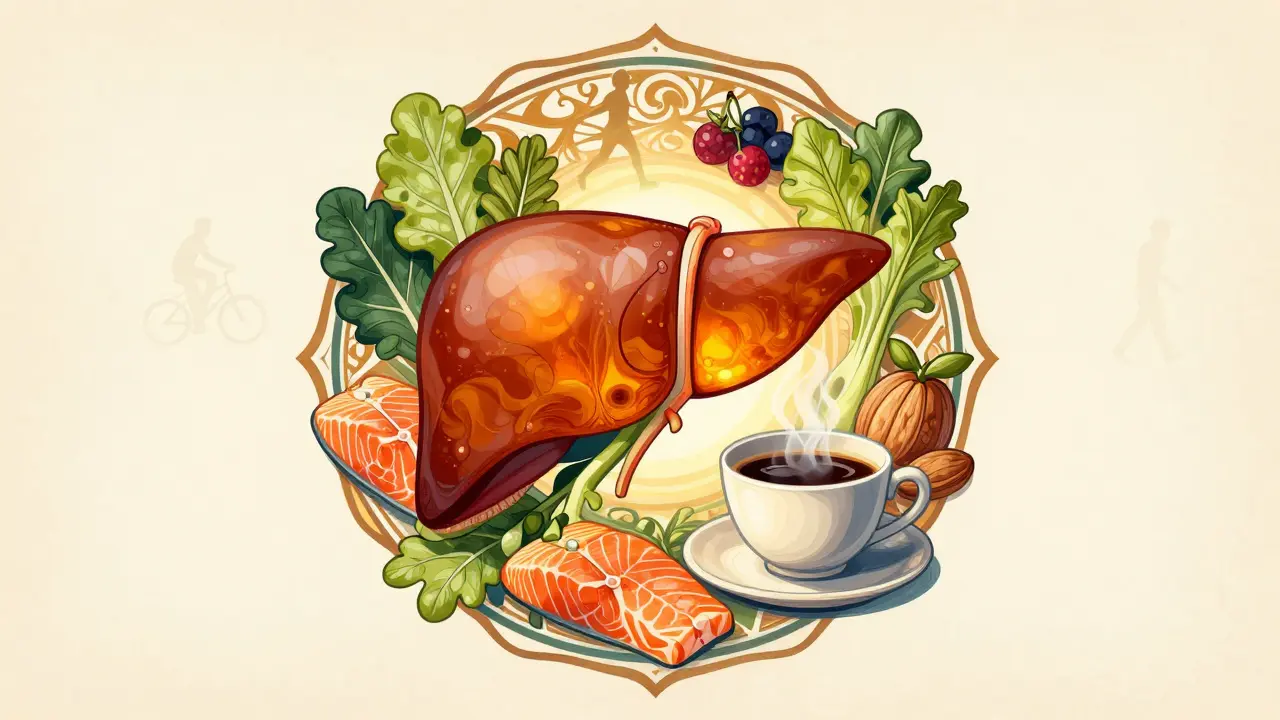
- Foods to Embrace: Olive oil (rich in monounsaturated fats), fatty fish like salmon (omega-3s reduce inflammation), nuts, seeds, leafy greens, berries, and legumes.
- Foods to Avoid: Added sugars, particularly fructose found in soda and processed snacks. Fructose is metabolized almost entirely by the liver and directly drives fat production. Refined carbohydrates like white bread and pastries spike insulin, telling your liver to store more fat.
A community study on the LiverLife App showed a 76% success rate in improving liver markers among users who stuck to a Mediterranean-style diet for six months.
Movement Matters
Exercise helps even if the scale doesn’t move. Aim for 150 minutes of moderate-intensity exercise per week. That could be brisk walking, cycling, or swimming. The goal is to improve insulin sensitivity. When your muscles become better at using glucose, your liver doesn’t have to work overtime to clear it from your blood. Try to hit 10,000 steps a day. It sounds cliché, but consistent daily movement burns visceral fat effectively.
Coffee: The Unexpected Hero
Yes, coffee. Multiple studies suggest that drinking 2-3 cups of black coffee daily may lower liver enzyme levels and reduce the risk of fibrosis. The antioxidants in coffee help protect liver cells from damage. Just skip the sugary syrups and heavy creams-you’re defeating the purpose.
Common Myths and Misconceptions
"I don’t drink alcohol, so I’m safe."
Wrong. As the name implies, this disease occurs without significant alcohol use. Metabolic health is the driver, not ethanol.
"I’m thin, so I can’t have fatty liver."
Incorrect. "Lean NAFLD" affects people with normal BMI but high visceral fat or genetic predispositions. Up to 10-20% of fatty liver patients are not overweight.
"Liver detox teas will clean my liver."
False. Your liver detoxifies itself. Detox teas often contain laxatives that cause water weight loss, not fat loss. Some herbal supplements can actually be toxic to the liver. Stick to food and proven lifestyle changes.
Looking Ahead: The Future of Liver Health
The landscape is changing fast. With the reclassification to MASLD, doctors are now looking at liver health as part of overall metabolic wellness. We are seeing more integrated care models where endocrinologists and hepatologists work together. New diagnostic tools are becoming less invasive, making screening easier. And with drugs like resmetirom entering the market, pharmacological options are finally arriving for those who struggle with lifestyle changes alone.
However, the root cause remains our modern environment: cheap, ultra-processed food and sedentary jobs. The CDC projects that 50% of U.S. adults will have obesity by 2030. Without personal intervention, the prevalence of fatty liver will follow suit. The power to change your trajectory lies in your kitchen and your daily habits. Start small. Cut the soda. Add a walk. Check your enzymes. Your liver will thank you.
Can fatty liver be reversed completely?
Yes, in its early stages. Simple steatosis (fat accumulation without inflammation) is highly reversible with lifestyle changes. Losing 5-7% of body weight can clear the fat. However, if the disease progresses to significant fibrosis or cirrhosis, the scarring may be permanent, though further damage can still be prevented.
What is the difference between NAFLD and MASLD?
They refer to the same condition, but MASLD is the new, preferred term adopted in 2023. NAFLD stood for Nonalcoholic Fatty Liver Disease, defining it by what it wasn't. MASLD stands for Metabolic Dysfunction-Associated Steatotic Liver Disease, highlighting that metabolic issues like obesity and diabetes are the primary drivers.
Does alcohol make fatty liver worse?
Yes. Even though the disease is "nonalcoholic," consuming alcohol adds extra stress to an already inflamed liver. Most guidelines recommend complete abstinence or strict limitation (less than 30g/day for men, less for women) to prevent progression to cirrhosis.
What foods should I avoid if I have fatty liver?
Avoid added sugars, especially high-fructose corn syrup found in sodas and processed snacks. Limit refined carbohydrates like white bread, pasta, and pastries. Reduce saturated fats from fried foods and processed meats. Focus on whole, unprocessed foods instead.
When should I see a doctor for liver symptoms?
You should see a doctor if you have risk factors like obesity, type 2 diabetes, or high cholesterol, even if you feel fine. If you experience persistent fatigue, abdominal pain in the upper right side, or unexplained weight loss, seek medical attention immediately. Routine blood tests can catch early signs before symptoms appear.