

Imagine waking up with a sharp pain in your heel or knee that ruins your morning run. You rush to the doctor, hoping for a quick fix. The offer? A corticosteroid injection. It sounds perfect-shoot up the pain and get back to life. But here is the twist: while that shot might silence the pain today, it could be weakening your tendon for tomorrow. For decades, we treated tendinopathy as simple inflammation, but modern science tells a different story. It’s not just swollen; it’s degenerative. And the cure isn’t always a needle-it’s often gravity, resistance, and patience.
The Shift from Inflammation to Degeneration
We need to clear up a massive misconception first. If you search "tendonitis," you’ll find millions of results suggesting rest and ice. That term implies inflammation (-itis). But if you’ve had persistent tendon pain for more than three months, you likely have tendinopathy (-pathy), which means disease or pathology. The tissue isn't just angry; it's structurally compromised. Collagen fibers are disorganized, and the tendon has lost its stiffness and strength.
This distinction matters because anti-inflammatory drugs (NSAIDs) and steroid injections target inflammation. If the problem is degeneration, treating it like inflammation is like putting a bandage on a broken bone. Research from the American College of Sports Medicine highlights that nearly 30% of sports medicine visits involve this issue, mostly affecting the Achilles and patellar tendons. Understanding that the root cause is mechanical failure, not chemical irritation, is the first step toward actually fixing it.
Why Eccentric Training Works
If the tendon is weak and disorganized, how do we rebuild it? We stress it. Specifically, we use eccentric training, where you lengthen the muscle under load. Think of lowering a heavy weight slowly rather than lifting it quickly. This type of loading stimulates tenocytes (the cells that build tendon) to realign collagen fibers and increase tendon stiffness.
A landmark study by Alfredson et al. in 1998 changed everything. They showed that high-load eccentric exercises could resolve chronic Achilles tendinopathy without surgery. Since then, protocols have evolved, but the principle remains: controlled, heavy loading triggers remodeling. Biomechanical studies using ultrasound confirm that consistent eccentric work increases tendon stiffness by 15-20% over 12 weeks. It’s not magic; it’s biology responding to demand.
Top Protocols: Achilles vs. Patellar
You can’t treat every tendon the same way. The anatomy dictates the exercise. Here is how the two most common sites differ:
| Tendon Site | Primary Exercise | Protocol Details | Key Consideration |
|---|---|---|---|
| Achilles | Heel Drops | 3 sets of 15 reps, twice daily. Straight knee (gastrocnemius) and bent knee (soleus). | Perform on a step edge. Lower slowly (3-5 seconds). |
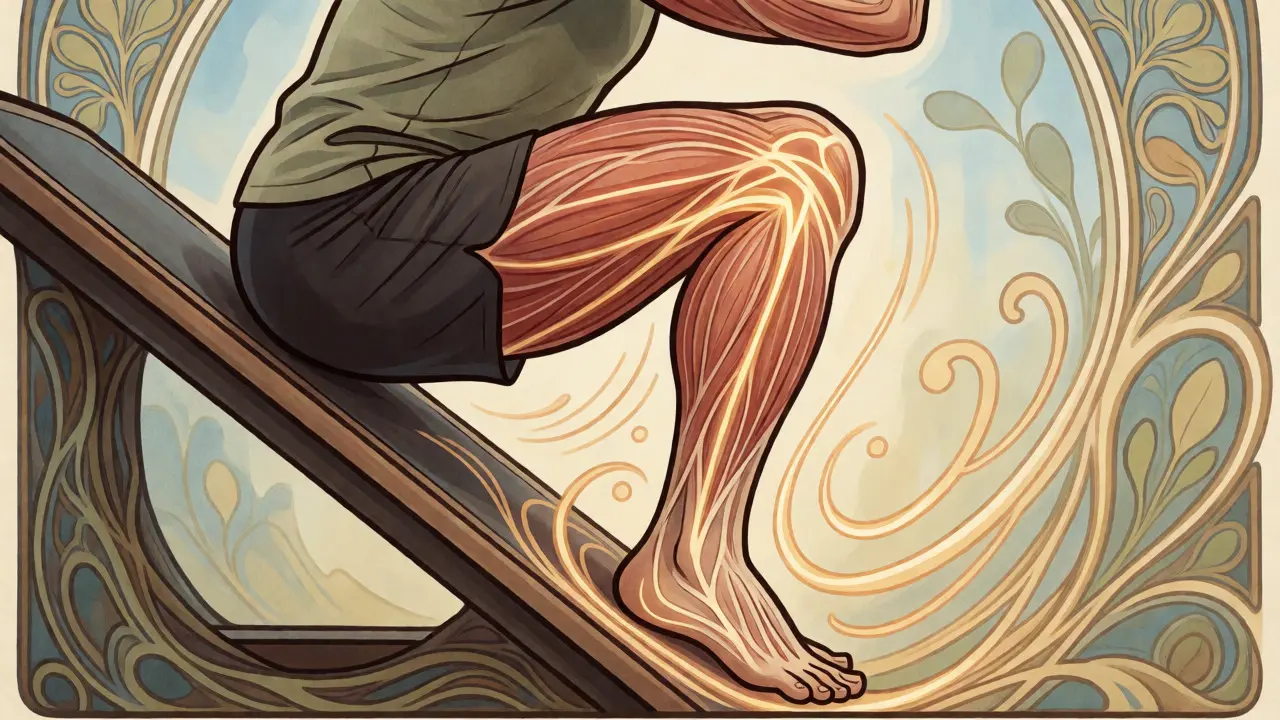
| Patellar | Decline Squats | Single-leg squats on a 25-degree decline board. 3 sets of 15 reps daily. | Knee must track over toes. Pain should stay below 5/10. |
| Rotator Cuff | External Rotation | Slow lowering phase against cable/band resistance. | Often combined with Heavy Slow Resistance (HSR). |
For the Achilles, the classic Alfredson protocol is still gold standard, though recent trials suggest Heavy Slow Resistance (HSR)-lifting heavier weights slower-might yield similar results with better adherence because it hurts less initially. For the patellar tendon, the decline squat targets the specific angle that stresses the tendon insertion point. Note that these aren't "feel good" exercises. They are hard work.
The Injection Dilemma: Steroids and PRP
So, what about those shots? Corticosteroids are potent anti-inflammatories. They reduce pain fast-often within days. But a major study published in the BMJ found that while steroids provided short-term relief, patients who relied on them had worse long-term outcomes than those who exercised. At six months, 65% of steroid-treated patients needed further intervention compared to 35% in the exercise group. Why? Steroids can inhibit collagen synthesis, potentially accelerating tendon degeneration.
Then there is Platelet-Rich Plasma (PRP). This involves injecting concentrated platelets from your own blood into the tendon. The theory is that growth factors will heal the tissue. However, the evidence is mixed. A 2020 systematic review in the American Journal of Sports Medicine found only a 15-20% improvement over placebo at six months. Given the cost and lack of consistent data, PRP is rarely a first-line treatment anymore. It might help specific cases, but it’s no replacement for rehab.
Pain Management During Rehab
Here is where people quit. Eccentric exercises hurt. A survey of runners found that 68% reported "unbearable" pain in the first two weeks. If you wait for pain to vanish before exercising, you’ll never start. The key concept is "acceptable pain." You want to stay between 2 and 5 out of 10 on the pain scale during exercise. If it spikes above 7, or if pain lasts more than 24 hours after the session, you did too much.
To manage this, many therapists now recommend starting with isometric holds. Holding a position (like a wall sit or calf raise hold) for 45 seconds can provide immediate pain relief-up to 50% reduction in some studies-without moving the joint. Use these holds before your eccentric work to calm the tendon down, then proceed with the slow lowering movements.

Adherence and Realistic Timelines
Rehabbing a tendon is a marathon, not a sprint. Structural changes visible on ultrasound take 8-12 weeks. Symptom relief might come sooner, but don’t stop when you feel better. A 2023 study showed that patients who worked with a physical therapist had a 92% success rate versus 68% for those self-managing. Why? Technique. Doing a decline squat wrong puts stress on the knee joint instead of the tendon.
Apps like Tendon Rehab have helped improve adherence by providing video feedback and reminders. Consistency is king. Missing sessions delays remodeling. Also, consider your load management outside the gym. If you’re doing 15km runs while rehabbing, you’re fighting an uphill battle. Reduce volume temporarily to let the tendon adapt.
When Eccentrics Aren’t Enough
About 30% of patients don’t respond to standard eccentric protocols. This doesn’t mean they’re failures; it means their case is complex. Maybe it’s insertional Achilles tendinopathy, where the tendon attaches directly to the bone, making heel drops painful or ineffective. Or maybe there’s underlying metabolic issues like diabetes or high cholesterol affecting healing.
In these cases, clinicians might look at alternative loading strategies, such as kinetic chain adjustments (fixing hip weakness that overloads the knee) or psychological approaches to address fear-avoidance behaviors. Emerging therapies, like shockwave therapy or new peptide-based treatments, are being studied, but none have yet displaced exercise as the cornerstone of care.
How long does eccentric training take to work?
You may feel pain relief within 2-4 weeks due to neural adaptations, but structural remodeling takes 12-16 weeks. Do not stop early even if symptoms improve, as the tendon is still vulnerable.
Is it normal for eccentric exercises to hurt?
Yes, mild to moderate pain (2-5/10) is expected and acceptable. Sharp pain or pain lasting more than 24 hours post-exercise indicates you need to reduce the load or range of motion.
Should I get a steroid injection for my tendon pain?
Generally, no, if you plan to return to activity. Steroids provide short-term relief but can weaken the tendon long-term. Exercise-based rehab has superior long-term outcomes.
What is the difference between tendinitis and tendinopathy?
Tendinitis implies acute inflammation, usually from recent overuse. Tendinopathy is a chronic degenerative condition with failed healing response. Most persistent cases are tendinopathy, requiring loading rather than just rest.
Can I do eccentric exercises if I have arthritis?
Often yes, but modifications are needed. Isometric holds are safer initially. Consult a physiotherapist to ensure exercises don't aggravate joint surfaces while targeting the tendon.




Kimberly Thomas
September 2, 2026 AT 22:43Stop romanticizing the pain. If you are still doing Alfredson heel drops in 2024, you are probably underloading and overdoing reps. Heavy Slow Resistance is objectively superior for adherence because it actually builds stiffness without turning your life into a repetitive stress injury nightmare. The data doesn't lie, but your ego does.
kishhore kumar
September 4, 2026 AT 20:04this is so true!! i tried the steroid shot first and felt great for like 2 weeks then BAM pain came back worse than before :( eccentric loading is hard work but worth it... also is there any specific app you guys recommend for tracking the slow lowering phase? i keep losing count lol
Adam Cox
September 6, 2026 AT 11:01You're missing the point entirely about individual variance. Not everyone has the same collagen turnover rate. Telling people to just 'load heavy' ignores the fact that 30% of patients fail standard protocols. It's not about ego, it's about biology. Some tendons are insertional, some are mid-portion. Treating them all with the same hammer is lazy medicine.
Morgan Law
September 6, 2026 AT 11:26Hey folks! 👋 Just wanted to chime in here because I see a lot of frustration in the comments. Remember that rehab is non-linear. If you're feeling discouraged, take a step back. Isometric holds are a fantastic tool to bridge that gap when eccentrics feel too aggressive. You don't have to white-knuckle every rep. Listen to your body, stay consistent, and maybe swap out one session for a walk or swim to keep blood flowing without the load. We've all been there!
Sarah Leitschuh
September 7, 2026 AT 20:18I appreciate the nuance here. As someone who spent years misdiagnosed with tendonitis, realizing it was degenerative changed everything. The shift from 'rest until it hurts less' to 'load until it adapts' is mentally tough. But having a physio check my form saved me months of ineffective effort. Technique really is king.
Marshall Stephens
September 9, 2026 AT 05:06Glad to hear the community is engaging with this. It’s refreshing to see people discussing actual mechanisms rather than just complaining about the pain. Keep up the good work sharing experiences.
Aaron Gragg
September 9, 2026 AT 15:53The discourse surrounding corticosteroid injections often neglects the profound impact on tenocyte metabolic activity and subsequent collagen synthesis inhibition. While the analgesic effect provides immediate symptomatic relief, the structural compromise inherent in repeated intra-tendinous steroid administration frequently precipitates a cascade of deleterious changes in the extracellular matrix. Consequently, the long-term prognosis for athletes seeking return-to-play status is significantly diminished compared to those undergoing progressive mechanical loading protocols such as Heavy Slow Resistance training. One must consider the biomechanical integrity of the tissue over the transient comfort provided by pharmacological intervention.
Curtis Surpless
September 10, 2026 AT 14:06eh whatever PRP is mostly snake oil anyway and half these studies are funded by device companies so dont believe the hype just lift heavy stuff slowly and shut up about your feelings
Harry Falk
September 11, 2026 AT 23:46Agreed. Consistency beats intensity.
Rose Boerner
September 12, 2026 AT 17:59It is frankly disheartening to witness the sheer negligence displayed by practitioners who continue to prescribe rest for chronic conditions. This lack of diligence perpetuates patient suffering unnecessarily. We must demand higher standards of care; otherwise, we remain complicit in the erosion of public health outcomes through our collective apathy toward evidence-based rehabilitation methodologies.
Akeem Feiton
September 13, 2026 AT 01:49AMERICAN SPORTS MEDICINE LEADS THE WORLD!!! These foreign studies always miss the mark cause they dont train like us. Get off your ass and do the work! Steroids are for quitters who cant handle the grind. USA STRONG 💪🇺🇸