
Vitamin E & Warfarin Risk Estimator
Do you have any of the following risk factors?
Risk Assessment
Recommended Monitoring Strategy
- Baseline Get an INR test immediately before starting.
- Frequency Weekly checks for the first month.
Warfarin is a powerful medication that saves lives by preventing dangerous blood clots. It works by blocking vitamin K, which your body needs to clot blood. However, because it affects such a critical bodily function, even small changes in your routine can tip the balance from protection to danger. One of the most confusing questions patients ask their doctors is whether they can take Vitamin E supplements. The answer isn't a simple yes or no. It involves understanding how these two substances interact, why research findings often contradict each other, and what specific risks you face if you combine them without careful monitoring.
The Mechanism Behind the Interaction
To understand why Vitamin E (specifically alpha-tocopherol) might be risky with warfarin, we have to look at what both do individually. Warfarin stops your blood from clotting too easily by interfering with vitamin K-dependent clotting factors. Vitamin E is an antioxidant, but it also has antiplatelet activity. This means it makes platelets-the cells responsible for starting the clotting process-less sticky.
When you take both, you aren't just adding two effects together; you are attacking the clotting system from two different angles. Warfarin reduces the chemical factors needed for clots, while Vitamin E reduces the physical ability of platelets to stick together. For some people, this combination doesn't cause issues. For others, it leads to a significantly higher risk of bleeding. The problem is that there is no easy test to predict which group you belong to before you start taking them together.
Conflicting Research: Why Experts Disagree
If you search online, you will find conflicting advice. This confusion stems from studies that use different methods, durations, and dosages. Let's look at two key pieces of evidence that shape this debate.
On one side, a landmark 1996 study published in the American Journal of Cardiology followed 21 patients on chronic warfarin therapy. They were given either Vitamin E or a placebo. The researchers found no significant changes in their International Normalized Ratio (INR), a measure of how long it takes blood to clot. Based on this short-term data, they concluded that Vitamin E could be safely given to patients on warfarin.
On the other side, a much larger retrospective study published in the Journal of the American Heart Association in 2013 analyzed over 1,000 patients with atrial fibrillation. This study found a clear link between high serum levels of Vitamin E and increased bleeding events. Specifically, patients with Vitamin E levels above 4.49 μmol/mmol cholesterol had a higher risk of any bleeding, and those above 5.56 μmol/mmol faced the highest risk for major bleeding, including brain hemorrhages. This suggests that while short-term INR checks might look normal, the actual risk of bleeding increases over time.
| Study Source | Year | Sample Size | Key Finding | Clinical Implication |
|---|---|---|---|---|
| American Journal of Cardiology | 1996 | 21 subjects | No significant INR change | Suggested safety for chronic use |
| J Am Heart Assoc | 2013 | 1,011 patients | High serum Vitamin E linked to bleeding | Warning against high doses |
| EBSCO Research Starters | 2023 | Case reports & small trials | Bleeding appeared after 4 weeks at 800 IU | Risk may be delayed |

Dosage Thresholds: Where Does the Risk Begin?
Not all Vitamin E is created equal when it comes to risk. The dosage matters immensely. Most clinical guidelines agree that low-dose Vitamin E, such as what you get from a standard multivitamin or dietary sources like nuts and seeds, is generally safe. The danger zone begins with high-dose supplementation.
Many experts draw the line at 400 IU daily. Doses above this threshold are associated with a statistically significant increase in bleeding risk. Some case reports show adverse effects appearing only after four weeks of concurrent use at 800 IU daily. This delay is dangerous because patients might feel fine initially, assume the combination is safe, and then experience sudden bleeding later. Even lower doses, such as 42 IU daily, have shown additive anticoagulant effects in sensitive individuals, highlighting that genetic variability plays a huge role.
Monitoring Your INR: The Safety Net
If you decide to take Vitamin E while on warfarin, you cannot rely on guesswork. You need strict monitoring. The International Normalized Ratio (INR) is the standard test used to measure how thin your blood is. A typical target range for most conditions is between 2.0 and 3.0. If your INR goes too high, your blood is too thin, and you risk bleeding. If it goes too low, you risk clotting.
Here is a practical monitoring strategy recommended by anticoagulation clinics:
- Baseline Measurement: Get an INR test before starting any new Vitamin E supplement.
- Weekly Checks: Monitor your INR weekly for the first month of combined use. This catches early spikes.
- Ongoing Monitoring: If your INR remains stable, switch to biweekly checks. Continue this heightened schedule for as long as you take the supplement.
This approach requires more clinic visits and blood draws, but it is the only way to ensure safety. Ignoring this step is playing Russian roulette with your health.
Who Is Most at Risk?
Not everyone reacts the same way to this interaction. Certain groups face higher risks and should avoid high-dose Vitamin E entirely unless under direct specialist supervision:
- Elderly Patients: Older adults often have thinner skin and weaker blood vessels, making them more prone to bruising and internal bleeding.
- Patients with History of Bleeding: If you have previously experienced gastrointestinal bleeding or easy bruising, add another antiplatelet agent like Vitamin E is ill-advised.
- Those with Genetic Variations: Polymorphisms in genes like CYP2C9 and VKORC1 affect how your body processes warfarin. These variations can make you more sensitive to additional anticoagulants.
- People Taking Other Supplements: Combining Vitamin E with fish oil, garlic, ginger, ginkgo biloba, or turmeric creates a "stacking effect" that dramatically increases bleeding risk.
Practical Advice for Patients
You don't have to choose between heart health and general wellness. You just need to be strategic. First, talk to your doctor or anticoagulation manager. Do not start Vitamin E on your own. Second, check the label. Many multivitamins contain Vitamin E, but usually in safe amounts (around 15-30 mg or roughly 22-45 IU). Avoid standalone high-dose capsules unless prescribed.
Third, watch for symptoms. Increased risk of bleeding manifests as unusual bruising, nosebleeds that won't stop, bleeding gums, red or dark urine, or black tarry stools. If you notice any of these, seek medical attention immediately and mention your Vitamin E intake.
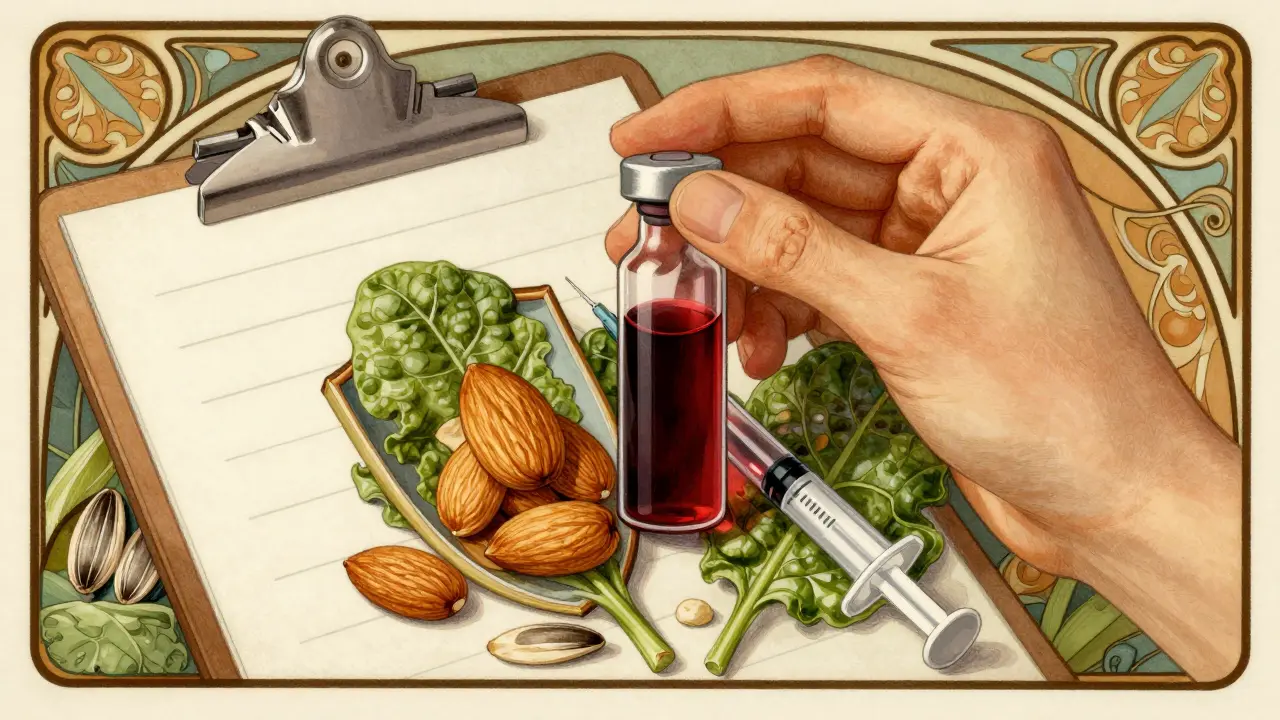
Finally, consider alternatives. If you are taking Vitamin E for skin health or antioxidant support, ask your doctor about safer options. Dietary sources of Vitamin E, such as almonds, sunflower seeds, and spinach, provide the nutrient without the concentrated dose that triggers pharmacological interactions.
Can I take a multivitamin with Vitamin E while on Warfarin?
In most cases, yes. Standard multivitamins typically contain low doses of Vitamin E (often less than 30 mg or 45 IU), which are generally considered safe. However, you should always inform your healthcare provider about every supplement you take, as individual sensitivity varies. Check the label to ensure the Vitamin E content is within this low range.
How quickly does Vitamin E affect my INR?
The timeline varies. Some studies show no immediate change in INR, while others report effects appearing after several weeks. Case reports indicate that abnormal bleeding can emerge after four weeks of concurrent use at high doses (800 IU). Because the onset is unpredictable, regular INR monitoring is essential rather than relying on a single initial test.
What is the maximum safe dose of Vitamin E for someone on Warfarin?
There is no universally agreed-upon "safe" high dose. However, clinical guidelines and expert consensus suggest avoiding doses above 400 IU daily. Doses exceeding this threshold are associated with a significantly increased risk of bleeding. Low-dose supplementation (under 100 IU) is generally considered lower risk but still requires monitoring.
Does food-based Vitamin E pose the same risk as supplements?
No, food-based Vitamin E is much safer. The amounts found in natural foods like nuts, seeds, and leafy greens are unlikely to reach the pharmacological levels that interfere with warfarin. The risk is primarily associated with concentrated supplement forms, particularly high-dose capsules.
Should I stop taking Vitamin E if I am already on Warfarin?
Do not stop or start any medication or supplement without consulting your doctor. If you are currently taking high-dose Vitamin E and warfarin, your doctor may advise you to taper off the Vitamin E while closely monitoring your INR to prevent sudden shifts in your anticoagulation status. Abrupt changes can be dangerous.



Javier Arauz
May 14, 2026 AT 02:09Wake up people. This is just another way the system tries to control what you put in your body. They want you scared so you stay dependent on their meds and their tests. I take my vitamins and I feel fine, unlike these lab rats running around getting blood drawn every week. It’s a scam.
Kris Wong
May 14, 2026 AT 12:02The FDA knows exactly what they are doing 🚫💊 They hide the real studies because big pharma doesn't want you to know that natural remedies work better than their poison. The 1996 study was probably funded by the same company that makes warfarin. Think about it. 🧠👀
Danny S
May 15, 2026 AT 18:44:( You cannot trust any of this data. The 'experts' are paid off. I have been tracking my own INR at home for years and never had an issue with high dose E. They only publish the bad results to keep you compliant. Stay vigilant out there. :)
Jeremiah Cassandra
May 17, 2026 AT 00:17Sarcasm aside, if you ignore basic pharmacology you will end up in the ER 🏥 Vitamin E isn't magic, it's a chemical compound that interacts with platelets. If you think your doctor is trying to hurt you, maybe try listening to them instead of reading conspiracy forums. 🙄
charles robert
May 17, 2026 AT 21:58The universe balances itself 🌌 When we interfere with the clotting cascade we disrupt the delicate harmony of life. Warfarin is a blunt instrument, a sledgehammer used to crack a nut. Vitamin E is the whisper of nature. Combining them creates chaos in the microcosm of your bloodstream. It is tragic that society values convenience over understanding the profound metaphysical implications of anticoagulation. We are all just vessels waiting to burst or clot, depending on our karma. 😔
Warren Brewer
May 18, 2026 AT 19:54Hey everyone. Just remember to talk to your doc. It is simple. Do not guess. Ask questions. Stay safe. That is all.
Mark Ronson
May 19, 2026 AT 20:56I must admit that the literature presents a complex picture indeed. However, from my perspective as someone who works in healthcare, the risk is real. Please do not ignore the warning signs. The typo prone nature of my typing does not diminish the severity of the situation. Bleeding is bad. Monitor your levels carefully. 🩺
Mikey Mann
May 20, 2026 AT 21:27Look, life is full of risks. But we can choose to be informed. I started taking low dose E after asking my doctor and checking my INR. It has been great. Don't let fear stop you from living well, but respect the science. We are capable of handling complexity if we approach it with optimism and caution. ☀️
Mollie Louise
May 21, 2026 AT 22:56Oh my gosh, this is such important information! 💖 I always say that communication is key in health matters. If you are on warfarin, please please please talk to your healthcare team before adding anything new. I know it feels like extra work, but your safety is worth it! Let's support each other in making smart choices and staying healthy together. We can do this! ✨🌈
Christina Moran
May 22, 2026 AT 17:03i dont get why ppl make it so hard. just eat nuts. done. no pills needed. why complicate things?
mardy duffy
May 23, 2026 AT 21:29Boring.
Desirea Gaona
May 24, 2026 AT 07:40It is imperative that individuals adhere strictly to medical advice regarding supplement interactions. The potential for adverse outcomes is significant and should not be underestimated. One must consult with a qualified physician prior to initiating any new regimen. This is not a matter of personal preference but of clinical necessity. Please exercise due diligence in your health management practices.
Yuvraj Singh
May 25, 2026 AT 16:59Hello friends. In India, we often use herbal supplements too. It is very important to check with your doctor. Many herbs interact with medicines. Please be careful and monitor your health regularly. Safety first always. 🙏
Dana Ellington
May 26, 2026 AT 18:00OMG this is scary!! 😱 I was taking high dose E for my skin and didnt know. Im stopping now and calling my doc. Thanks for the heads up guys. Please watch out for those bruises ok? Love yall ❤️