
When a pharmacist fills a prescription for a generic drug, they’re not just handing out a cheaper version of a brand-name medicine. They’re navigating a complex web of federal and state laws designed to balance cost savings with patient safety. In 2023, generic drugs made up 90.5% of all prescriptions dispensed in the U.S., yet accounted for only 17.3% of total drug spending. That’s over $313 billion saved annually-money that goes back into patients’ pockets and the healthcare system. But behind every generic dispensed is a pharmacist carrying serious legal responsibility.
What Makes a Generic Drug Legally Substitutable?
Not every generic drug can be swapped in place of a brand-name version. The FDA’s Orange Book is the official source that lists drugs approved as therapeutically equivalent. Only products rated as "A"-meaning they’ve passed rigorous testing for bioequivalence-are eligible for substitution. This means the generic must have the same active ingredient, strength, dosage form, route of administration, and performance as the brand. It’s not just about the pill looking similar; it’s about how the body absorbs and uses it.Some drugs, like levothyroxine or warfarin, have a narrow therapeutic index. That means even tiny differences in blood levels can cause harm. The FDA says these generics are still safe, but state laws often treat them differently. In California, for example, pharmacists cannot substitute levothyroxine unless the prescriber allows it. In Tennessee, substitution of antiepileptic drugs is banned outright for patients with epilepsy-even if the generic has an "A" rating.
State Laws Dictate Whether Substitution Is Required or Optional
There’s no single federal rule that applies everywhere. Instead, each of the 50 states and D.C. has its own law governing whether pharmacists must substitute, can substitute, or can’t substitute. As of 2023, 24 states require pharmacists to substitute generic drugs whenever possible-unless the prescriber says "do not substitute" or the patient objects. These are called mandatory substitution states. New York and California fall into this group, and they see higher rates of generic use-around 92.7% compared to 87.3% in states that don’t require it.The other 26 states are permissive substitution states. Here, pharmacists can choose to swap a brand for a generic, but they’re not forced to. This gives them more flexibility when dealing with complex cases-like a patient who’s had bad reactions to a previous generic, or someone on multiple medications where consistency matters.
Consent Rules: Do Patients Need to Know?
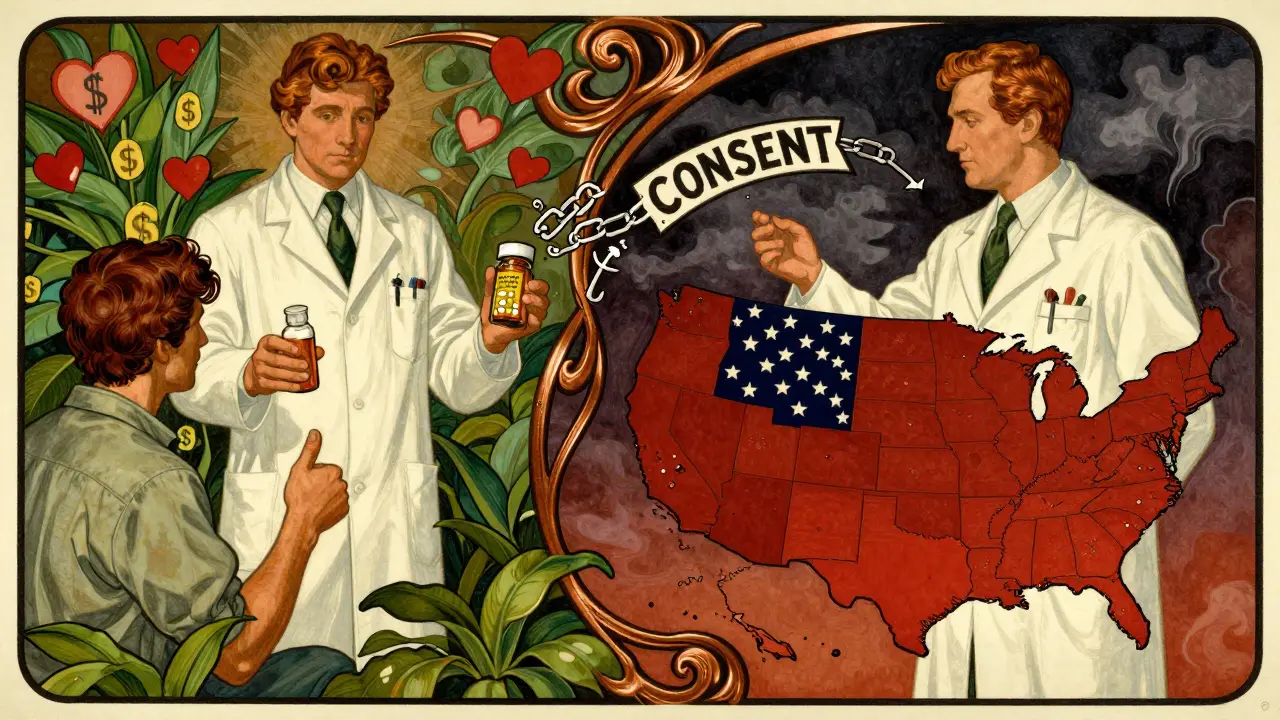
Even if substitution is allowed, the law doesn’t always require the pharmacist to ask the patient first. In 18 states, consent is presumed. That means if the prescriber doesn’t block substitution, the pharmacist can swap the drug without telling the patient. In 32 states, however, consent is explicit. Pharmacists must inform the patient, explain the switch, and get their approval before dispensing the generic.Here’s where things get messy. A patient walks in with a prescription for Lipitor. The pharmacist sees the generic atorvastatin is cheaper and approved. In a presumed consent state, they can hand over the generic without saying a word. In an explicit consent state, they have to say: "This is a generic version of Lipitor. It’s the same medicine, just cheaper. Do you want to use it?" If the patient says no, the pharmacist must fill the brand. Failure to get consent in these states can lead to disciplinary action by the state board of pharmacy.
"Medically Necessary" Is a Legal Phrase, Not Just a Suggestion
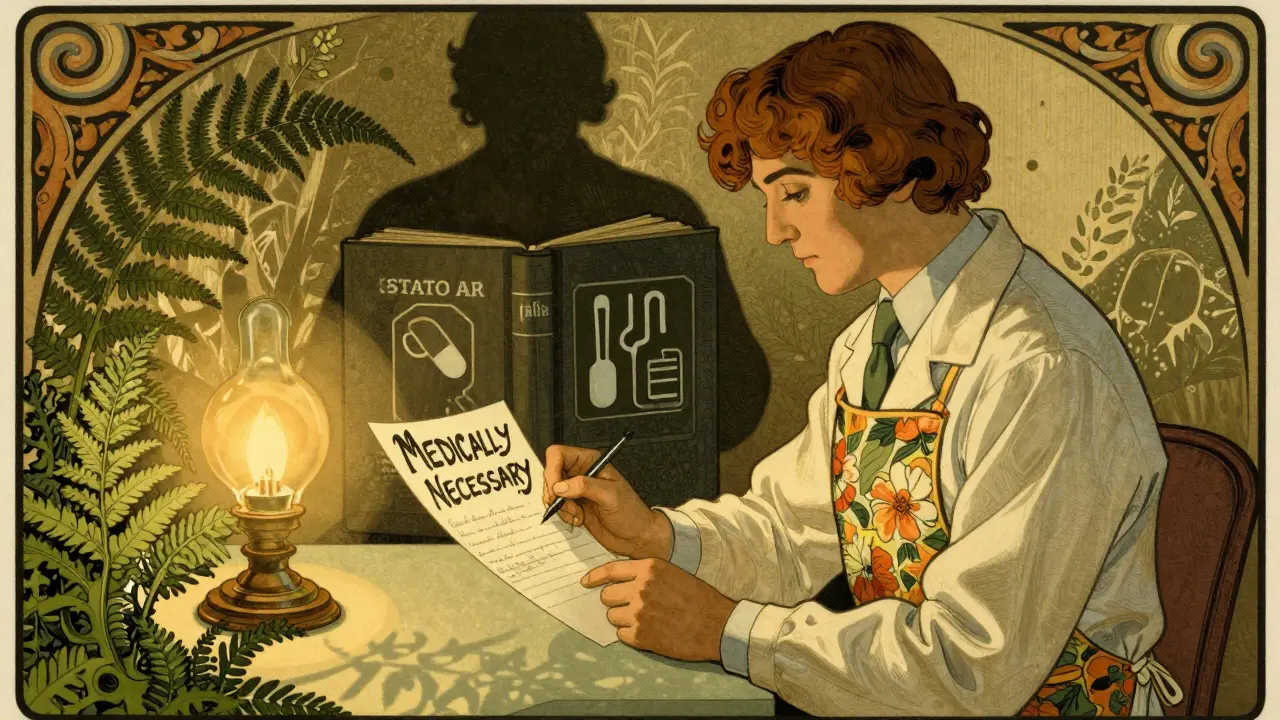
Prescribers can stop substitution by writing "MEDICALLY NECESSARY" on the prescription. But it’s not enough to type it into an electronic system. In Florida, for example, the prescriber must write those exact words in their own handwriting on a paper script. For electronic prescriptions, they must select a specific option that signals "do not substitute." If they don’t, the pharmacist is legally allowed to swap the drug-even if the prescriber intended to block it.Some states go further. Florida also bans substitution for drugs with a narrow therapeutic index unless the prescriber has documented why it’s safe. This includes drugs like digoxin, phenytoin, and theophylline. A 2019 study in JAMA Internal Medicine found that substituting certain cardiac glycosides led to a 12.7% increase in adverse events-even though they were FDA-approved generics. That’s why some pharmacists refuse to substitute these drugs, even when the law allows it.
What Happens When Pharmacists Get It Wrong?
Errors aren’t just about bad outcomes-they’re about legal liability. In 2022, 68% of all disciplinary actions by state pharmacy boards involved documentation failures. That means a pharmacist might have done everything right, but didn’t record the patient’s consent, didn’t note the prescriber’s "medically necessary" instruction, or didn’t update the electronic record properly.One real case from Tennessee made headlines in 2023. A pharmacist substituted an antiepileptic drug for a patient with epilepsy, unaware of the state’s strict ban. The patient had a seizure. Emergency care was needed. The pharmacist faced suspension and mandatory retraining. This wasn’t a mistake of judgment-it was a failure to know the law.
Pharmacists are expected to know the rules for all 51 jurisdictions. That’s why continuing education is critical. The National Community Pharmacists Association estimates pharmacists spend 40 to 60 hours a year just learning about state-specific substitution laws. And it’s not static: 17 states changed their laws in 2022 alone.
What Pharmacists Must Do Every Time
To stay compliant, pharmacists must follow a clear checklist every time they fill a prescription:- Check the FDA Orange Book for the therapeutic equivalence rating of the generic.
- Verify the prescription doesn’t have "Do Not Substitute" or "MEDICALLY NECESSARY" written by the prescriber.
- Confirm the state’s substitution law: mandatory or permissive?
- Check if the drug is on the state’s exclusion list (like antiepileptics in Tennessee or thyroid meds in California).
- Determine if explicit consent is required. If yes, explain the switch and get the patient’s approval.
- Document everything: consent, refusal, prescriber instructions, and the generic dispensed.
- Update the patient’s profile in the pharmacy system to reflect the substitution.
Even small oversights can lead to complaints, lawsuits, or loss of license. A patient who didn’t know they were switched from a brand to a generic may feel misled. A prescriber whose "medically necessary" note was ignored may file a formal complaint. The pharmacy board doesn’t care if it was an honest mistake-they care about compliance.
The Bigger Picture: Why This Matters
Generic substitution isn’t just about saving money. It’s about making healthcare accessible. But it’s also about trust. Patients need to know their pharmacist isn’t cutting corners. When done right, substitution means a diabetic patient can afford insulin. A senior on fixed income can keep taking their blood pressure pill. But when done wrong, it can lead to hospitalizations, lost trust, and legal consequences.The system works best when pharmacists act as both guardians of safety and advocates for affordability. That means knowing the law, asking the right questions, and never assuming a patient understands the difference between brand and generic. It’s not just a job-it’s a legal duty.
What’s Changing in 2025?
New labeling rules from the FDA, required by the 2022 Consolidated Appropriations Act, are now in effect. All generic drug packages must include a clear statement like: "This drug is a generic version of [brand name]. It is approved by the FDA as safe and effective." This is meant to reduce patient confusion and build trust.States are also starting to adopt the National Association of Boards of Pharmacy’s Model Substitution Act, which aims to create more uniform rules across states. But for now, the patchwork remains. Pharmacists in Texas still follow Texas rules. Those in New Jersey follow New Jersey’s. There’s no national shortcut.
The pressure from pharmacy benefit managers to maximize substitution continues to rise. Meanwhile, physicians are pushing back, arguing they know their patients best. Until there’s federal clarity, the pharmacist remains the frontline-responsible for knowing the law, protecting the patient, and getting it right every single time.
Can a pharmacist substitute a generic drug without telling the patient?
It depends on the state. In 18 states, consent is presumed, meaning the pharmacist can substitute without informing the patient. In 32 states, explicit consent is required-the pharmacist must explain the switch and get the patient’s approval before dispensing the generic. Failing to get consent in those states is a violation of pharmacy law.
Are all generic drugs safe to substitute?
The FDA approves all generics as bioequivalent to their brand-name counterparts. But some drugs, like antiepileptics, thyroid medications, and blood thinners, have a narrow therapeutic index. Even small differences in absorption can cause harm. Many states ban substitution for these drugs regardless of FDA rating. Pharmacists must check both federal guidelines and state-specific restrictions before substituting.
What does "MEDICALLY NECESSARY" mean on a prescription?
It’s a legal instruction from the prescriber that blocks generic substitution. In most states, the prescriber must write those exact words in their own handwriting on a paper prescription or select a specific electronic option. If the prescriber doesn’t do this correctly, the pharmacist is legally allowed to substitute the generic-even if the prescriber intended to prevent it.
What happens if a pharmacist substitutes a drug incorrectly?
The pharmacist can face disciplinary action from the state board of pharmacy, including fines, mandatory training, suspension, or license revocation. If a patient is harmed, civil or criminal liability may follow. Documentation errors-like failing to record consent or ignoring a "medically necessary" note-are the most common reasons for penalties.
Do pharmacists need to check the FDA Orange Book every time?
Yes. The Orange Book is updated monthly and lists which generics are rated as therapeutically equivalent (A-rated). A generic may be approved by the FDA but not yet listed as interchangeable. Pharmacists must verify the current rating before dispensing. Relying on memory or outdated information is a common cause of compliance errors.



Monica Puglia
January 12, 2026 AT 15:10Just had a patient cry because she thought her thyroid med was "changed"-turned out she didn’t know generics were the same. 😔 Pharmacies need to do better with communication. I get the cost thing, but trust matters more.
steve ker
January 14, 2026 AT 08:07Rebekah Cobbson
January 14, 2026 AT 21:51Monica’s comment hit home. I’ve had patients ask me why their pill changed color and I always take 3 minutes to explain it’s the same medicine, just cheaper. It’s not just law-it’s empathy. And yeah, sometimes they’re surprised. But they leave feeling heard.
Audu ikhlas
January 16, 2026 AT 15:05Sonal Guha
January 16, 2026 AT 22:23TiM Vince
January 16, 2026 AT 22:33My dad’s from rural Texas. He still calls atorvastatin "the blue pill" even though he’s been on it for 8 years. I showed him the FDA label saying "generic version of Lipitor"-he said, "So why’d they make it look like a different color then?" That’s the real problem. No one explains it.
Lawrence Jung
January 17, 2026 AT 06:56One thing no one mentions: the electronic health record systems often don’t flag "medically necessary" properly. I’ve seen prescriptions where the prescriber typed "do not substitute" in the notes field-and the pharmacy system ignored it because it wasn’t in the correct dropdown. That’s a systemic failure, not a pharmacist error. We need better tech integration, not more blame on frontline staff.
Alice Elanora Shepherd
January 19, 2026 AT 02:48My niece has epilepsy. Her neurologist refuses to write "medically necessary" on e-scripts because he doesn’t know how. So her pharmacist refuses to substitute-every time. She’s had three seizures in six months because the pharmacy won’t risk it. The law isn’t protecting her-it’s trapping her in a system that doesn’t work. Someone needs to fix this.
Ben Kono
January 19, 2026 AT 17:50Cassie Widders
January 19, 2026 AT 20:01My cousin works in a pharmacy in Ohio. She says the hardest part isn’t the laws-it’s the patients who get mad when they find out they’ve been on generics for years and didn’t know. Like they were tricked. But they never asked. It’s weird.
Konika Choudhury
January 21, 2026 AT 06:05Darryl Perry
January 21, 2026 AT 08:13