

Why Your Current Pill Routine Might Be Risky
You grab your morning coffee and reach for the bottle of pills on the counter. You pop them down with a gulp of water, rush out the door, and don't think about it again until dinner. It feels efficient. But if you are taking more than one prescription, or even mixing prescriptions with over-the-counter supplements, that efficiency might be hiding a serious problem.
Medication scheduling isn't just about remembering to take your drugs. It is about timing. Taking two medications at the exact same moment can cause drug interactions where one substance blocks the absorption of another, or amplifies its side effects to dangerous levels. The Institute of Medicine reported in 2006 that medication errors harm at least 1.5 million people annually in the United States. A huge chunk of those errors aren't mistakes made by doctors; they are errors in how we organize our daily routines.
If you are managing five or more medications-a practice known as polypharmacy-you are in a high-risk group. Studies show that patients in this category experience drug interactions at rates as high as 82%. The good news? You have control. By restructuring your schedule using proven methods like the Universal Medication Schedule (UMS), you can drastically cut these risks without needing a medical degree.
The Problem with "Twice Daily" Instructions
Have you ever looked at a prescription label that says "take twice daily" and wondered what that actually means? Does it mean every 12 hours? Or does it mean once in the morning and once at night? This ambiguity is a major source of error.
Research published in JAMA Internal Medicine found that vague instructions led to a 34% misinterpretation rate among patients. If your doctor meant "every 12 hours" to maintain steady blood levels, but you took both doses within four hours of each other because you forgot the afternoon dose, you might experience toxicity followed by ineffective treatment later in the day.
To fix this, experts recommend adopting the Universal Medication Schedule (UMS), which replaces ambiguous terms like 'twice daily' with specific time windows: Morning (6-10 AM), Noon (10 AM-2 PM), Evening (2-6 PM), and Bedtime (8 PM-12 AM). This system was developed by researchers including Michael S. Wolf at Northwestern University Feinberg School of Medicine. When implemented, it reduced medication misinterpretation from 34% down to just 6%. It turns guesswork into a clear, actionable plan.
Step 1: The Brown Bag Review
You cannot build a safe schedule if you don't know exactly what you are working with. Many people forget that vitamins, herbal supplements, and over-the-counter pain relievers count as medications too. They interact just as potently as prescription drugs.
Start with a "brown bag review." Literally take all your medications-prescriptions, OTCs, and supplements-and put them in a bag. Bring this bag to your pharmacist or primary care provider. Pharmacists report that this simple act identifies an average of 3.2 medication discrepancies per patient. These discrepancies include expired drugs, duplicate therapies prescribed by different specialists, and forgotten bottles sitting in the bathroom cabinet.
Create a master list. Include:
- Drug name and strength (e.g., Lisinopril 10mg)
- Purpose (what condition it treats)
- Current dosage instructions
- Known allergies
Update this list at every appointment. Do not rely on memory. If a specialist adds a new drug, write it down immediately.
Step 2: Identify Critical Timing Requirements
Not all medications are created equal when it comes to timing. Some need food to prevent stomach upset; others require an empty stomach to be absorbed properly. Some must be spaced hours apart to avoid chemical clashes.
Here are common interaction rules you need to watch for:
- Thyroid Medication (Levothyroxine): Must be taken on an empty stomach, ideally 30-60 minutes before breakfast. Calcium and iron supplements can block its absorption if taken too close together.
- Statins: Often recommended with dinner or at bedtime, depending on the specific type, to align with the body's natural cholesterol production cycles.
- Antibiotics: Some require strict spacing (e.g., every 8 hours) to remain effective against bacteria. Missing a window can lead to resistance.
- Bisphosphonates (for osteoporosis): Require upright positioning for 30 minutes after ingestion to prevent esophageal irritation.
Your pharmacist can screen for over 150 common drug interactions using tools like Lexicomp. Ask them specifically: "Are there any pairs in my regimen that need to be separated by at least two hours?"
Step 3: Build Your Visual Schedule
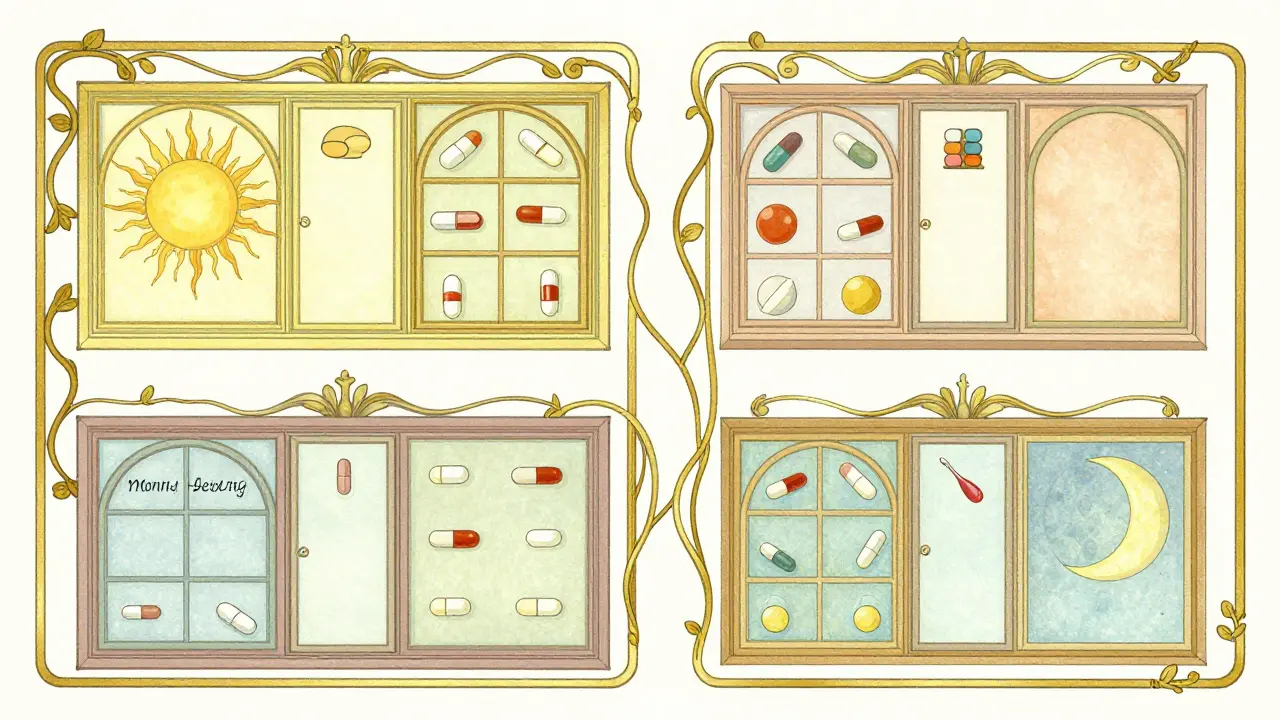
Once you have your list and your timing constraints, map them onto the UMS framework. Group your medications into the four time blocks: Morning, Noon, Evening, and Bedtime.
| Time Window | Medications | Special Instructions |
|---|---|---|
| Morning (6-10 AM) | Levothyroxine, Multivitamin | Take Levothyroxine first. Wait 60 mins before eating or taking other pills. |
| Noon (10 AM-2 PM) | Lisinopril, Aspirin | Take with lunch to reduce stomach upset. |
| Evening (2-6 PM) | Metformin | Take with dinner. |
| Bedtime (8 PM-12 AM) | Atorvastatin, Melatonin | Take right before brushing teeth. |
Print this chart and tape it to your refrigerator or medicine cabinet. Visual cues are powerful. Research shows that 72% of successful users maintain a large chart near their medication station. For those who struggle with visual organization, color-coding helps. Use a red sticker for heart meds, blue for diabetes, and green for general health. This makes it instantly obvious if you missed a category.
Tools to Reduce Errors: Organizers vs. Apps
Willpower alone rarely sustains a complex regimen. You need tools. Two main options exist: physical pill organizers and digital apps.
Pill Organizers: A 2018 meta-analysis in the Annals of Internal Medicine found that pill organizers with AM/PM compartments reduce dosing errors by 45%. They provide a tactile confirmation-you see the empty slot, so you know you took the pill. Look for 7-day segmented containers with separate slots for morning and evening. Fill them once a week, preferably on Sunday night, so you can spot issues early.
Digital Apps: Apps like Medisafe and MyTherapy offer automated reminders and interaction checks. A 2021 study in the Journal of Medical Internet Research showed these apps achieve 20-35% higher adherence rates than paper systems. However, adoption varies by age. Only 38% of users over 65 consistently engage with app reminders. If you are tech-comfortable, apps are great for tracking trends and sharing data with your doctor. If not, stick to a simple calendar or organizer.

Simplifying Refills: The "90 x 4" Method
A hidden source of stress is managing different refill dates. One drug runs out on the 1st, another on the 15th. This fragmentation leads to gaps in coverage.
Ask your doctor about medication synchronization. The American Medical Association's STEPS Forward program recommends the "90 x 4" approach: getting 90-day supplies filled four times a year, all on the same day. This saves clinicians up to two hours daily and ensures you never have a "refill gap" where you miss a dose because you forgot to pick up a specific bottle. It simplifies your life and reduces the chance of running out.
Red Flags: When to Call Your Doctor
Even with a perfect schedule, interactions can happen. Know the signs that something is wrong. Common symptoms of adverse drug interactions include:
- New or worsening dizziness
- Unexplained gastrointestinal distress (nausea, diarrhea)
- Unusual bruising or bleeding (especially if on blood thinners)
- Confusion or changes in mental state
If you notice these, do not stop your medication abruptly unless instructed. Contact your healthcare provider immediately. Keep a log of when the symptoms started relative to your last dose. This information is invaluable for diagnosing the issue.
Maintaining Long-Term Success
Creating the schedule is only half the battle. Maintaining it requires routine. Set aside 15 minutes every week to review your supply and refill your organizer. Involve a family member or caregiver if possible-they can serve as a second set of eyes.
Remember, medication management is dynamic. As your health changes, your regimen will change. Revisit your schedule every six months or whenever a new medication is added. The goal is not just compliance; it is safety and effectiveness. By taking control of your timing, you turn a potential hazard into a manageable part of your day.
What is the Universal Medication Schedule (UMS)?
The Universal Medication Schedule is a standardized system that replaces vague instructions like "twice daily" with specific time windows: Morning (6-10 AM), Noon (10 AM-2 PM), Evening (2-6 PM), and Bedtime (8 PM-12 AM). It was developed to reduce misinterpretation and improve adherence, particularly for patients with multiple medications.
How do I know if my medications interact?
You should consult a pharmacist or use a reliable drug interaction checker. Common interactions involve timing conflicts (like calcium blocking thyroid meds) or additive side effects (like increased bleeding risk with NSAIDs and blood thinners). A "brown bag review" with your pharmacist is the most thorough way to identify these risks.
Should I take all my pills at once?
Generally, no. While some medications can be taken together, many require separation to ensure proper absorption or to avoid side effects. For example, antibiotics often need precise spacing, and thyroid medication needs an empty stomach. Always follow the specific timing instructions provided by your doctor or pharmacist.
What is polypharmacy?
Polypharmacy refers to the use of multiple medications by a single patient, typically defined as taking five or more drugs daily. It increases the risk of drug interactions, adverse events, and non-adherence. Approximately 40% of adults aged 65 and older experience polypharmacy.
Can over-the-counter supplements cause interactions?
Yes. Supplements like St. John's Wort, Vitamin K, and calcium can significantly interact with prescription drugs. For instance, Vitamin K can reduce the effectiveness of warfarin, a blood thinner. Always include supplements in your medication list and discuss them with your healthcare provider.