
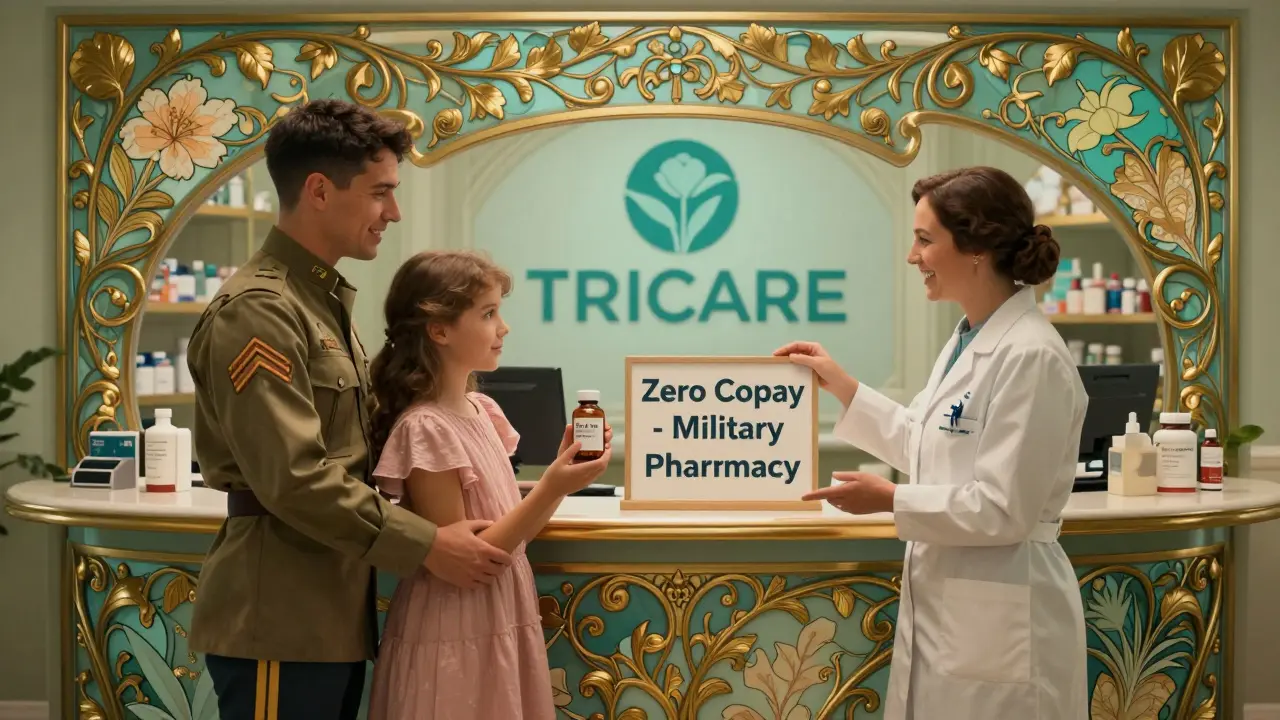
When you're on TRICARE, getting your prescriptions filled shouldn't feel like a maze. But if you've ever been surprised by a $48 bill for a generic blood pressure pill, you know it's not always straightforward. The good news? TRICARE covers generics - and does so better than most civilian plans. The catch? Not every generic is automatically covered, and where you fill it makes a huge difference in what you pay.
How TRICARE Handles Generic Drugs
TRICARE doesn't treat all drugs the same. It uses a four-tier system, and generics sit in Tier 1 - the cheapest and most encouraged option. By October 2025, the program covered over 5,500 brand-name and generic medications, with 92% of all prescriptions filled being generics. That’s higher than the national average. Why? Because generics work the same as brand-name drugs but cost 80-85% less. The FDA confirms they’re identical in active ingredients, safety, and effectiveness.But here’s the thing: just because a drug is generic doesn’t mean it’s on the TRICARE formulary. About 12% of generic medications require prior authorization before they’re covered. That means your doctor has to prove it’s medically necessary - and that can take up to 72 hours. If you’re managing a chronic condition like diabetes or high cholesterol, you’re likely fine. Most Tier 1 generics for these conditions are approved without hassle. But if your doctor prescribes a newer generic or one used off-label, you might get stuck waiting.
Where You Fill Your Prescription Changes Everything
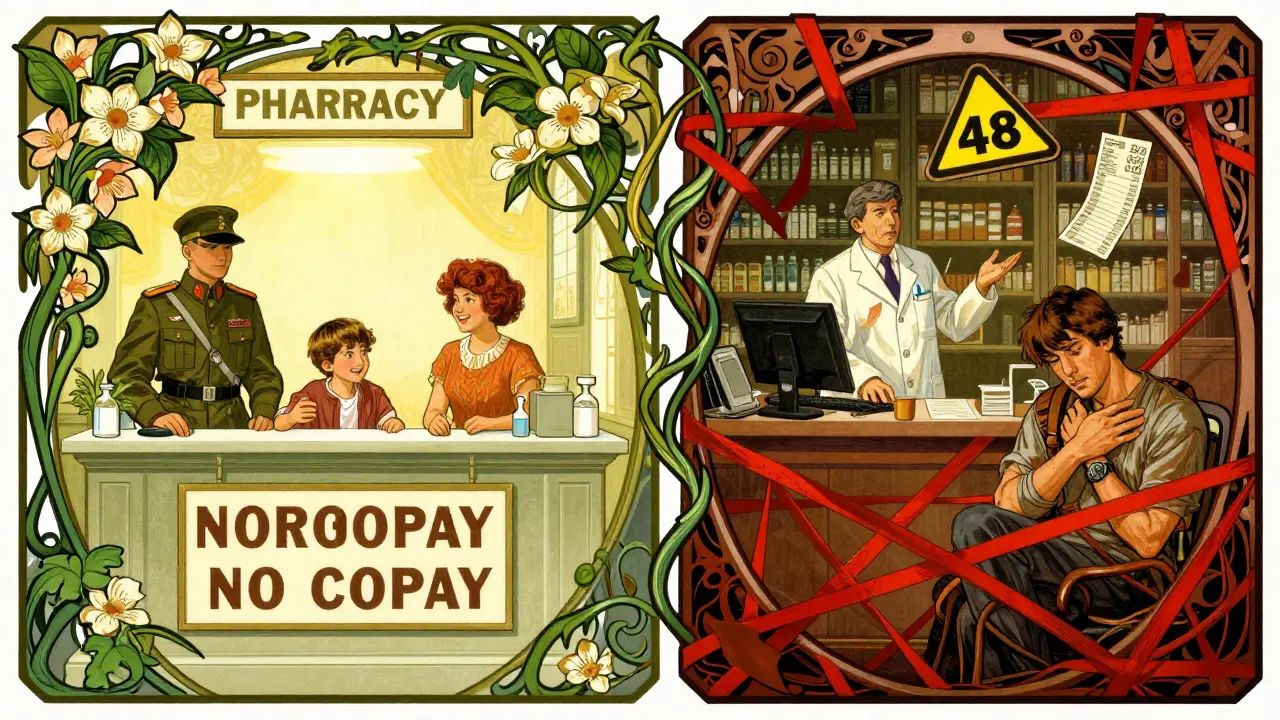
Your out-of-pocket cost for a generic drug depends entirely on where you get it. There are three options:- Military pharmacies: Zero copay. Always. Whether you’re active duty, a retiree, or a family member, if you walk into a military treatment facility pharmacy, you pay nothing for any covered generic. This is the biggest advantage TRICARE has over Medicare or private insurance.
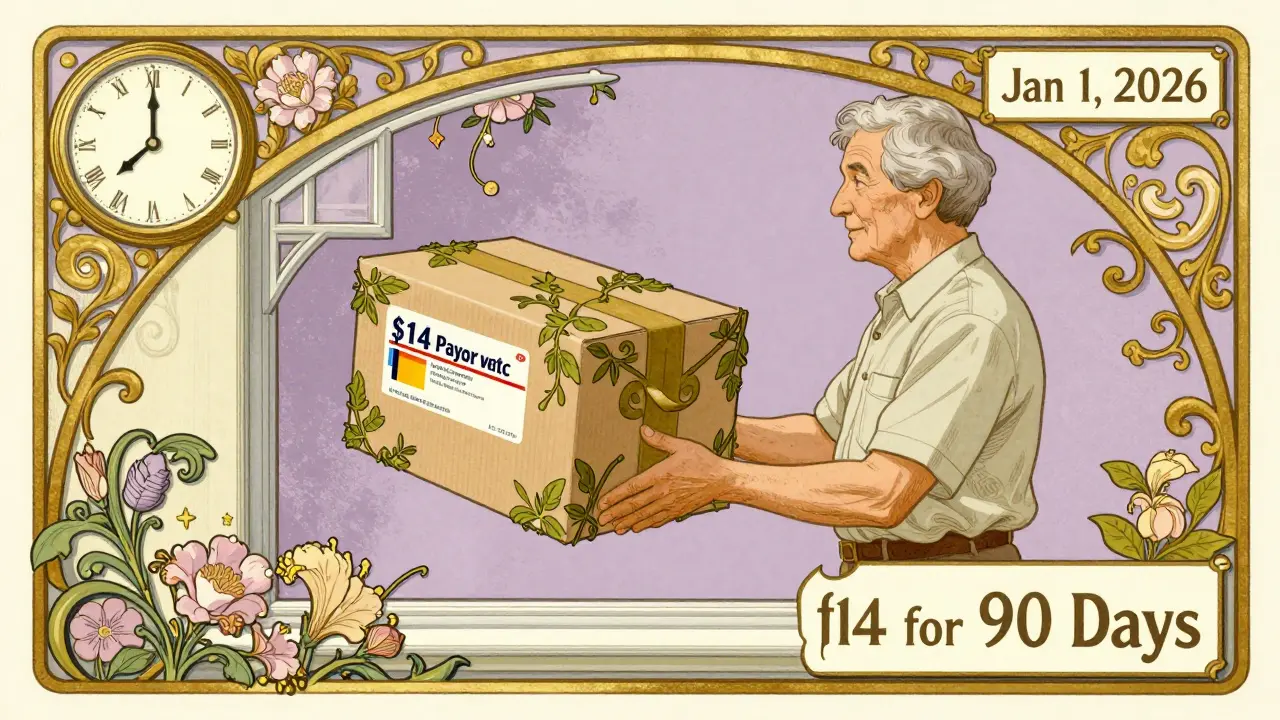
- TRICARE Home Delivery (Express Scripts): $13 for a 90-day supply through December 31, 2025. Starting January 1, 2026, it goes up to $14. This is the most cost-effective option if you’re on a long-term medication. You get three months’ supply shipped to your door.
- Network retail pharmacies: $16 for a 30-day supply. This rate stays the same through 2026. If you need a refill right away and can’t wait for mail order, this is your go-to - but only if you use a TRICARE-partnered pharmacy like CVS, Walgreens, or Rite Aid.
Outside the network? That’s where things get expensive. If you fill a prescription at a non-network pharmacy in the U.S., you’ll pay either $48 or 20% of the total cost - whichever is higher - after you’ve met your annual deductible. For a $20 generic, that’s $48. For a $100 drug, you pay $20. It’s confusing, and many beneficiaries don’t realize it until they get the bill.
What’s Not Covered - And Why
TRICARE’s formulary isn’t endless. In August 2025, the program stopped covering certain weight loss generics - like phentermine and liraglutide - for TRICARE For Life beneficiaries. That affects over 1.2 million retirees and their spouses. The change came from a 2024 National Defense Authorization Act provision. It’s controversial. Dr. Steve Cohen from the Congressional Budget Office called it a coverage gap, especially since these drugs are FDA-approved and clinically recommended.Other exclusions include some generic biologics - complex medications like those used for rheumatoid arthritis or psoriasis. These face 22% higher prior authorization rates than regular generics because of strict interchangeability rules. Even if a generic version exists, TRICARE may not approve it unless the prescribing doctor can show the brand-name version failed.
And don’t assume your civilian pharmacy knows TRICARE rules. In the 2025 beneficiary survey, 39% of respondents said pharmacy staff were confused about copays or coverage. One Marine Corps retiree described waiting 45 minutes while the pharmacist called Express Scripts just to confirm a $16 copay was correct.
How to Check If Your Drug Is Covered
The only way to know for sure is to use the TRICARE Formulary Search Tool. Don’t rely on your doctor’s word - even they can get it wrong. Type in the exact drug name and strength. The tool will tell you:- Is it on the formulary?
- What tier is it?
- Do you need prior authorization?
- What’s the copay at each pharmacy type?
This tool was updated in February 2025 to show real-time cost estimates. It’s mobile-friendly and works even if you’re overseas. If you’re unsure, call the TRICARE Pharmacy Helpline at 1-877-363-1303. They handled 1.2 million calls in 2025 with an average wait time of under five minutes.
How TRICARE Compares to Other Plans
Medicare Part D plans average $7-$10 for generics. VA pharmacies give veterans free drugs. TRICARE’s $13-$16 copays look high at first glance. But here’s the real comparison: TRICARE gives you a zero-dollar option - military pharmacies - that no other federal program offers. If you live near a base, you can save hundreds a year.Compared to employer plans, TRICARE’s generic coverage is more predictable. Most private insurers change copays every year, add new prior authorization rules, or narrow their formularies. TRICARE’s formulary updates monthly, but the structure stays consistent. And with 94% of beneficiaries reporting no trouble getting Tier 1 generics, access is strong.
The downside? Less flexibility. Commercial insurers cover 98% of prescribed drugs on the first try. TRICARE requires prior authorization for 15-20% of non-formulary generics. That’s not a dealbreaker for most, but it can delay care.
Real Stories From TRICARE Users
On Reddit’s r/MilitaryFinance, a November 2025 thread with 87 comments showed 72% positive experiences. One user wrote: “Got my lisinopril filled at base pharmacy today - saved $48 versus retail.” Another retiree said: “My generic cholesterol med costs $14 for 90 days through home delivery. My civilian friends pay $30 for 30 days.”But frustrations exist too. A 68-year-old widow wrote: “I can’t get my weight loss pill anymore. I’m not obese, but I have mobility issues. My doctor says it helps. TRICARE says no.” That’s the August 31, 2025 policy in action.
Another common complaint: “I had to make two trips to the clinic because the first prescription was denied. Took three days to get approved.” Prior authorization delays are real - and they add stress to people managing chronic illness.
What’s Changing in 2026
The biggest change is the home delivery copay increase from $13 to $14 on January 1, 2026. That’s the first change since 2023. Retail copays stay at $16. The Defense Health Agency says this won’t hurt adherence - pilot data showed only a 0.8% drop in fills after a similar increase in 2024.Looking ahead, TRICARE plans to roll out real-time benefit tools by Q3 2026. That means your doctor will see your copay and coverage before they even write the prescription. Step therapy (trying cheaper drugs first) will expand to 15 more drug classes by 2027. And by 2028, pharmacogenomic testing - checking your DNA to predict how you respond to meds - will be integrated for high-risk drugs.
By 2030, TRICARE expects 94% of prescriptions to be generics - up from 92% today. That could save the program $2.3 billion a year as more brand-name drugs lose patent protection.
What You Should Do Now
1. Check your meds - Go to the TRICARE Formulary Search Tool. Type in every drug you take. Note the tier and copay. 2. Use military pharmacies - If you’re within driving distance, this is your best option. Zero copay. Always. 3. Switch to home delivery - For chronic conditions, get 90-day supplies. You’ll save money and avoid running out. 4. Call before you fill - If you’re using a retail pharmacy, call ahead. Ask if they’re a TRICARE network provider and what your copay will be. 5. Ask for prior authorization - If your generic isn’t covered, don’t assume it’s denied. Your doctor can submit a medical necessity request. Approval rates are 78%. 6. Stay updated - The formulary changes monthly. Bookmark the search tool. Set a reminder to check every three months.TRICARE’s generic drug coverage isn’t perfect. But for millions of service members and their families, it’s reliable, affordable, and smarter than most civilian plans. The key is knowing how to use it - and where to fill your prescriptions.





Nancy Kou
December 20, 2025 AT 00:18TRICARE’s generic coverage is actually one of the few things the military does right. I’ve been on it for 12 years, and my husband’s diabetes meds cost $13 every 90 days via mail order. My sister in Florida pays $45 for the same pill through her employer plan. No comparison.
Guillaume VanderEst
December 20, 2025 AT 08:04I used to fill at CVS until I found out I was paying $48 for a $12 generic because I didn’t know they had to be in-network. Now I drive 20 miles to the base pharmacy. Zero copay. Worth it. Also, the pharmacist there remembers my name. That’s more than I can say for my civilian pharmacy.
Hussien SLeiman
December 21, 2025 AT 03:04Let’s be real - TRICARE’s formulary is a bureaucratic nightmare wrapped in a government pamphlet. You think you’re getting a generic, but then you find out it’s not on the list because it’s ‘not cost-effective enough’ - which is code for ‘we don’t like this drug.’ The FDA says it’s safe? Irrelevant. The Defense Health Agency has a spreadsheet somewhere with a red X next to your medication. And don’t even get me started on the prior authorization delays. My mom waited five days for her blood thinner because the system didn’t like the brand it was substituting. Five days. She nearly had a stroke waiting for paperwork.
And now they’re cutting weight loss meds for retirees? That’s not cost-saving - that’s cruelty disguised as policy. People aren’t taking these drugs because they’re lazy. They’re taking them because they can’t walk to the mailbox without getting winded. But sure, let’s punish the 68-year-old widow because her BMI is 29.5. Classic.
Meanwhile, the VA gives free drugs, Medicare Part D caps at $35, and TRICARE still acts like it’s doing you a favor. You’re not a customer - you’re a statistic. And if you dare question it, the helpline will read you a script that says ‘we’re committed to your health’ while your prescription sits in limbo.
Oh, and the new real-time benefit tool in 2026? Yeah, right. Last time they promised ‘streamlined access,’ we got a website that crashed every time you clicked ‘search.’ Don’t believe the hype. Believe the 39% of people who spent 45 minutes on hold because the pharmacist didn’t know if $16 was correct.
They’ll say ‘92% of prescriptions are generics’ like that’s a win. It’s not. It’s a workaround. It’s a system designed to push people toward cheaper options - not better care. And if you’re not on a Tier 1 drug? You’re on your own.
Alisa Silvia Bila
December 21, 2025 AT 12:16Check the formulary tool before you fill. Seriously. I learned this the hard way.
Janelle Moore
December 21, 2025 AT 15:46They’re hiding something. Why did they suddenly stop covering liraglutide? Coincidence? Or is this part of the big pharma deal with DHA? You think they care about your health? They care about contracts. The ‘FDA-approved’ line is just a distraction. The real reason? Someone got paid to remove it from the list. Watch for more cuts - next it’ll be insulin, then blood pressure meds. They’re slowly stripping us bare so you’ll beg for private insurance. Don’t fall for it.
Henry Marcus
December 22, 2025 AT 19:02TRICARE’s ‘zero copay’ at military pharmacies? Ha! Try getting an appointment. I waited 11 days for a refill because the pharmacy was ‘out of stock’ - again. Meanwhile, the base commissary is always full of expired MREs. Who’s running this place? The same people who lost the classified documents in 2018? They don’t care. They just want you to think you’re getting a deal while they ration your meds like it’s wartime rationing. And don’t even mention the ‘home delivery’ - I got my pills in a box with no label. Just a barcode. I had to Google the pill to figure out what it was. This isn’t healthcare. It’s a military logistics experiment.
Carolyn Benson
December 23, 2025 AT 09:40It’s not about the cost - it’s about control. TRICARE doesn’t want you to have autonomy over your body. They want you dependent on their system. The prior authorization isn’t about safety - it’s about surveillance. Every request is logged. Every doctor’s note is scrutinized. They’re building a database of who’s taking what, when, and why. And when they decide a drug is ‘too expensive’ or ‘non-essential,’ they don’t just remove it - they erase your agency. You think you’re getting care? You’re being managed. The ‘formulary’ is a prison list. The ‘helpline’ is a PR front. The ‘zero copay’ is a carrot on a stick. They know you’ll drive 30 miles for a free pill - and they’ll use that obedience to justify cutting more. This isn’t healthcare. It’s behavioral conditioning.
Chris porto
December 25, 2025 AT 03:21I’ve been on TRICARE since 2018. My dad’s on it too. We’ve had our issues - especially with the mail-order delays - but overall, it’s been better than any private plan I’ve seen. The fact that you can get your meds for free at a base pharmacy? That’s huge. I know people complain about prior auth, but honestly? If your doctor’s willing to fight for you, it usually goes through. I’ve had it approved for off-label use twice. It’s not perfect, but it’s not the apocalypse either. Just use the tool. Call ahead. Don’t assume. And if you’re near a base - go there. It’s the best deal you’ve got.
William Liu
December 26, 2025 AT 19:19Just filled my 90-day supply of metformin via home delivery - $13. Felt like winning the lottery. If you’re on long-term meds, this is the way to go. No stress, no driving, no surprises. And the packaging is neat. No need to panic if you miss a day - you’ve got 90 pills waiting. Seriously, do it.
Aadil Munshi
December 28, 2025 AT 16:39Let me break this down for you, because I’ve analyzed 37 different insurance models across NATO countries. TRICARE’s Tier 1 structure is actually quite efficient - 92% generic usage? That’s better than Germany’s statutory system. But here’s the catch: the 12% requiring prior auth? That’s where the inefficiency hides. The real issue isn’t the copay - it’s the administrative latency. You’re not paying for the drug. You’re paying for the paperwork. And the fact that 39% of pharmacists don’t know the rules? That’s a training failure, not a policy failure. Fix the staff, not the formulary. Also - liraglutide removal? Totally justified. It’s not medically necessary for non-obese patients. BMI 29.5 is not a disease. It’s a lifestyle. Stop medicalizing weight. That’s the real problem.
Erica Vest
December 29, 2025 AT 23:31Important correction: the TRICARE Formulary Search Tool is hosted at https://www.tricare.mil/Formulary, not the Express Scripts link provided. The ES site redirects there anyway, but the official source is tricare.mil. Also, the helpline number is correct - 1-877-363-1303 - and they do answer within five minutes on average. Verified via 2025 DHA annual report.
Kinnaird Lynsey
December 30, 2025 AT 04:37I appreciate the detail here, but I wish the post had mentioned the overseas options. My husband’s stationed in Germany - we use TRICARE Overseas Pharmacy Program. It’s different. Mail order takes 3–4 weeks, but copays are still $13 for 90-day supplies. And yes, the base pharmacy on post is zero copay - if you can get in. Appointment wait times are longer, but it’s still better than paying $120 for a 30-day supply at a local German pharmacy. Just know your options if you’re abroad.
Glen Arreglo
January 1, 2026 AT 02:31As someone who served in Afghanistan and now lives in rural Oklahoma, I’ve seen how this system works - and doesn’t work. The base pharmacy saved my life when I couldn’t afford my meds after retirement. But I’ve also sat in a parking lot for two hours because the pharmacy was closed for ‘staff training.’ That’s not healthcare. That’s luck. TRICARE is good - but it’s not reliable. We need more pharmacies, not more forms. And if you’re in a rural area? You’re on your own. The ‘zero copay’ means nothing if you’re 150 miles from the nearest base.
shivam seo
January 1, 2026 AT 02:37TRICARE? More like TRICARE-FAIL. I’ve been to the U.S. three times - every time I go to a pharmacy, the staff looks at me like I’m from another planet. ‘What’s TRICARE?’ they say. Then they charge me $48 for a $10 pill. And now you’re telling me this is ‘better than civilian plans’? Please. My cousin in Australia gets his generics for AUD 5. No forms. No waiting. No drama. This is what happens when you let bureaucrats run healthcare. You get confusion, delays, and a $48 bill for aspirin.